
Moe Gyo is a writer and consultant working with ethnic organizations in Myanmar. Writing from the Thai–Myanmar borderlands, he draws on years of direct engagement with communities shaped by conflict and disrupted health systems. His work captures firsthand how resilience and informal support networks develop under prolonged irregular warfare. His writing has appeared in the Small Wars Journal and the Journal of Special Operations Medicine, among others.
Introduction
The failures of Ernesto “Che” Guevara‘s guerrilla campaigns in the Congo (1965) and Bolivia (1966–1967) have traditionally been interpreted as evidence of the shortcomings of foco theory. According to this view, Guevara’s belief that a small guerrilla vanguard could generate revolutionary conditions through armed struggle proved fundamentally flawed. Factors have been identified that indicated a range of factors contributed to the collapse of both campaigns, including weak organizational structures, inadequate logistical support, poor intelligence, limited popular backing, difficult relations with local political actors, and effective counterinsurgency efforts by state forces. In the Congo, fragmented rebel movements and the legacies of decolonization undermined efforts to create a coherent revolutionary force. In Bolivia, the inability to mobilize rural communities and the enduring effects of the 1952 National Revolution left the insurgency isolated from the population it sought to mobilize. These explanations are persuasive and account for much of what occurred on the ground.
Yet the significance of the Congo and Bolivia campaigns extends beyond the failure of a particular guerrilla strategy. Che’s defeats were not merely military setbacks; they exposed the limits of a broader revolutionary worldview. In both cases, Guevara selected countries that he believed could serve as strategic centers for continental revolution. The Congo was envisioned as a potential nucleus for revolutionary expansion throughout Africa, while Bolivia was intended to become a focal point for insurgency across South America. Underlying both campaigns was the assumption that the essential dynamics of the Cuban Revolution could be reproduced in different societies and subsequently spread across entire regions through revolutionary initiative and armed struggle.
The Congo and Bolivia campaigns revealed the limits of revolutionary transferability itself. Guevara’s failures were not simply the result of poor execution or unfavorable circumstances. Rather, they exposed the difficulties of applying a political model developed in one historical context to societies shaped by very different experiences, identities, institutions, and forms of political organization. The problem was not merely that Che misapplied a successful strategy. It was that he underestimated the extent to which revolutionary movements emerge from specific social environments and cannot be understood apart from the histories that produce them.
Viewed from this perspective, the Congo and Bolivia campaigns illuminate a broader problem that extends beyond Guevara, beyond foco theory, and even beyond revolutionary politics. They challenge the assumption that successful political models can be transferred across societies because underlying conditions appear similar. The campaigns demonstrated that political grievances do not automatically generate common forms of consciousness and that social transformation cannot be reduced to a universal formula. Instead, they revealed the enduring importance of local history, collective identity, and political culture in shaping how individuals and communities understand both power and the possibilities for change.
Foco Theory and Revolutionary Agency
Che Guevara’s revolutionary strategy emerged directly from the experience of the Cuban Revolution. Reflecting on the overthrow of the Batista regime, Guevara concluded that small groups of determined revolutionaries could play a decisive role in transforming political conditions. This insight became the foundation of foco theory, which argued that a relatively small guerrilla force operating in rural areas could initiate a process of revolutionary change that would eventually expand into a mass movement.
Central to foco theory was the belief that revolutionary conditions did not need to exist before armed struggle began. Contrary to more orthodox Marxist approaches that emphasized the prior development of class consciousness and political organization, Guevara argued that revolutionary action itself could generate political awakening. The guerrilla foco would serve not only as a military force but also as a political catalyst. Through its example, discipline, and willingness to confront state power, it would inspire broader sectors of society to join the struggle. In this sense, foco theory represented a highly activist conception of politics in which committed revolutionaries could accelerate historical change rather than simply wait for objective conditions to mature.
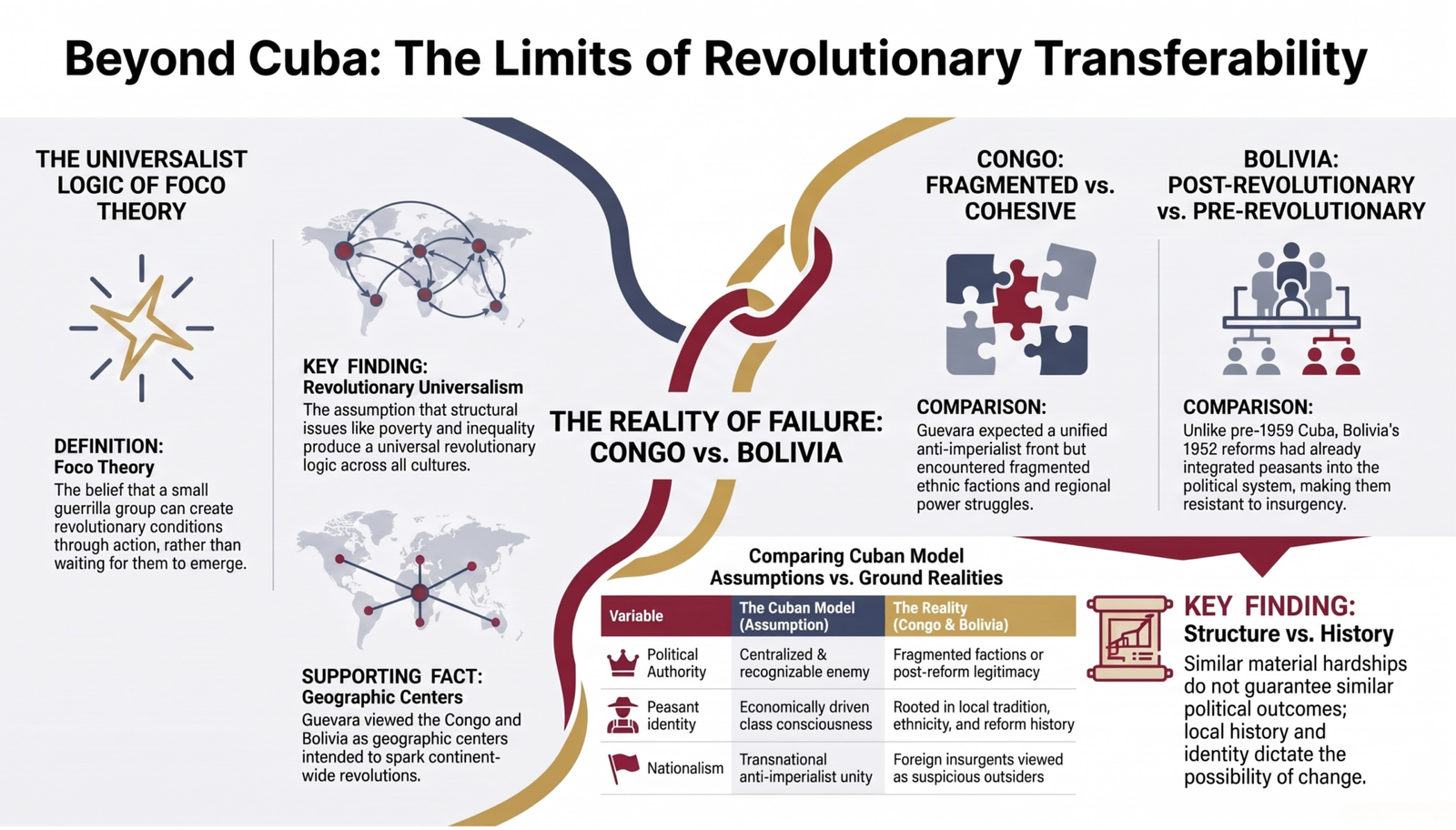
This emphasis on revolutionary initiative reflected Guevara’s broader faith in human agency and political will. The success of the Cuban Revolution appeared to demonstrate that determined actors could overcome unfavorable circumstances and create opportunities where none seemed to exist. Yet embedded within this vision was a larger assumption about the nature of political mobilization itself. If revolutionary consciousness could be generated through struggle, then the dynamics that had produced revolution in Cuba might also be reproduced elsewhere. It was this broader assumption that gave foco theory its universal ambitions and would shape Guevara’s later efforts in both the Congo and Bolivia.
Foco theory was therefore more than a military doctrine. It embodied a broader understanding of how political change occurs and how revolutionary movements are created. By placing revolutionary initiative at the center of historical transformation, Guevara argued that committed militants could help generate the conditions necessary for revolution rather than simply respond to them.
This conception of political agency would ultimately shape not only Guevara’s strategic thinking but also his belief that the lessons of the Cuban Revolution could be applied far beyond Cuba itself. If revolutionary consciousness could be generated through armed struggle, then successful insurgencies might serve as catalysts for wider regional transformations. This conviction would later lead Guevara to view both the Congo and Bolivia not simply as national struggles but as potential centers from which revolutionary warfare could spread across entire continents.
A simplified, condensed treatment of foco theory and Che Guevara’s guerrilla theory overall, distilled into a single accessible volume.
View on Amazon →The Universalist Logic of Foco Theory
Here, revolutionary universalism refers to the assumption that the fundamental dynamics of political liberation are sufficiently similar across societies that a successful revolutionary model can be transferred from one context to another with only limited adaptation. It assumes that structural conditions such as inequality, exploitation, foreign domination, and political exclusion generate broadly comparable forms of political consciousness and resistance regardless of historical or cultural setting. Differences between societies are therefore treated as secondary variations upon a common underlying logic rather than as constitutive factors shaping political outcomes.
While foco theory emerged from the specific circumstances of the Cuban Revolution, Guevara increasingly interpreted its lessons as possessing universal significance. The Cuban experience was no longer understood as a historically contingent success but as evidence of a more general process through which revolutionary change could occur. If armed struggle could generate revolutionary consciousness in Cuba, then similar structural conditions elsewhere should produce comparable political dynamics. The guerrilla foco therefore became more than a military strategy; it became the mechanism through which latent revolutionary potential could be activated across diverse societies.
This assumption also shaped Guevara’s broader vision of revolutionary internationalism. He viewed anti-imperialist struggles as expressions of a common historical process rather than as fundamentally distinct political experiences. Structural conditions such as poverty, inequality, foreign domination, and political exclusion were understood to create a shared revolutionary predicament that transcended national boundaries. Because these conditions were assumed to operate according to the same underlying logic, a successful revolutionary model could be adapted and reproduced across different societies without requiring fundamental revision.
The campaigns in the Congo and Bolivia represented the practical expression of this universalist outlook. Guevara selected both countries not only because he believed revolution was possible there, but because he regarded them as strategically positioned nuclei from which revolutionary warfare could spread throughout Africa and South America respectively. Their significance lay less in their unique political histories than in their perceived capacity to reproduce and disseminate the revolutionary dynamics that had succeeded in Cuba. As the following sections demonstrate, it was precisely this assumption of political transferability that the Congo and Bolivia campaigns ultimately challenged.
The Congo: Foco Theory Confronts a Fragmented Post-Colonial Society
The Congo represented Che Guevara’s first major attempt to apply the lessons of the Cuban Revolution outside Latin America and in a radically different social environment. Following the assassination of Patrice Lumumba and the political upheavals that accompanied Congolese independence, the country descended into a complex struggle involving rebel movements, regional leaders, ethnic factions, foreign governments, and competing visions of national authority. To Guevara, the situation appeared to present an ideal opportunity for revolutionary intervention. The presence of foreign influence, widespread poverty, weak state institutions, and armed resistance seemed to resemble the conditions that revolutionary theory identified as fertile ground for anti-imperialist struggle.
Guevara did not view the Congo merely as a national revolution. Like Bolivia later in South America, he envisioned it as a strategic center from which revolutionary warfare could spread across an entire region. This continental perspective reinforced the universalist assumptions embedded within foco theory. The Congo’s significance lay less in its particular social and political conditions than in its perceived potential to serve as a catalyst for wider anti-imperialist transformation throughout Africa. Ironically, this broader revolutionary vision may have further distracted Guevara from the local realities that ultimately determined the campaign’s fate.
This strategic vision did not emerge spontaneously. By 1964, Guevara had become increasingly dissatisfied with his governmental responsibilities in Cuba and had embraced the view that the survival of the Cuban Revolution depended upon the expansion of revolutionary movements throughout the developing world. During an extensive tour of Africa, he concluded that the continent represented one of imperialism’s weakest regions, where newly independent states, fragile political institutions, and continuing foreign intervention created conditions that appeared favorable for guerrilla warfare.
The decisive step toward the Congo came during Guevara’s visit to Algiers in December 1964, where he met Algerian President Ahmed Ben Bella. Ben Bella argued that the Congo had become one of the principal battlegrounds of the global anti-imperialist struggle and that its central geographical position made it a potential catalyst for revolutionary change across Africa. More importantly, Algeria’s close ties with African liberation movements provided Guevara with political contacts, intelligence, and access to Congolese rebel leaders, transforming his broader commitment to revolutionary internationalism into a concrete operational plan.
To Guevara, the Congo therefore appeared to offer both symbolic and strategic advantages. The legacy of Patrice Lumumba gave the rebellion considerable anti-colonial legitimacy, while the Simba movement seemed to provide a local revolutionary partner that Cuban advisers could strengthen and discipline. These assumptions ultimately shaped Guevara’s expectations before entering the Congo and formed the basis of his belief that the Cuban revolutionary model could be successfully transplanted to Central Africa.
The assumptions that led Guevara to choose the Congo also shaped the way he understood the conflict once he arrived. They reflected a tendency to view the country primarily through universal revolutionary and continental strategic categories rather than through the specific realities of Congolese society. Guevara arrived expecting to assist a revolutionary movement that could be transformed into a disciplined guerrilla force similar to the one that had triumphed in Cuba. Instead, he encountered a conflict whose internal dynamics differed profoundly from those assumed by foco theory.
One of the most significant differences concerned the nature of political organization. The Cuban Revolution had been led by a relatively cohesive movement operating under centralized leadership and united by a broadly shared political objective: the overthrow of the Batista regime. Although divisions existed within the Cuban opposition, the revolutionary movement gradually developed a coherent command structure and strategic vision.
In the Congo, by contrast, political authority was fragmented among numerous actors whose interests often diverged. Rebel leaders frequently exercised influence only over particular regions, ethnic constituencies, or local networks. Cooperation between different factions was inconsistent, and there was often no universally accepted political program capable of unifying the various groups engaged in armed resistance.
Che interpreted many of these problems as evidence of inadequate revolutionary commitment. He repeatedly expressed frustration with what he perceived as poor discipline, weak leadership, and a lack of dedication among local fighters. Yet these observations reveal as much about his assumptions as about the Congolese rebels themselves. The expectation that local forces should conform to Cuban revolutionary norms reflected an implicit belief that successful revolutionary movements share a common organizational logic. When Congolese fighters failed to behave according to this model, Che often viewed the problem as one of deficiency rather than difference.
This misunderstanding extended beyond military organization to the broader political environment. In the Congo, political power was understood through local structures of authority that had evolved under specific historical conditions. Questions of ethnicity, regional autonomy, patronage, and community security frequently carried greater immediate significance than the ideological concerns that occupied Guevara and his Cuban comrades.
As a result, the anti-imperialist framework that Che regarded as the central organizing principle of the struggle often failed to resonate in the way he expected. The priorities of local actors were often rooted in local disputes, historical grievances, and practical concerns rather than participation in a global revolutionary project. Che’s tendency to emphasize common anti-imperialist interests led him to underestimate the degree to which local political identities shaped behavior on the ground.
The issue was not simply cultural misunderstanding. Rather, it reflected a deeper theoretical assumption embedded within foco theory itself. The theory presumed that structural conditions such as poverty, foreign domination, and political instability would generate broadly similar revolutionary possibilities across different societies. The Congo demonstrated that these conditions do not produce uniform political responses. Similar material circumstances may be interpreted in radically different ways depending on historical experience, social organization, and collective identity.
Che’s difficulties were further compounded by the fact that the Congo was experiencing a crisis of state formation rather than a straightforward revolutionary confrontation. In Cuba, guerrillas had mobilized opposition against a recognizable national regime. In the Congo, the very nature of political authority remained unsettled. Multiple actors claimed legitimacy, competing centers of power existed simultaneously, and no broadly shared conception of national political order had yet emerged. Foco theory assumed the existence of a population that could be united around a revolutionary project. In the Congo, however, the boundaries of political community itself remained contested.
The Congo campaign therefore revealed the limits of the assumptions that had drawn Guevara to Africa in the first place. His decision to intervene was based on the belief, reinforced during his encounter with Ben Bella in Algiers, that the Congo represented a uniquely promising convergence of symbolic significance, strategic location, and apparent revolutionary potential. Yet once on the ground, these expectations collided with a far more fragmented political reality in which armed factions lacked cohesive leadership, shared purpose, or stable organizational structures.
What appeared from afar to be a fertile setting for revolutionary expansion proved to be a highly specific political environment shaped by local histories of authority, identity, and conflict that could not be reorganized through external intervention alone. The campaign therefore exposed a deeper limitation of revolutionary universalism: the assumption that anti-imperialist struggle produces a common revolutionary logic across contexts.
In practice, Guevara encountered a society in which political mobilization was embedded in meanings and institutions that were historically specific and not readily transferable. Yet the implications of this failure were not fully resolved within the Congo itself. The question it raised, how far revolutionary outcomes depend on structural conditions as opposed to historically embedded forms of political organization, remained open and would be tested again in a different setting in Latin America.
Bolivia: Revolutionary Universalism Encounters a Post-Revolutionary Society
When Che Guevara secretly entered Bolivia in November 1966, he was not embarking upon an isolated guerrilla campaign confined to a single country. Rather, Bolivia was intended to serve as the starting point for a broader continental strategy of revolutionary expansion across South America. The decision followed the failure of the Cuban intervention in the Congo, which had demonstrated the limits of attempting to transplant the Cuban guerrilla model into societies with fundamentally different political and social structures. However, rather than abandoning revolutionary internationalism, Guevara redirected his focus toward Latin America, where he believed the structural conditions remained more conducive to armed struggle.
While Argentina, Peru, Colombia, Guatemala, and Venezuela all possessed active revolutionary movements and histories of political instability, Guevara selected one of the poorest and least populated countries on the continent. The decision was neither accidental nor based on personal preference. It reflected a convergence of strategic geography, ideological continuity with his continental theory of revolution, Cuban logistical preparation, and a set of local political expectations that appeared to make Bolivia operationally viable.
Bolivia was chosen not as an end in itself but as a geographic and political launching point for continental insurgency. It emerged from the intersection of Guevara’s post-Congo strategic recalibration, Cuban intelligence assessments, Tamara Bunke’s long-term infiltration work, preliminary expectations of support from the Bolivian Communist Party under Mario Monje, and Fidel Castro’s conditional approval. Together, these factors did not determine Guevara’s revolutionary goals, but they shaped the concrete circumstances that made Bolivia appear to be the most promising point of departure for a wider South American insurgency.
If the Congo exposed the limits of applying the Cuban model to a fragmented post-colonial conflict, Bolivia revealed a different set of constraints: the difficulty of initiating foco warfare in a society whose political and institutional structures had already been significantly reshaped by earlier revolutionary change. Bolivia occupied a central place in Guevara’s strategic vision because it appeared to combine regional accessibility with ongoing social and political instability, making it seem suitable as an initial trigger for continental insurgency. Its position at the heart of South America, bordering several key states, reinforced the expectation that a successful guerrilla foco could extend beyond national boundaries and generate a wider cycle of revolutionary mobilization.
Guevara therefore viewed Bolivia as more than the site of a national revolution. Much as he had earlier viewed the Congo as a potential center for revolutionary expansion in Africa, he saw Bolivia as a strategic platform from which insurgency could radiate across South America. Its significance lay not only in its internal political conditions but also in its geographic position bordering Argentina, Peru, Chile, Paraguay, and Brazil. A successful foco in Bolivia, he believed, could eventually ignite a wider continental struggle against imperialism and capitalist domination. This perspective reflected the broader internationalist ambitions of Guevara’s revolutionary project, but it also reinforced the universalist assumptions embedded within foco theory. Bolivia was valued less for its unique historical and social characteristics than for its perceived ability to reproduce and disseminate a revolutionary model developed elsewhere.
Che’s decision was based on a reading of Bolivian society that emphasized persistent poverty, social inequality, and rural underdevelopment while simultaneously viewing the country as a strategic launching point for broader continental revolution. From Guevara’s perspective, these conditions suggested the existence of a population receptive to revolutionary mobilization. The strategy assumed that a small guerrilla nucleus could establish itself in a remote rural area, engage state forces, and gradually inspire broader sectors of society to join the struggle. Through the example of armed resistance, political consciousness would emerge and revolutionary momentum would build.
What this analysis failed to appreciate was the extent to which Bolivia’s political landscape had already been transformed by a national evolution earlier in 1952. Unlike Cuba before 1959, Bolivia was not a society in which large sections of the peasantry remained entirely excluded from political life. The 1952 national revolution had implemented sweeping land reforms, dismantled much of the traditional hacienda system, expanded suffrage, and incorporated peasant communities into new political institutions. Although significant inequalities remained, many rural inhabitants had already experienced meaningful social and political change.
This historical context fundamentally altered how peasants interpreted the arrival of Che’s guerrilla force. Foco theory assumed that objective conditions of hardship would naturally translate into support for revolutionary insurgency. Yet political behavior is shaped not only by present circumstances but also by collective memories of past struggles and achievements. For many Bolivian peasants, the existing political order was not merely a source of oppression. It was also associated with reforms that had improved their lives. Consequently, the appearance of an armed revolutionary movement did not necessarily seem either desirable or necessary.
The contrast with Cuba is revealing. Prior to the Cuban Revolution, large sectors of the rural population experienced limited political representation and remained subject to significant social and economic inequalities. In Bolivia, however, the peasantry had already secured many of the demands that revolutionary movements elsewhere were still fighting to achieve. Che’s assumption that similar levels of poverty would produce similar revolutionary responses ignored the transformative impact of Bolivia’s earlier political history.
The campaign also exposed the limitations of viewing political identity primarily through the lens of class. Guevara expected rural populations to recognize a common interest in revolutionary struggle based upon their shared economic position. Yet many Bolivian peasants understood their political identity through a more complex combination of factors, including local community membership, indigenous traditions, peasant union structures, regional affiliations, and national political experiences. These identities often carried greater practical significance than the class categories emphasized by Marxist revolutionary theory.
In addition, Che underestimated the importance of nationalism. His vision of revolution was fundamentally internationalist. He imagined Bolivia as one front in a broader continental struggle against imperialism and capitalism. However, many Bolivians viewed politics through a national rather than transnational framework. The fact that the guerrilla leadership consisted largely of foreigners complicated efforts to establish legitimacy. Rather than appearing as representatives of a domestic revolutionary movement, the insurgents often appeared as outsiders attempting to initiate a conflict that local communities had not chosen.
The failure to establish meaningful connections with existing political organizations further illustrates the limits of foco theory. Bolivia possessed a rich tradition of labor activism, particularly among miners, as well as peasant organizations and political parties with deep roots in local society. Yet Che’s strategy largely bypassed these institutions in the belief that the guerrilla foco could generate revolutionary momentum independently. This reflected one of the theory’s central assumptions: that armed struggle itself could create the political conditions necessary for mass mobilization.
The Bolivian experience suggested the opposite. Rather than generating support through military action, the guerrillas remained isolated precisely because they lacked strong connections to preexisting social and political networks. The movement struggled to embed itself within the institutions through which ordinary Bolivians understood and pursued political change. The foco remained an external force rather than becoming an expression of local aspirations.
Ultimately, Bolivia revealed a deeper flaw in revolutionary universalism. Guevara assumed that structural conditions such as poverty and inequality would outweigh differences in historical experience, political culture, and collective identity. Yet the response of Bolivian peasants demonstrated that political grievances acquire meaning only within specific social contexts. Similar material conditions do not necessarily produce similar forms of political action. Revolutionary consciousness cannot simply be generated through armed struggle if the population interprets its circumstances through different historical narratives and institutional frameworks.
The failure of the Bolivian campaign therefore represented more than the collapse of a guerrilla insurgency. It exposed the limitations of a theory that treated local history as secondary to universal revolutionary dynamics. Bolivia demonstrated that successful political mobilization depends not merely upon objective conditions but upon the ways in which those conditions are understood by the people living within them. In this respect, the campaign provided perhaps the clearest evidence that the path taken by the Cuban Revolution could not be assumed to represent a universally transferable model of political transformation.
Ultimately, the Bolivian experience demonstrated that structural indicators such as poverty, inequality, and rural underdevelopment are insufficient on their own to explain political outcomes. These conditions did not operate in a vacuum but were mediated by prior histories of incorporation, existing forms of political organization, and established understandings of legitimacy and collective action. As a result, the relationship between material hardship and revolutionary mobilization was far less direct than foco theory assumed.
Rather than producing a self-evident revolutionary situation, Bolivia revealed that the meaning of structural conditions is itself historically produced. The same features that might suggest revolutionary potential in one context can generate very different political responses in another, depending on how they are interpreted within existing social and institutional frameworks.
| Analytical Axis | The Congo · 1965 | Bolivia · 1966–67 |
|---|---|---|
| Strategic role Guevara assigned | Nucleus for revolutionary expansion across Africa. | Launch point for continental insurgency across South America. |
| Political landscape encountered | Fragmented post-colonial conflict; contested authority, no shared national project. | Post-revolutionary society already reshaped by the 1952 land reforms and enfranchisement. |
| Where foco theory broke down | No cohesive movement to discipline into a Cuban-style guerrilla force. | Peasants who had already won reform saw no need for armed insurgency. |
| Decisive local factor | Ethnicity, region, and patronage outweighed anti-imperialist appeals. | National identity and prior incorporation outweighed shared class position. |
Editorial synthesis of the analysis in this article · The Resistance Hub
The Limits of Political Transferability
The central assumption underlying foco theory, that similar material conditions produce broadly similar revolutionary possibilities, rests on a category error. It treats structural resemblance as if it implied political equivalence. In reality, structures are not politically self-activating; they are interpreted through historically specific social frameworks that shape whether grievances become organized resistance, accommodation, fragmentation, or indifference.
The broader implication is that revolutionary strategy cannot be derived from structural diagnosis alone. Political mobilization depends not only on objective conditions but also on the prior formation of collective identities, organizational capacities, and legitimizing narratives. These elements are not interchangeable across societies, nor can they be generated externally through the introduction of a fixed insurgent model.
The limitations revealed by Guevara’s campaigns point beyond his specific strategic framework. They highlight a general constraint on comparative political reasoning: that similarity in material conditions does not guarantee similarity in political trajectories. Successful explanation and successful strategy alike must therefore account not only for what societies have in common structurally but also for the historically specific ways in which those structures are made politically meaningful.
Conclusion
The significance of Che Guevara’s campaigns in the Congo and Bolivia lies less in their operational failure than in what they reveal about the limits of revolutionary knowledge itself. Foco theory was built on the assumption that similar structural conditions would generate comparable political outcomes across different societies. The Cuban Revolution appeared to confirm this logic, encouraging the belief that a small insurgent nucleus could reliably reproduce revolutionary dynamics wherever poverty, inequality, and state weakness were present.
The experiences of the Congo and Bolivia demonstrate the fragility of this assumption. In both cases, Guevara encountered political environments in which the relationship between society, authority, and collective identity had been shaped by distinct historical trajectories. These differences were not superficial variations around a common structural core; they were constitutive of how political grievances were understood and acted upon. As a result, conditions that appeared analogous from a strategic distance produced fundamentally different political responses on the ground.
What emerges from the Congo and Bolivia campaigns is a broader insight into the nature of political transformation. Revolutionary movements do not arise from structural conditions alone but from historically constituted configurations of institutions, identities, and political meanings. Although revolutionary ideas and strategies may travel across borders, they do not operate independently of the societies into which they are introduced. Their effectiveness depends upon local histories that shape the possibilities of collective action. Ultimately, the failures of the Congo and Bolivia campaigns demonstrate that the path forged in Cuba could inspire revolution elsewhere, but it could not simply be reproduced beyond Cuba.
Moe Gyo is a political consultant and strategist working on the Thailand-Myanmar border.
- Che Guevara, the TRH profile of the strategist whose two failed campaigns this essay examines.
- Revolutionary Warfare in Three Visions, the companion piece setting Guevara beside Mao and Giap.
- Vo Nguyen Giap: The Architect of Operational People’s War, on the socially embedded model foco theory lacked.
- Resistance Mobilization, on why movements grow out of specific social environments rather than being imported into them.
- The Most Influential Thinkers in Counterinsurgency Theory, for the state side of the same argument.
- Irregular Warfare and Resistance Glossary, for foco, vanguard and the other terms used here.
