Resistance Operating ConceptFoundations for National Resistance
The ROC is the planning framework a government uses to organize national resistance in peacetime, before sovereignty is threatened or lost. Special Operations Command Europe developed it with the Swedish Defence University and published it in 2019. It defines what resistance is, names its component parts, and gives allied planners a shared vocabulary for describing them.
What Is the ROC?
The Resistance Operating Concept sets out how a legitimate government prepares for and coordinates national resistance when its sovereignty comes under threat. It treats resistance as something a state organizes in peacetime, inside its normal defense planning cycle, with the legal instruments, civil structures and allied relationships already in place before they are needed.
Its central move is definitional. The ROC establishes a common lexicon for the parts of a resistance organization, drawing on terms allied forces already recognize: the underground, the auxiliary, the guerrilla force, and the shadow government that preserves civil authority under occupation. Where those terms have been used loosely across national doctrines, the ROC fixes their meaning so that planners in different capitals describe the same structures the same way. Many of them also appear in the Irregular Warfare and Resistance Glossary.
The ROC is a conceptual and terminological framework. It defines national resistance, names its component parts, and gives a government and its allies a shared vocabulary for planning. Its audience is national planners, policymakers, legal advisors and partner-nation forces, and its subject is the preparation a state undertakes before a crisis. Execution belongs to national doctrine, which the ROC deliberately leaves to each government to write for itself.
Within that scope, the document is built to:
- Establish a common understanding of national resistance across civil and military domains
- Clarify the roles of government, civil society and security institutions
- Align partner nations and allies on terminology, structures and expectations
- Encourage pre-crisis legal preparation, governance arrangements and resilience building
- Situate resistance planning inside Total Defense and Comprehensive Defense models
Loading podcast player…
The Resistance Leaders Guide
The doctrinal concept, turned into practice. Structured on the three tasks a resistance leadership actually owns: mobilise a population without exposing the network, employ the force that mobilisation produces, and transition it once the fighting ends.
What Is Inside the Document
The ROC runs to 227 pages in its first edition and is organized into four chapters, followed by ten appendices lettered A through J. The chapters carry the argument. The appendices carry most of the material a planner reaches for repeatedly, which is why the document is longer in practice than its chapter count suggests.
Introduction
Frames the problem: a state facing partial or complete loss of sovereignty, and the planning window that exists before that happens.
Resilience as a Foundation for Resistance
Treats societal resilience as the precondition. A population that can absorb disruption is the base on which any organized resistance is built.
Resistance
The organizational core: components, recruitment, intelligence, financing, logistics, training and communications.
Interagency Planning and Preparation
How a government wires resistance planning into its own ministries, legal system and alliance relationships ahead of time.
The Appendices
Appendices A through J cover legal considerations, nonviolent resistance methods, hybrid warfare, resilience assessment, population dynamics under occupation, and case studies drawn from the Second World War and the Cold War. The legal appendix is the one most often cited in the secondary literature, because the question of when and how a government can lawfully authorize resistance in advance is the hardest part of the whole framework. Readers approaching that question from the civil side will find related material in International Law and Know the Law.
Two editions exist and they differ. The first edition was published by the Swedish Defence University in Stockholm in 2019, 227 pages, ISBN 978-91-86137-93-9. The second edition was issued by JSOU Press at MacDill Air Force Base in 2020, ISBN 978-1-941715-43-7, and runs to 284 pages in print. The PDF hosted on this page is the JSOU Press edition.
The Resistance Components
The ROC describes a resistance organization as four interlocking parts. Separating them matters because each has a different exposure profile, a different recruitment pool and a different relationship to the population. Collapsing them into a single idea of “the resistance” is what produces plans that cannot survive contact with an occupying security service.
Underground
The clandestine cellular network. It conducts sabotage, subversion and espionage, and it operates inside the occupied population under compartmented security.
Auxiliary
The overt or semi-covert support base. It supplies materiel, shelter, transport, medical care and early warning, and it is the component that makes the other two sustainable over years.
Guerrilla Force
The overt paramilitary element operating in less controlled terrain. Its characteristic actions are the raid, the ambush and reconnaissance.
Shadow Government
The parallel civil authority that preserves the legitimacy of the displaced state, administers what it can reach, and gives the resistance a lawful principal to answer to.
Resilience and Resistance Are Different Things
The distinction the ROC works hardest to establish is the one between resilience and resistance. Resilience is the capacity of a society to absorb shock and keep functioning: supply, governance, information, public confidence. Resistance is the organized effort to restore sovereignty once it has been taken. The ROC treats the first as the foundation of the second, which is why its second chapter deals with resilience before its third deals with resistance at all. The five household and community domains that sit underneath national resilience are covered in the Resilience Toolkit.
That ordering is also the part of the framework under the most active challenge. See section 07.
Why Was It Created?
Special Operations Command Europe began the effort in 2013 and ran the first workshops and tabletop exercises with Baltic allies in January 2014. Russia’s seizure of Crimea two months later turned an academic exercise into a planning requirement, and the work continued as a seminar series hosted in part at the Swedish Defence University in Stockholm.
The gap it was written to fill was a real one. Two decades of Western military literature had been oriented toward counterinsurgency, which trains an army to defeat a resistance movement. Very little of that literature helps a small state organize one on its own territory, and the nations most exposed to that scenario had the least written down.
The ROC was created to:
- Provide a coherent national resistance framework spanning civil and military domains
- Strengthen deterrence by making organized resistance a visible, prepared option before a crisis
- Guide governments on the legal, political and societal groundwork that has to be laid in peacetime
- Establish resistance as a standing element of national defense planning
- Clarify how resistance, resilience and allied support relate to one another
The ROC draws on nations that have maintained resistance planning continuously, chief among them the Nordic and Baltic states, and converts their experience into a transferable model for allies starting from nothing. Its lexicon is aligned with NATO-compatible terminology so that a partner force arriving to support a resistance effort and the national planners who prepared it are working from the same definitions.
How to Use It
The ROC works best when it is folded into planning that already happens, which is to say defense planning cycles, civil preparedness programs and multinational training. Six settings account for most of its practical use. Exercise designers in particular will find the framework easier to apply alongside the campaign material in The Resistance Toolkit.
Defense Planning
Inform Total Defense and Comprehensive Defense program development at national and institutional levels.
Resilience Strategy
Build or refine national resilience strategies and align interagency organizations around shared resistance principles.
Policy and Governance
Develop the policy, legal and governance frameworks that enable resistance before a crisis requires them.
Professional Education
Teach the organizational and societal dimensions of resistance and irregular warfare to security professionals.
Allied Interoperability
Improve interoperability with partners who may support resistance activities, using a shared operational lexicon.
Training and Exercises
Run staff rides, tabletop exercises and wargames against national defense and resistance scenarios.
How the ROC Relates to ARIS and the OSS Manuals
The Resistance Hub hosts three bodies of doctrine, and they sit in a specific order. Reading them in that order is the fastest way to get from historical evidence to a workable plan.
ARIS: the evidence base
Assessing Revolutionary and Insurgent Strategies is a case-study library. It documents how undergrounds, auxiliaries and shadow governments actually behaved across dozens of twentieth-century conflicts. It describes what happened and draws conclusions from it, without telling a government what to do.
The ROC: the planning framework
The ROC takes that evidence and turns it into structure: definitions, components, phases, and the interagency preparation a state needs to complete in peacetime. It operates at the level of national planning and stops short of tactics on purpose.
The OSS manuals: the tactical layer
The declassified OSS manuals sit underneath both. They are the wartime working documents of an organization that ran resistance support at scale, and they show what the ROC’s components look like at the level of an individual operator.
Put simply: ARIS tells you what has happened, the ROC tells you how to organize, and the OSS manuals show you what the work looked like in practice. A planner who reads only one of the three gets a partial picture. Applied studies of the same structures in contemporary conditions appear in Urban Resistance Tactics and Protecting Critical Infrastructure.
Reception and Critique
The ROC has been reviewed favorably and criticized substantively, and both are worth reading before a planner leans on it. The most useful single body of commentary is the Journal on Baltic Security special issue of 2022, edited by Asta Maskaliūnaitė and Kevin D. Stringer, which runs nine peer-reviewed articles testing the framework against historical and contemporary cases. Stringer was the original project leader for the ROC’s development, so the issue is a rare case of a doctrinal framework being examined in public by the people who built it alongside people who dispute it.
Asta Maskaliūnaitė’s Exploring Resistance Operating Concept (2021) sets out the sharpest challenge. Building a clandestine network in peacetime requires recruiting, training and sustaining people for a contingency that may never arrive, while keeping the network invisible to a future occupier who may already be watching. She identifies five points of strain: command and control, legitimacy, recruitment, long-term sustainability, and communication under secrecy. None of them is fatal to the framework, and all of them are harder in practice than the ROC’s own treatment implies.
In January 2026, Maurice Duclos and Chad Machiela argued in Small Wars Journal that the ROC uses “resilience” as an umbrella term covering several distinct properties. They propose separating resilience (recovery capacity), robustness (resisting shock without fragmenting) and antifragility (turning adversary pressure into advantage), on the grounds that treating them as one thing produces misallocated resources. The argument matters most for gray-zone scenarios, where encroachment arrives in increments and the moment of invasion never clearly comes.
On the other side, Bayasgalan Lkhagvasuren’s 2021 review for Small Wars Journal makes the case for the document’s practical value, particularly for the leadership of smaller states, and notes that the breadth of its case-study coverage is uncommon in military curricula. Otto Fiala and Ulrica Pettersson’s own summary in PRISM 8:4 is the shortest authoritative account of what the framework is meant to do.
Sources and Standards
Every factual claim this page makes about the ROC’s origin, authorship, structure and reception maps to a published source. All were verified in July 2026.
- SOCEUR and the Swedish Defence University produced the ROC, announced December 2019 U.S. Department of Defense, DVIDS release: SOCEUR and Swedish Defense University collaborate on academic publication, the Resistance Operating Concept
- First edition: Swedish Defence University, Stockholm 2019, ISBN 978-91-86137-93-9, 227 pages; copyright asserted by SOCEUR Full text, Swedish Defence University institutional repository: Resistance Operating Concept (DiVA)
- Second edition and the file hosted here: JSOU Press, MacDill AFB 2020, ISBN 978-1-941715-43-7 Joint Special Operations University Press publication record: Resistance Operating Concept (ROC)
- Origin in 2013, Baltic workshops from January 2014, and the framework’s purpose in the authors’ own words Otto C. Fiala and Ulrica Pettersson, “ROC(K) Solid Preparedness: Resistance Operations Concept in the Shadow of Russia,” PRISM 8, no. 4, pp. 17 to 27, NDU Press
- Peacetime preparation critique: command and control, legitimacy, recruitment, sustainability, communication Asta Maskaliūnaitė, “Exploring Resistance Operating Concept: promises and pitfalls of (violent) underground resistance,” Journal on Baltic Security 7, no. 1 (2021), pp. 27 to 38
- Nine-article peer-reviewed special issue examining the framework Asta Maskaliūnaitė and Kevin D. Stringer, eds., Special Issue on the Resistance Operating Concept, Journal on Baltic Security 8, no. 1 (2022)
- The resilience, robustness and antifragility objection Maurice Duclos and Chad Machiela, “Beyond Resilience: A Nuanced Framework for Conceptualizing Resistance Networks,” Small Wars Journal, 7 January 2026
- Assessment of the document’s practical value for smaller states Bayasgalan Lkhagvasuren, “Book Review: Resistance Operating Concept,” Small Wars Journal, 21 June 2021
As an Amazon Associate and affiliate partner, The Resistance Hub earns from qualifying purchases at no extra cost to you.
Resistance Operating Concept (ROC)
The PDF above is free and complete, and for most readers it is the right way to use this document. A print edition exists for anyone who wants the ROC on a shelf, marked up, or in front of a class. It is a print-on-demand reproduction of the same publicly available text, sold independently, so buying it supports neither JSOU nor SOCEUR.
Check price on Amazon// Download the ROC
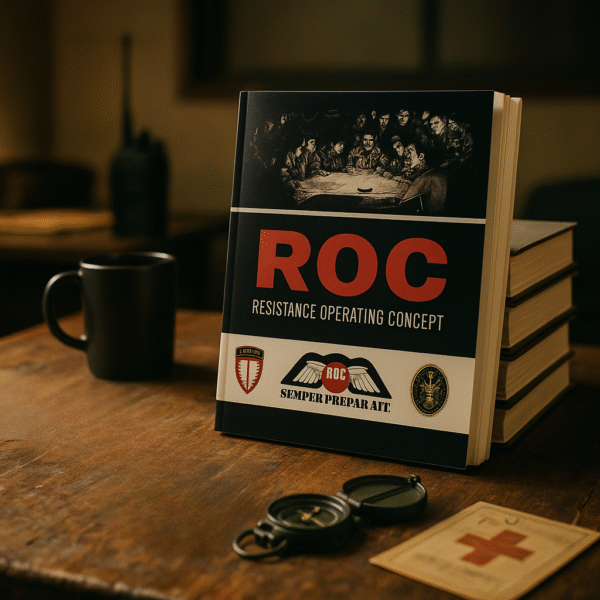
Source: Image is AI generated by The Resistance Hub
The complete Resistance Operating Concept, JSOU Press second edition, hosted unmodified.
Download the PDF// Page Contents
// Key Concepts
Underground
Clandestine cellular network operating covertly inside occupied or hostile territory.
Auxiliary
Overt or semi-covert population providing logistical and material support to the resistance.
Guerrilla Force
Overt paramilitary element conducting raids, ambushes and reconnaissance in less controlled terrain.
Shadow Government
Parallel civil authority preserving state legitimacy and governance under occupation.