Resistance Core Concepts
The Doctrine of Irregular Warfare
A structured reference to the foundational theory, tactics, and thinkers that define resistance movements, guerrilla warfare, and underground operations. From the writings of Mao Zedong to the cell structures of the SOE, these concepts form the doctrinal backbone of every successful resistance campaign in modern history.
Key Thinkers
// 01The theoretical foundations of irregular warfare were not written in seminar rooms. They were developed in the field, under fire, by practitioners who needed frameworks that could explain why small, under-resourced forces could defeat conventional armies. Three figures above all others codified this knowledge into doctrine that is still studied and applied today.
Mao Zedong
The architect of protracted people’s war. Mao’s three-phase doctrine, strategic defensive, strategic stalemate, strategic offensive, remains the most complete theory of guerrilla-to-conventional transition ever formalized. His writings on the mass line and the relationship between the guerrilla and the rural population are foundational to all subsequent resistance theory.
T.E. Lawrence
Lawrence of Arabia distilled irregular warfare into a geometric logic: the guerrilla’s advantage is space, time, and information, not firepower. His railway sabotage campaigns across the Hejaz demonstrated how a small mobile force could deny a conventional army freedom of movement. His Seven Pillars of Wisdom and analytical essays remain operationally relevant a century later.
Che Guevara
Guevara’s foco theory, the idea that a small armed vanguard could ignite revolutionary conditions rather than waiting for them, represented a radical departure from Maoist orthodoxy. His Guerrilla Warfare manual is a practical operational text as much as a political document, addressing logistics, security, and the relationship between combatants and rural communities.
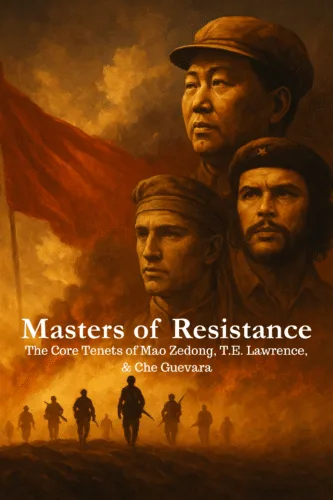
Masters of Resistance
Mao, T.E. Lawrence, and Che Guevara, the three foundational guerrilla theorists condensed into one essential primer on strategy and revolutionary doctrine. The theoretical backbone of this section in a single readable volume.
Social Dynamics
// 02Movements do not appear fully formed. They are built, and the building is a technical problem: how grievance becomes organization, how organization survives contact with a hostile state, and how a network keeps functioning once its members begin to disappear. The three concepts below cover the theory, the operational practice, and the structural mathematics that separate movements which last from movements which collapse in their first year.
Social Movement Theory
Why do populations mobilize? How do grievances become organizations, and organizations become campaigns? Covers resource mobilization theory, political opportunity structures, and the framing processes that determine whether a resistance movement gains popular legitimacy or collapses into factionalism.
Resistance Mobilization
The operational side of building a movement: recruitment, retention, the management of defection risk, and the transition from diffuse sympathy to organized resistance. Covers how historical resistance organizations built durable networks under sustained adversary pressure.
Understanding Human Networks
Social network analysis applied to resistance: how cells are structured, how information flows under compartmentalization, and how adversaries map and disrupt networks. Covers centrality, bridging nodes, redundancy, and the mathematical structure of resilient clandestine organizations.
Guerrilla Tactical Triad
// 03The guerrilla cannot afford a decisive engagement, so the guerrilla does not offer one. What remains is a small repertoire of actions that trade terrain and information for the firepower the irregular force does not have. These three recur with remarkable consistency from the Hejaz railway to the contested city, and they are best read alongside our analysis of recent developments in guerrilla warfare and urban resistance in occupied cities.
The Raid
The deliberate, rapid attack on a fixed position to seize, destroy, or capture, followed by immediate withdrawal. The raid exploits surprise and local knowledge, denies the adversary time to respond, and avoids the decisive engagement the guerrilla cannot afford to lose.
The Ambush
A surprise attack from a concealed position against a moving or temporarily halted target. The ambush is the most reliable force multiplier available to an irregular force, trading terrain advantage for firepower parity. Includes near and far ambush variants, linear and L-shaped formations.
Reconnaissance
Information is the guerrilla’s primary asymmetric advantage. Reconnaissance, the systematic collection of information about terrain, enemy disposition, and target vulnerabilities, precedes all effective irregular action. Covers route and area recon, surveillance, and HUMINT collection methods.
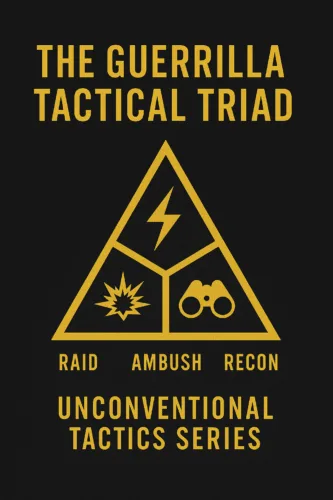
The Guerrilla Tactical Triad
Raid, ambush, and reconnaissance, the three operational pillars above, condensed into a concise reference built for practitioners and analysts. Doctrine without the footnotes.
Underground Tactical Triad
// 04Where the guerrilla operates in territory the adversary does not fully control, the underground works inside territory the adversary does. That single constraint shapes everything: the underground cannot mass, cannot hold ground, and cannot survive exposure, so its three functions are correspondingly indirect. For applied treatment across the archive, see sabotage in warfare: a brief history, Operation Gunnerside, the role of sabotage in hybrid warfare, undersea sabotage, and the defender’s side of the same problem in protecting critical infrastructure.
Sabotage
The deliberate destruction or disruption of infrastructure, equipment, or systems to degrade an adversary’s capacity to operate. Covers the distinction between destructive and obstructive sabotage, target selection logic, transportation nodes, communications, industrial capacity, and the psychological effect of sustained infrastructure campaigns.
Subversion
The systematic undermining of a regime’s legitimacy, cohesion, and capacity to govern. Subversion operates through infiltration of institutions, degradation of the opponent’s support base, and the exploitation of internal contradictions. Distinct from propaganda, subversion creates structural conditions for collapse rather than persuasion.
Espionage
The clandestine collection of intelligence on an adversary’s capabilities, intentions, and operations. Covers agent recruitment and handling, tradecraft fundamentals, cover, communication, counter-surveillance, and the organizational structures that protect collection operations. Draws heavily on SOE, OSS, and Cold War case material.
Related Disciplines
// 05Resistance does not operate in isolation. It is met by a counterinsurgency apparatus, it competes inside an information environment it does not control, and it is judged, eventually, against a legal framework it had no part in writing. These three disciplines define the conditions every campaign above has to survive.
Counterinsurgency
How states and occupying forces attempt to defeat resistance movements, the tactical, political, and population-focused doctrines of COIN, and what the historical record shows works and what does not.
Influence Operations
The use of information, narrative, and perception management to shape the operating environment, from wartime propaganda to modern information warfare and psychological operations (PSYOP).
International Law
The legal framework governing armed conflict, occupation, and resistance, the Geneva Conventions, the laws of war, and how irregular fighters navigate protected and non-protected status.
Reference Resources
All Resources →About This Section
The Resistance Core Concepts section is the theoretical foundation of The Resistance Hub. Unlike the news section, which tracks current events, or the toolkit section, which provides structural information, Core Concepts examines the theory, history, and strategic logic that underpins organized resistance activity. Content draws on primary sources from key thinkers, declassified government archives, academic research institutions, and professional military journalism. For editorial standards and source verification methodology, see the Editorial Policy →
Mao, T.E. Lawrence & Che Guevara, the three foundational guerrilla theorists condensed into one essential primer.
Buy on Amazon →Raid, ambush, and reconnaissance, the three operational pillars of irregular warfare in a concise reference format.
Buy on Amazon →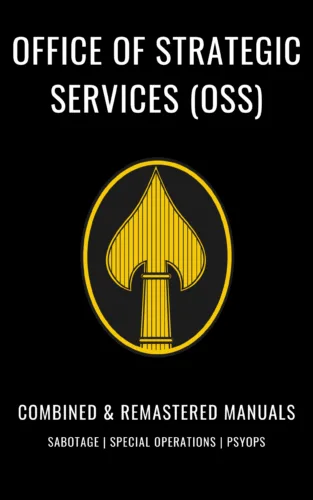
All eight original WWII OSS manuals, sabotage, resistance org, psyops, and covert comms, in one authoritative edition.
Buy on Amazon →