
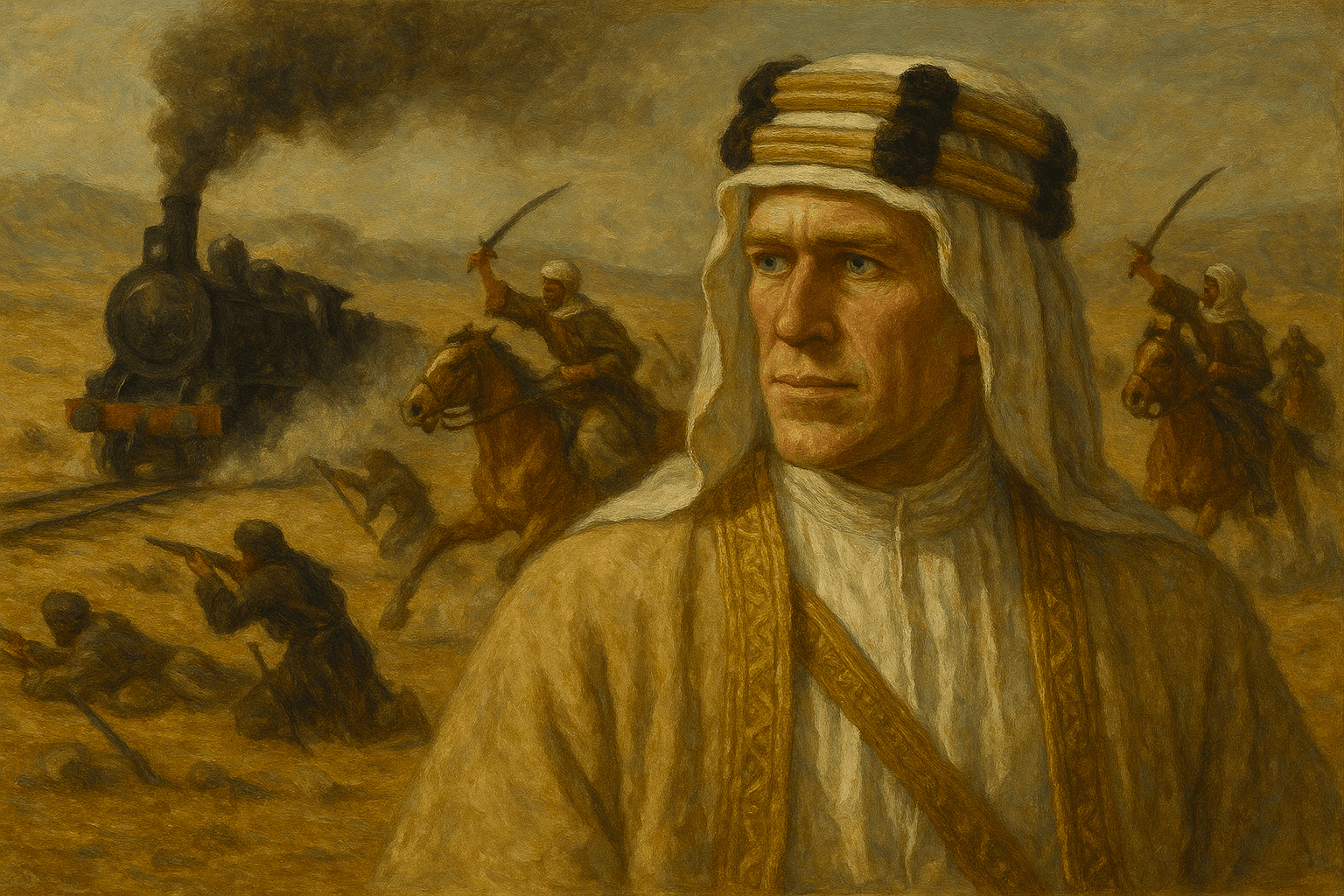
T.E. Lawrence, celebrated as Lawrence of Arabia, transformed the art of irregular warfare. His campaigns during the Arab Revolt against the Ottoman Empire combined strategic brilliance with cultural sensitivity, changing the way modern militaries think and operate.
Operating in the harsh deserts of the Arabian Peninsula during World War I, Lawrence partnered with Bedouin tribes to challenge Ottoman control. His goal was liberation. He worked to free Arab lands and unite tribes under a shared vision. Achieving this required more than military force. It demanded deep cultural understanding and the ability to inspire trust.
Lawrence’s most famous work, Seven Pillars of Wisdom, offers a detailed account of his experiences and tactics. He focused on undermining enemy morale as his primary objective. His strategy included striking vulnerable supply lines, such as the Hejaz Railway, to cripple Ottoman logistics. By doing so, he forced them to divert resources and spread their forces thin across hundreds of miles of desert territory.
He was skilled in psychological warfare, using surprise attacks and swift withdrawals to create uncertainty. Lawrence also used the desert itself as a weapon. Knowledge of terrain allowed his forces to move undetected and launch effective raids.
The lessons from his campaigns continue to shape modern conflicts, from Vietnam to Afghanistan. Both insurgents and counterinsurgents have adopted his principles, including mobility, cultural engagement, and political alignment.
Today, his strategies remain relevant. They demonstrate that in irregular warfare, success depends on adaptability, understanding the human environment, and combining military actions with political objectives.
Setting the Stage: Lawrence’s Historical Context
World War I provided the arena for Lawrence’s rise as a guerrilla strategist. Operating in the harsh deserts of the Arabian Peninsula, he aligned with Bedouin tribes to challenge the Ottoman Empire. Lawrence’s goals were political. He worked to liberate Arab lands and foster unity among tribes. This mission required more than military force. It demanded cultural understanding and the ability to inspire.
Lawrence’s writings, particularly Seven Pillars of Wisdom, offer profound insights into guerrilla tactics. He prioritized undermining the enemy’s morale as his core method, which influenced later figures like Mao Zedong and Che Guevara. Lawrence’s pragmatism and respect for his allies’ autonomy set him apart from those who followed.
Principles of Lawrence’s Irregular Warfare
1. Economy of Force
Lawrence recognized that smaller forces, when applied with precision and purpose, could achieve results far beyond their size. In Seven Pillars of Wisdom, he stresses that success in irregular warfare often depends on efficiency, agility, and strategic focus over sheer numbers.
Lawrence targeted Ottoman logistical lifelines, knowing that disrupting supply chains could produce effects disproportionate to the effort. His most famous example was the campaign against the Hejaz Railway, the critical link supplying Ottoman bases across the desert.
By striking isolated sections of track, ambushing repair crews, and destroying bridges, Lawrence forced the Ottomans to divert troops and resources away from key fronts. These attacks slowed operations, eroded morale, and made nowhere along the line truly secure.
The Hejaz Railway raids embodied Lawrence’s belief in doing more with less by striking vulnerabilities. His forces, often outnumbered and outgunned, created strategic impact by exploiting weaknesses in infrastructure, communications, and enemy confidence.
Lawrence later gave the method a name. In “The Evolution of a Revolt,” published in the Army Quarterly in October 1920, he called the Arab campaign a war of detachment, fought by “containing the enemy by the silent threat of a vast unknown desert” and never disclosing his own force until the moment of attack. The object was not to destroy Ottoman units but to make every mile of track and every isolated garrison a liability, so the enemy spent his strength holding ground instead of seeking battle.
This approach aligns with modern strategic thinking. Military theorists such as John Boyd, creator of the OODA Loop, have echoed Lawrence’s emphasis on speed, adaptability, and maintaining the initiative. By acting faster than the enemy could respond, small units could keep larger, slower forces in a reactive posture.
Today, the principle of economy of force remains a cornerstone of both insurgent operations and counterinsurgency campaigns. Precision, timing, and efficiency can outweigh numerical or technological superiority.
The Desert and the Sword: T.E. Lawrence on Irregular Warfare
Lawrence’s writing on irregular warfare, drawn out of the Seven Pillars narrative and set out as doctrine: the algebraic, biological and psychological factors, and what they still explain.
2. Psychological Warfare
Lawrence understood that in irregular warfare, perception could be as decisive as physical force. He excelled at creating psychological uncertainty, keeping Ottoman forces off balance through unpredictable strikes and sudden disappearances into the vast desert. By avoiding fixed patterns, he denied the enemy the ability to anticipate his movements, forcing them to remain constantly alert and stretched thin across vulnerable positions.
These tactics amplified fear and eroded morale. To the Ottomans, Lawrence’s small, mobile force seemed omnipresent. His fighters appeared capable of striking anywhere, at any time. This perception magnified their strength far beyond their actual numbers, a hallmark of effective guerrilla warfare.
Lawrence’s psychological strategy extended beyond battlefield maneuvers. He deliberately cultivated a legend around the Arab Revolt, portraying it as an unstoppable movement with wide tribal support. This narrative spread among his allies and his enemies, influencing decision-making at all levels. For the Arabs, it reinforced unity and commitment to the cause. For the Ottomans, it fueled doubt and hesitation, undermining their will to fight.
His approach illustrates a fundamental truth of irregular conflict. Shaping the enemy’s perception can be as important as inflicting physical damage. By controlling the narrative and projecting strength, Lawrence gained strategic advantages disproportionate to his actual resources.
This focus on psychological effects remains central in modern warfare, from counterinsurgency campaigns to information operations. The ability to affect enemy morale and public perception continues to define success in asymmetric conflicts, whether through media influence, disinformation, or precision strikes.
3. Terrain as a Force Multiplier
For Lawrence, the Arabian desert was a decisive ally. While conventional armies viewed its vast, barren expanse as hostile and unmanageable, the Bedouins understood its every nuance. They knew the locations of hidden water sources, the safest routes, and the skills needed to survive its extremes. This local knowledge transformed the environment into a powerful strategic asset.
Lawrence leveraged this advantage to outmaneuver and outlast the Ottoman forces. The desert’s vastness allowed his forces to move undetected, conceal their true intentions, and strike where least expected. Surprise attacks could be launched deep behind enemy lines, followed by rapid withdrawals into terrain that discouraged pursuit. Harsh conditions, which drained conventional troops, became a protective barrier for his fighters.
The principle of using terrain to offset disadvantages remains central to irregular warfare. Modern insurgent movements have adopted similar methods in vastly different environments. The Viet Cong turned the dense jungles of Vietnam into a defensive shield and staging ground. In Afghanistan, the mujahideen used mountainous terrain to frustrate both Soviet and NATO forces.
When properly understood and exploited, terrain can neutralize technological superiority and larger numbers. It allows smaller forces to dictate the terms of engagement, control the tempo of operations, and impose disproportionate costs on the enemy. Lawrence’s campaigns in the Arabian desert remain a textbook example of how environmental mastery through effective reconnaissance can redefine the balance of power in asymmetric conflict.

4. Integration of Political and Military Goals
For Lawrence, military success could never be separated from political purpose. His ultimate objective during the Arab Revolt was to foster Arab unity and secure independence. Every raid, ambush, and strategic move was designed to support this larger vision, ensuring that battlefield victories translated into lasting political gains.
A key to his success was aligning military operations with the goals of the tribes he worked alongside. By respecting their autonomy, honoring cultural traditions, and recognizing their political goals, Lawrence built trust and loyalty that endured through hardship. This mutual respect made cooperation possible even among diverse and sometimes rival tribal factions.
His approach mirrors modern counterinsurgency doctrine, such as the principles found in the U.S. Army’s Field Manual 3-24. In irregular warfare, winning requires building a legitimate and sustainable political future. Without this, military gains can collapse once fighting ends.
Lawrence demonstrated that political alignment strengthens military effectiveness. Ignoring it risks alienating allies and undermining long-term objectives. This integration of strategy remains vital in contemporary operations, from coalition building in counterinsurgency campaigns to stabilization efforts in post-conflict environments.
By combining military precision with political foresight, Lawrence ensured that his campaigns served both immediate tactical needs and enduring strategic aims. His legacy shows that in irregular warfare, the battle for legitimacy runs alongside the fight for territory.
The Twenty-Seven Articles: Lawrence’s Field Guide
In August 1917, Lawrence distilled these principles into a compact field guide for British officers arriving in the Hejaz. Published in the classified Arab Bulletin, the Twenty-Seven Articles are a working operator’s manual, written from inside the relationship they describe. More than a century later, the document remains a foundational reference for anyone operating by, with, and through partner forces.
The full text, typeset and produced by The Resistance Hub for reference use. Nine pages, branded cover, clean interior. Ideal for saving to a field reference folder or working library.
The Articles were not doctrine but personal conclusions, written as what Lawrence called “stalking horses for beginners in the Arab armies.” Their value lies in what they reveal about how he thought: the deliberate subordination of Western expertise to local knowledge, the cultivation of influence over authority, and the discipline of studying people as carefully as terrain. Read alongside the campaign history that follows, the Articles show the theory that made Aqaba, the Hejaz Railway raids, and Damascus possible.
Timeline of the Arab Revolt (1916 to 1918)
The Arab Revolt unfolded over two years of increasingly effective guerrilla operations. Each phase built on the last, moving from localized uprisings to a coordinated campaign that reshaped the Middle East. The timeline below traces the key inflection points.
Lawrence’s Impact on Modern Warfare
Lawrence’s principles have profoundly shaped modern military doctrine. The U.S. military, for example, integrated many of his ideas into its counterinsurgency practices. Cultural understanding, population-centric strategies, and psychological operations all reflect his influence.
Applications in Contemporary Conflicts
The Vietnam War saw guerrilla tactics reminiscent of Lawrence’s campaigns. The Viet Cong used mobility and terrain to frustrate U.S. forces, avoiding direct confrontations while targeting supply lines. In Afghanistan, both Soviet and NATO forces faced insurgents who leveraged local geography and community networks.
Counterinsurgents have also adopted Lawrence’s lessons. The Sunni Awakening during the Iraq War, where U.S. forces collaborated with tribal leaders, echoes Lawrence’s emphasis on local autonomy and culture.
Lawrence, Mao, and Guevara in a single condensed volume. The three foundational texts of guerrilla strategy, distilled for working practitioners and serious readers.
View on Amazon →Lessons for Today’s Leaders
1. Understand Local Context
Lawrence’s deep engagement with Arab culture allowed him to tailor strategies to his allies’ needs. He worked within their tribal structures, earning trust and fostering cooperation. His plans matched local realities and gained stronger support. Modern military leaders must similarly prioritize cultural intelligence to succeed in complex environments.
2. Prioritize Psychological Advantage
Undermining enemy morale remains as crucial today as in Lawrence’s time. Creating uncertainty, leveraging perception, and inspiring allies can quickly shift momentum. Psychological advantages often decide outcomes in asymmetric conflicts, even when military strength alone is insufficient.
3. Balance Independence and Support
Lawrence ensured that Arab forces kept their autonomy while using British resources. Modern insurgencies and counterinsurgencies face similar challenges. Overreliance on outside aid can weaken legitimacy. Complete independence may reduce effectiveness. Striking the right balance is critical for sustaining both operational success and political strength over time.
Seven Pillars of Wisdom: The Doctrine Made Text

Seven Pillars of Wisdom functions as both historical account and doctrinal primer. It is the principal written record of Lawrence’s campaigns and the fullest expression of the theory behind them. The work explores leadership, military strategy, cultural adaptation, and personal transformation with a candor uncommon in military memoir.
The Arab Revolt (1916 to 1918) was a critical uprising against the Ottoman Empire, supported by Britain to weaken a common enemy. Serving as a British officer, Lawrence worked closely with Arab forces led by Prince Faisal and Sherif Hussein. His narrative blends personal experience with significant historical events, producing a vivid account of the revolt’s military operations, political dimensions, and cultural dynamics.
The Political Betrayal
In Seven Pillars of Wisdom, Lawrence details the strategic motives behind British support for the Arab Revolt. Britain sought to weaken the Ottoman Empire by offering Arab independence in return for military cooperation. These promises aimed to secure crucial allies in a difficult and strategically important theater of World War I.
Lawrence was deeply troubled by the dishonesty behind these commitments. He knew of the secret Sykes-Picot Agreement, which divided the Middle East between Britain and France with Russian assent, directly contradicting the independence pledges. This betrayal appears repeatedly in his writing, highlighting the tension between imperial ambitions and genuine self-determination.
The episode underscores a central theme in Lawrence’s story: the conflict between wartime strategy and moral responsibility. It also reveals the essential role of trust in coalition warfare. When political duplicity enters the equation, even the most effective military campaigns risk collapse. This historical context continues to hold relevance for understanding both irregular warfare and the complex geopolitics of the modern Middle East.
Cultural Adaptation and the Limits of Influence
Lawrence’s deep immersion in Arab culture is a defining feature of his narrative. He adopted local dress, customs, and language, earning the trust and respect of his Arab counterparts. This cultural sensitivity allowed him to bridge the gap between British strategic goals and Arab aspirations, creating a foundation for genuine cooperation.
Seven Pillars of Wisdom emphasizes the vital role of cultural understanding in leadership, diplomacy, and irregular warfare. Lawrence’s success was rooted in his ability to empathize with Arab grievances, aspirations, and traditions, shaping strategies that aligned with local values. By respecting tribal autonomy and recognizing cultural identity, he strengthened alliances that endured under pressure.
Lawrence also accepted the limits of his influence. Tribal rivalries, shifting loyalties, and competing visions for the revolt’s ultimate goal often complicated his mission. These realities show a timeless lesson. Cultural understanding must pair with adaptability, patience, and awareness that not all objectives align.
Leadership and Moral Ambiguity
Leadership is a central theme throughout Seven Pillars of Wisdom, and Lawrence offers a candid view of its complexities. He reflects on his role as a leader, often confronting moral ambiguities and the tension between strategic necessity and ethical responsibility. For Lawrence, effective leadership meant guiding others while allowing them to retain their agency and dignity.
This philosophy is most evident in his collaborative relationship with Prince Faisal, whom he portrayed as the revolt’s rightful figurehead. By deferring to local authority, Lawrence strengthened legitimacy and trust among his allies. His account also reveals personal doubts and insecurities, exposing the internal struggles of a leader balancing competing loyalties.
He wrestled with the ethical implications of using Arab forces to advance British objectives, questioning whether his actions truly supported Arab independence. This self-awareness deepens the historical value of his work. Leadership in irregular warfare is as much about moral judgment as it is about tactical skill.
Myth, Narrative, and the Shaping of History
Lawrence infused his storytelling with a deliberate sense of myth, framing the Arab Revolt as a heroic and unifying struggle. He elevated its participants to near-legendary status, ensuring their deeds would inspire far beyond the immediate conflict. He also recognized the gap between myth and reality, openly acknowledging the revolt’s contradictions, rivalries, and imperfections.
This dual awareness adds depth to his work, showing that even powerful narratives must be understood in their full complexity. It underscores the role of myth in shaping historical memory and influencing contemporary and future perceptions. Lawrence’s skill in weaving compelling stories cemented his own legacy and shaped how the Arab Revolt is remembered and studied. In both warfare and politics, the story told can be as influential as the events themselves.
Lawrence understood that controlling physical territory was often less important than shaping how people think and feel. He focused on creating zones of influence, where loyalty, perception, and alliances mattered more than geographic boundaries. This approach is just as relevant in modern conflicts, where information warfare, strategic communications, and psychological operations can decide the outcome of campaigns.
Conclusion
T.E. Lawrence’s contributions to irregular warfare extend beyond his time in the Arabian Desert. His insights into terrain, psychology, and the integration of military and political goals remain essential for understanding modern conflicts. Guerrilla fighters and counterinsurgents alike continue to draw on his wisdom.
As warfare evolves, the principles Lawrence championed continue to offer enduring guidance: adaptability, cultural understanding, and strategic alignment. His campaigns show that victory often hinges on the ability to inspire, adapt, and outthink the enemy rather than on sheer force.
Seven Pillars of Wisdom remains the cornerstone text for studying these ideas. Its principles, from guerrilla tactics to deep cultural engagement, offer practical tools for navigating modern conflicts and political challenges. Lawrence’s work continues to influence military planners, political leaders, and scholars confronting the complexities of warfare, culturally diverse environments, and the integration of strategy with moral purpose.
Recommended Reading
- Seven Pillars of Wisdom: A Triumph by T.E. Lawrence. Lawrence’s masterwork: a memoir of the Arab Revolt that doubles as a manual on guerrilla strategy, cultural engagement, and the moral complexities of irregular warfare.
- Masters of Resistance (Distillery Press, Series 1). Lawrence, Mao, and Guevara: three foundational insurgent texts in one volume. The essential primer on guerrilla strategy and revolutionary doctrine.
- Invisible Armies: An Epic History of Guerrilla Warfare by Max Boot. Boot’s sweeping history features Lawrence prominently and places the Arab Revolt within the broader arc of irregular warfare from antiquity to the present.
- Counterinsurgency Warfare: Theory and Practice by David Galula. The counter-perspective: how governments can defeat the strategies Lawrence and other guerrilla theorists pioneered.
For expanded definitions of the terms used in this article, see the IW & Resistance Glossary. For the full curated reading list, visit Essential Books on Resistance.
