
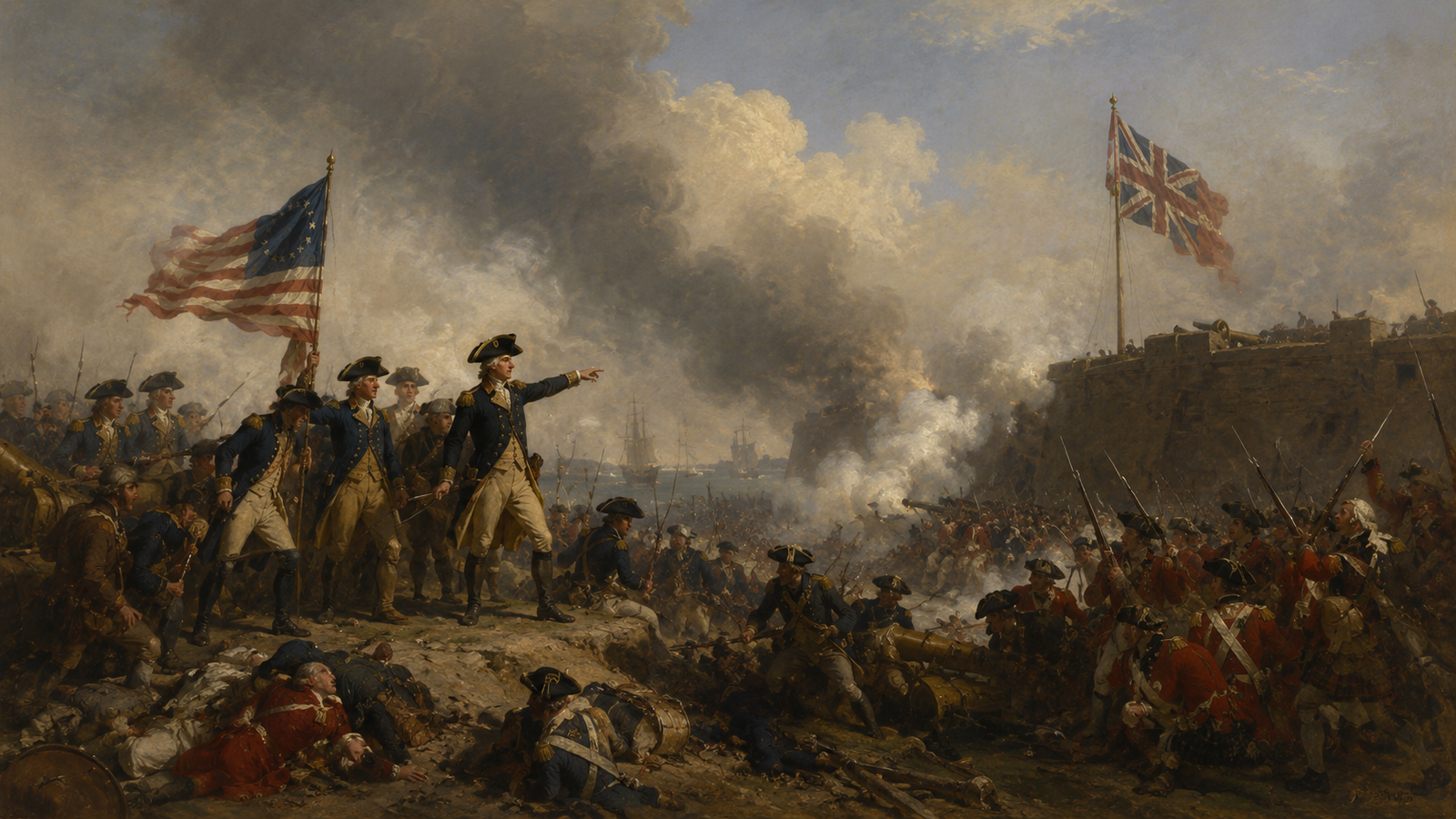
In July 1776 the Continental Congress declared the independence of thirteen British colonies. The anniversary invites commemoration, but for students of irregular warfare the Revolutionary War insurgency invites something more useful: analysis. The ARIS case study The Patriot Insurgency (1763 to 1789), written by Robert R. Leonhard and a Johns Hopkins Applied Physics Laboratory team for US Army Special Operations Command, does exactly that. It sets aside the familiar narrative history of the American Revolution and scrutinizes the Patriots through the lens of modern insurgency doctrine: underground, auxiliary, armed component, public component, shadow governance, and transition to legitimate rule.
The result is one of the most instructive documents in the ARIS collection, because the case it examines is the one American readers think they already know. TRH has previously examined the Revolution as a foundational case of irregular warfare; this article works through the ARIS study itself, which lives in full on the ARIS resource page, and draws out the doctrinal findings that the commemorative version of the story leaves behind.
Published on the 250th anniversary of the Declaration of Independence, this installment of TRH’s walkthrough of the ARIS case study collection examines the insurgency that produced the United States. The full case study PDF is available on the ARIS resource page.
The Revolutionary War insurgency was four wars at once
The case study opens by dismantling the idea that the Revolution was a single conflict. Declaring independence committed the Patriots to three simultaneous wars and courted a fourth. First, they had to defeat or outlast the armies and navy of Great Britain, the most powerful military establishment on earth. Second, they had to fight the Native American nations of the Ohio Valley and the remnants of the Iroquois Confederation, who entered a coalition of convenience with the British because both wanted the colonists kept east of the Appalachians. Third, the Revolution was in every sense a civil war: Loyalists made up at least a fifth of the colonial population, and Patriot victory required their political and military defeat. Fourth, and least discussed, was the latent class war inside the Patriot coalition itself, where the propertied elite’s definition of liberty and the common farmer’s definition could not permanently coexist.
The study’s judgment is that the Patriots won because they maintained just enough unity to outlast their enemies. The sectional and class cleavages inside the movement were managed through compromise and postponement, not resolution, and the postponed questions returned with interest in 1861. That framing matters for any analyst of coalition insurgencies: the internal fracture lines of a resistance movement do not disappear at victory, they inherit the state.
The components: shadow government before the first shot
Mapped against modern doctrine, the Patriot insurgency’s organizational story is striking for how early its underground matured. When royal governors dissolved the colonial assemblies, the colonists answered with Committees of Safety that governed illegally in parallel to official British authority, an activity the study identifies as textbook shadow government. The Committees of Correspondence functioned as the insurgent network binding thirteen distinct political communities into a common purpose. By 1777 the work was essentially complete: every royal governor but one had been run out of office, Loyalist assemblymen and printers were silenced, the militias were in Patriot hands, and the shadow government was the only functioning authority across most of colonial North America.
The auxiliary was the population itself. The study repeats the rough contemporary arithmetic that a third of colonists embraced the Patriot cause, a third opposed it, and a third were undecided, then identifies the two documents that broke the deadlock in 1776: Thomas Paine’s Common Sense and the Declaration of Independence. The public component ran through the colonial press. Papers like the Boston Gazette, the Pennsylvania Journal, the Massachusetts Spy, and the Connecticut Courant framed every crisis from the Boston Massacre onward, and the Patriots gained control of the press early and suppressed Loyalist newspapers. Samuel Adams used the Gazette to normalize the rhetoric of resistance years before any army existed to act on it. Readers tracking how movements build consensus before violence will recognize the pattern from resistance mobilization theory and from the mechanics of subversion.
The inverted force model
The most doctrinally interesting finding concerns the armed component. The canonical models of revolutionary warfare build guerrilla cells first and graduate to conventional forces only in a final phase. The Patriots ran the model in reverse. From the outset their leaders chose to field conventional militias and then a Continental Army intended to stand in line of battle against British regulars and Hessian mercenaries, with irregular forces playing a significant but subordinate role.
The study gives three reasons. The insurgency grew out of established governments, courtrooms, and legislatures rather than mountain refuges, and its landowner and merchant leadership had estates and infrastructure that required conventional defense. The colonies already possessed militia institutions, enlistment rolls, and military traditions pointed toward regular organization. And the Continental Army was an instrument of public diplomacy: an aspiring nation fielding a respectable army is harder to dismiss as a criminal rabble. Washington himself, a former Virginia militia officer who had aspired to a British commission, expressed lifelong contempt for undisciplined irregulars, integrated them only when the war demanded it, and reverted to conventional forces whenever he could. The Southern campaigns of 1778 to 1781, where Greene and Morgan ran an irregular campaign that accepted conventional battle selectively to bleed the British, show the synthesis at its most effective.
Ideology: property, a good king turned bad, and a conspiracy theory
The study’s treatment of Patriot ideology resists modern back-projection. Liberty in the eighteenth-century Whig vocabulary meant property: the right to own it and dispose of it without government interference, grounded in Locke’s social contract theory. The Sugar Act and Stamp Act read as assaults on property and therefore on liberty itself, because taxation without representation severed the constitutional link between consent and extraction. The uncomfortable corollary, which the study states plainly, is that property in the eighteenth century included human beings, so the Patriot ideology of liberty implied protection of slaveholding. To raise armies from the middling and lower classes, the Patriot elite had to concede a broader definition of liberty as economic opportunity and civil rights, a concession Paine’s Common Sense accelerated, though it extended only to free white men.
Two narrative mechanisms did the heaviest ideological work. The first was the transformation of George III from ally to enemy. Until remarkably late, even ardent Patriots cast the king as their advocate against a rapacious Parliament and his evil councilors. Only when the king personally championed the crackdown after the Intolerable Acts did the Declaration’s drafters aim the indictment at him directly, and the study marks that shift as the death of any hope of avoiding revolution. The second was conspiracy theory. The colonial press propagated the belief that the Earl of Bute was pulling strings behind the throne in a plot to enslave Englishmen and impose Catholicism, and effigies of local Tories were hanged with a boot around their necks in his honor. The study treats this culture of paranoia not as a curiosity but as a powerful motivator that carried ordinary people toward revolution.
Decision at sea
The study’s most deliberate departure from conventional histories is its weighting of the naval war over the land campaigns. Its argument runs as follows. The land campaigns could stave off defeat, deny Britain political control of American territory, and raise the cost of the war, but they could not by themselves produce independence. Decision required pressure on Parliament, and Parliament was a body of men with commercial interests spanning Europe, the Caribbean, North America, and the Indo-Pacific. The way to reach those interests was at sea. More men served at sea than in the land campaigns, more were taken prisoner there, and more damage was done to the British economy there. By the war’s end the number of American privateers had risen to 1,697, waging a war of the chase against British merchant shipping that reached into Britain’s own territorial waters. When the East India Company, the trading houses, and the English merchants saw their profits disappearing to American and French commerce raiding, they pressed their government to end the war. In the study’s formulation, the land campaigns provided critically important defense, but the naval campaigns, together with diplomacy and the non-importation movements, produced decision.
The British counterinsurgency, covered in the study’s Government Countermeasures chapter, is a catalog of the opposite instinct. Parliament answered a political problem with coercion at every turn: the Declaratory Act, the Townshend duties, regulars quartered in Boston, and a succession of generals fixated on destroying the Continental Army in the belief that a battlefield decision would translate into political surrender. It never did. Troops trained for conventional battlefields were sent to police riots they were never taught to handle, and the Boston Massacre handed the Patriot press a propaganda gift it never stopped using. The pattern belongs on the same shelf as the theorists in our survey of counterinsurgency thought, most of whom wrote their warnings against exactly this reflex two centuries too late for the ministry of Lord North.
Masters of Resistance
The Distillery Press anthology of the foundational thinkers behind unconventional warfare and resistance doctrine. The doctrinal vocabulary ARIS applies to the Patriots, from underground to auxiliary to shadow government, descends directly from this literature.
View on Amazon →The transition to governance, and the unseen seed
The hardest test for any insurgency is the transformation from clandestine network to legitimate government, and the study’s conclusion explains why the Patriots passed it. Their leaders had governed for years in colonial legislatures before the first shot. The Intolerable Acts forced them into functioning shadow government before the war began. And by the peace of 1783 the Continental Congress had operated as a national government for eight years. The insurgency did not have to learn governance after victory; it had been practicing the entire time. Even so, the Articles of Confederation barely sufficed to prosecute the war, and the 1787 Constitution resolved the structural problems of taxation, debt, and treaty power through the twin instruments the study names candidly: compromise and postponement. The Three-Fifths Compromise deferred the question of slavery until it was answered in the blood of 620,000 dead nearly a century later.
The study also insists on the true character of the war. Set against the mythology of a respectable, orderly revolution, the record shows Americans killing Americans at a rate matched only by the Civil War, coerced loyalty oaths, public shaming that licensed violence, and sixty thousand Loyalists driven into exile as refugees. One fifth of the population remained enslaved throughout the great struggle for liberty, an irony the study notes bedeviled the Patriot leadership to their graves.
The closing analytic observation may be the study’s most transferable. Histories of insurgency dwell on deprivation, grievance, and state weakness as causes, and the ARIS methodology chapters survey that literature thoroughly. But the Patriot insurgency, the authors argue, grew from success: Britain’s success as a global empire, which left Parliament trying to govern a far-flung enterprise with home-country rules, and the colonies’ own economic and political success, which produced a confident, modern, Enlightenment-shaped society that discovered political sensitivities only after prosperity freed it from the struggle to survive. Insurgency does not emerge solely from shared deprivation. It also grows from shared success. For analysts watching prosperous, politically maturing societies chafe inside institutional arrangements built for an earlier era, that is the sentence worth carrying out of the document.
Related Articles on The Resistance Hub
Recommended Reading
- Masters of Resistance · The Distillery Press anthology of foundational thinkers behind modern unconventional warfare and resistance doctrine.
- The Guerrilla Tactical Triad · Distillery Press treatment of the operational logic connecting irregular and conventional force employment, the exact synthesis the Southern campaigns demonstrate.
- OSS: Combined & Remastered · The canonical OSS field manuals on simple sabotage, intelligence, and underground organization.
The full ARIS study, Case Studies in Insurgency and Revolutionary Warfare: The Patriot Insurgency (1763 to 1789) by Robert R. Leonhard, Summer D. Agan, and Stephen P. Phillips (USASOC, 2019), is available on the ARIS resource page alongside the rest of the case study collection.
