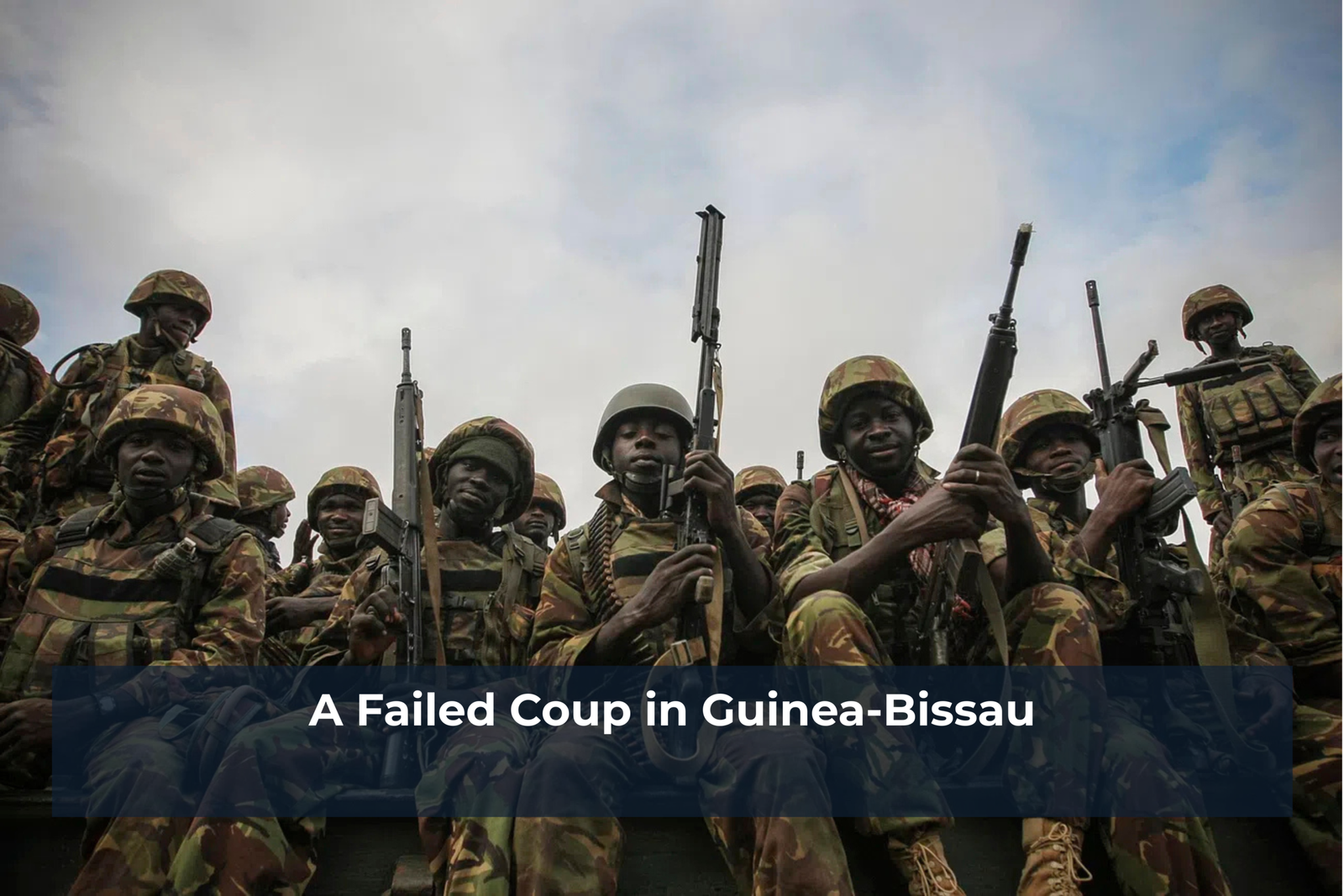
This article originally reported the Guinea-Bissau coup of 26 November 2025 as a failed attempt. That was wrong, and the sections below have been rewritten. The coup succeeded. President Umaro Sissoco Embaló was detained at his office, flown to Senegal on 27 November and later relocated to the Republic of the Congo. General Horta Inta-A Na Man was proclaimed interim president for a one year transition, and both ECOWAS and the African Union suspended Guinea-Bissau. A constitutional referendum is now set for 30 August 2026 and general elections for 6 December 2026.
Overview of the Events
On 26 November 2025, three days after presidential and legislative elections and before any result had been announced, soldiers seized control of key state facilities in the capital, Bissau. Brigadier General Dinis Incanha, head of the Military Office of the Presidency, led the operation and announced that the armed forces had taken total control of the country. The takeover met no organised resistance and no sustained fighting followed.
President Umaro Sissoco Embaló was arrested at his office without a shot fired. The armed forces chief of staff, General Biague Na Ntan, his deputy, General Mamadou Touré, and Interior Minister Botche Candé were detained in the same operation, as were opposition candidate Fernando Dias da Costa and PAIGC leader Domingos Simões Pereira. The junta suspended political institutions, closed media outlets and borders, imposed a curfew and halted the electoral process. Embaló was flown to Senegal on 27 November and later relocated to the Republic of the Congo. There was no large-scale civilian mobilization either for or against the takeover.
On 27 November, General Horta Inta-A Na Man was proclaimed interim president at the head of a self-declared High Military Command for the Restoration of National Security and Public Order, with a stated transition period of one year. Ilídio Vieira Té, who had run Embaló’s campaign, was appointed prime minister on 28 November. ECOWAS suspended Guinea-Bissau on 27 November and the African Union followed on 28 November. A National Transitional Council was announced on 4 December and a Transitional Charter published on 9 December barred both Inta-A Na Man and Vieira Té from standing in future elections.
The election that preceded the takeover has never been resolved. On 2 December 2025 the electoral commission reported that armed men in balaclavas had destroyed the tally sheets from the 23 November vote and seized its computers, making verification impossible. That single fact underwrites the most persistent reading of the episode, which is that the seizure was timed to stop a result from being certified rather than to remove a president who could not otherwise be removed.

Preconditions for Revolution
The coup did not emerge in a vacuum. Several recurring structural conditions made such an effort conceivable. These conditions reflect long-standing patterns of elite competition, weak civilian oversight of the security sector, and unresolved questions of political legitimacy rather than any sudden rupture. In such environments, the use of force remains an available instrument for political bargaining when institutional channels are viewed as ineffective or closed.
Civil-military politicization remains a defining feature of Guinea-Bissau’s post-independence history. The armed forces have long operated as political stakeholders rather than strictly professional institutions. This blurring of roles lowers the threshold for military involvement in elite disputes.
Elite factionalism also played a central role. Power struggles in Guinea-Bissau tend to occur within narrow political and security circles. In this context, force becomes an arbitration mechanism among elites rather than a tool for mass political transformation. The dynamics mirror patterns of political subversion seen across fragile states, where institutional channels are bypassed in favor of covert maneuvering.
A perceived legitimacy deficit contributed to the timing. Public dissatisfaction with governance exists, but it is uneven and not ideologically organized. For coup plotters, this creates an assumption that decisive action at the top can succeed without popular mobilization. This dynamic aligns with the concept of relative deprivation, where frustration is driven less by absolute hardship than by perceived disparities in access, status, and opportunity among elites and connected networks. In such contexts, grievance concentrates upward, encouraging action by those who feel excluded from power rather than mass-based revolt from below.
Finally, regional contagion effects mattered. The run of successful coups in parts of the Sahel has normalized unconstitutional seizures of power as a viable option. Even where local conditions differ, precedent lowers psychological barriers and reshapes expectations among would-be plotters. The broader pattern of democratic backsliding across West Africa provided additional cover for those willing to act outside constitutional channels.
Taken together, these factors made a seizure of power not merely conceivable to a narrow circle of officers but cheap. The institutions that would have had to resist it were the same ones the plotters already commanded.
Why It Succeeded
The same structural environment that made the attempt conceivable also delivered it.
Command and control held. The operation ran from inside the presidential security apparatus, led by an officer with lawful access to the president, so the plotters never had to fight their way to the decisive node. Embaló, the chief of the general staff and his deputy were all in custody within the first hours, which removed every figure with the standing to issue a counter-order.
Security force alignment was never seriously contested. Coups in the region turn on rapid alignment across key military and internal security units. In Guinea-Bissau no unit had an institutional interest in defending a president who had governed without a sitting parliament and whose own mandate was disputed, and none moved.
There was no countervailing popular mobilization. No mass protest, general strike or civilian mobilization formed to defend the constitutional order, and none was likely to. The vote that might have conferred a democratic mandate on somebody had not been certified, so there was no clear figure for a crowd to defend. Civilian compliance followed the logic it follows in any governance competition: populations align with whoever is credibly supplying order, and in Bissau that was the army within a day.
External signalling raised costs without changing outcomes. ECOWAS and the African Union suspended Guinea-Bissau within 48 hours, and Portugal, France and South Africa condemned the takeover. None of it moved the junta. Suspension imposes reputational cost on a government with little international standing to lose, and no member state offered the one thing that would have mattered, which is a credible threat of reversal. The ECOWAS of 2017 massed troops on the Gambian border and removed Yahya Jammeh in days. That leverage no longer exists, and the contrast with the January 2026 external intervention in Venezuela is instructive: outcomes change when an outside actor is willing to apply force, not when it issues a communiqué. The role of external influence in African political crises is now largely declaratory, and plotters have priced that in.
The outcome reflected structural conditions the plotters read more accurately than their critics did. Nothing about it was improvised.
The Legacy of Coups in Africa
Coups have been a recurring feature of African politics since independence, but their character has evolved. Earlier interventions often claimed ideological justification or revolutionary intent. Contemporary coups are more frequently transactional, aimed at redistributing power among elites rather than reshaping political systems.
In this context, coups function less as causes of instability than as symptoms of institutional weakness. Where mechanisms for elite competition, succession, and accountability are underdeveloped, force becomes a fallback option. Conflicts elsewhere on the continent, from Sudan’s civilian resistance to the war in eastern Congo, rest on the same structural foundation of weak institutions creating openings for both coups and prolonged insurgencies.
The emergence of a so-called coup belt has reinforced this dynamic, but it has also obscured important variation. Guinea-Bissau is the extreme case rather than the representative one. It has seen repeated successful seizures of power and many more attempts since independence in 1974, and no elected president has completed a full term in office. The November 2025 takeover does not show a system under sudden strain. It shows one in which the military never stopped being the final arbiter.
Analytically, a successful coup is uninformative only if the reading stops at the seizure itself. What matters is what the takeover exposes about which institutions carried any independent weight, and in Guinea-Bissau the answer was close to none. The ARIS case studies document the same dynamic across dozens of twentieth and twenty first century political crises, tracing how elite fragmentation and institutional decay interact to produce or prevent regime collapse.
What’s Next
The junta has published a calendar. A decree of 22 January 2026 set legislative and presidential elections for 6 December 2026. Ahead of that, a constitutional referendum is scheduled for 30 August 2026 on a revised text that would expand presidential powers. The Transitional Charter bars Inta-A Na Man and Vieira Té from standing, although charters of this kind have proved easy to amend elsewhere in the region.
The opposition has not been reintegrated. Domingos Simões Pereira was released on 30 January 2026 and placed under house arrest. Fernando Dias da Costa took refuge in the Nigerian embassy. Neither has agreed to join the transitional government, and the ECOWAS and African Union suspensions remain in force. Under international law the transition has no constitutional basis, which matters for recognition and for access to external finance, but it has not cost the junta control of the state.
The conditions that produced the takeover are all still in place: politicized security institutions, elite rivalry arbitrated by force, and no domestic actor able to impose a cost on the army. The referendum of 30 August 2026 is the first real test. If a constitution expanding presidential power passes under a military transition, the December election becomes a ratification exercise rather than a transfer. Watch the referendum turnout and whether the opposition contests it, not the election date.
OSS: Combined & Remastered. The Distillery Press edition of the foundational OSS manuals on sabotage, subversion and covert operations, covering the same tradecraft that underpins elite power struggles and unconstitutional seizures of power.
