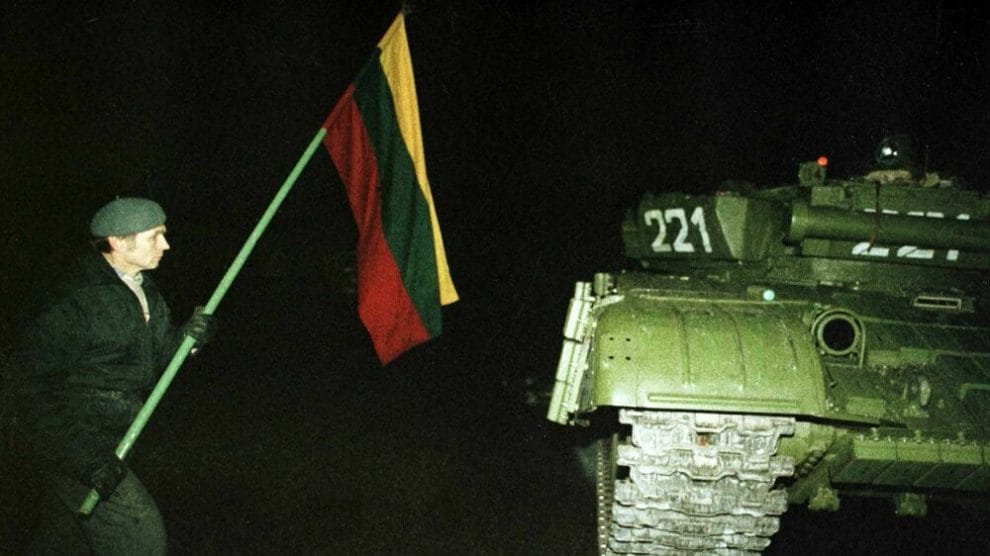
On the night of January 12–13, 1991, Soviet paratroopers and KGB special forces stormed the Vilnius television tower and radio station. Fourteen unarmed Lithuanian civilians were killed. Hundreds more were wounded. The crowd — thousands of ordinary citizens who had gathered to physically defend their country’s broadcast infrastructure — did not disperse. They stood in front of tanks, sang hymns, and refused to yield.
The January Events, as they became known, were the bloodiest episode in the Baltic States’ struggle for independence from the Soviet Union. They were also among the most consequential. Within ten months of the Vilnius massacre, the Soviet Union ceased to exist. Lithuania’s resistance mobilization — peaceful, disciplined, and strategically coherent — had succeeded where decades of armed insurgency could not.
The Road to January 13
On March 11, 1990, Lithuania became the first Soviet republic to formally declare the restoration of its independence. The Supreme Council, led by Vytautas Landsbergis and backed by the Sąjūdis independence movement, voted to reinstate the pre-1940 Lithuanian constitution — a direct repudiation of Soviet authority.
Moscow’s response was immediate. Mikhail Gorbachev imposed an economic blockade, cutting oil and gas supplies to Lithuania throughout the spring and summer of 1990. Soviet troops already garrisoned in Vilnius were reinforced. The Kremlin demanded that Lithuania revoke its declaration and restore the Soviet constitution — demands the Lithuanian parliament rejected.
By January 1991, while global attention was fixed on the Gulf War, the Kremlin escalated. On January 8, a pro-Soviet crowd — organized by the Yedinstvo movement and backed by the local Communist Party — attempted to storm the parliament building. They were repelled by Lithuanian defenders using fire hoses. Over the next three days, Soviet special forces began seizing government buildings in Vilnius, Kaunas, Šiauliai, and Alytus. Roads were blocked. The Vilnius railway junction was captured. Lithuania was being systematically isolated.
The Assault on the Television Tower
In response to the growing military threat, Sąjūdis called on citizens across Lithuania to converge on Vilnius and defend the remaining institutions of the independent state: the parliament, the television tower, and the radio station. Tens of thousands answered. Bonfires were lit around the parliament. Families, students, factory workers, and pensioners formed human barriers around the broadcast facilities — Lithuania’s last link to its own population and to the outside world.
At approximately 1:50 AM on January 13, a column of Soviet T-72 tanks and armored personnel carriers advanced on the television tower. KGB Alpha Group commandos — the Soviet Union’s premier counter-terrorism unit — led the assault. Tanks drove directly into the crowd. Soldiers fired live rounds, used concussion grenades, and deployed tear gas. Loreta Asanavičiūtė, a 23-year-old seamstress, was crushed under a tank. She became the most recognized of the fourteen victims.
The television signal was cut. But emergency broadcasting had already been relocated to Kaunas, Lithuania’s second city, ensuring that news of the massacre reached both the Lithuanian population and international audiences. The Soviet forces seized the tower and the radio building — but they did not take the parliament. Thousands of defenders remained around the Seimas building throughout the night, and the order to storm it never came. Gorbachev, confronted with international condemnation and the scale of civilian resistance, pulled back.
The Historical Context: Lithuania’s Resistance Tradition
The January Events did not emerge from a vacuum. Lithuania has one of the longest continuous resistance traditions in Europe. After the Soviet occupation in 1940 and the subsequent Nazi and second Soviet occupations, an armed partisan movement known as the Forest Brothers waged a guerrilla campaign against Soviet forces from 1944 to 1953. At its peak, an estimated 28,000 fighters operated across Lithuania — conducting raids, disrupting Soviet elections, and maintaining an underground press. The last known Lithuanian partisan, Antanas Kraujelis, was killed by KGB forces in 1965.
The Forest Brothers ultimately failed militarily — they received no Western support despite repeated appeals, and Soviet espionage and infiltration operations systematically dismantled the partisan networks. But the memory of armed resistance became a foundational element of Lithuanian national identity. When the opportunity for independence arose again in 1988–1991, Lithuanians drew on that tradition — this time channeling it through social movement theory and nonviolent mass mobilization rather than guerrilla warfare.
Aftermath and Accountability
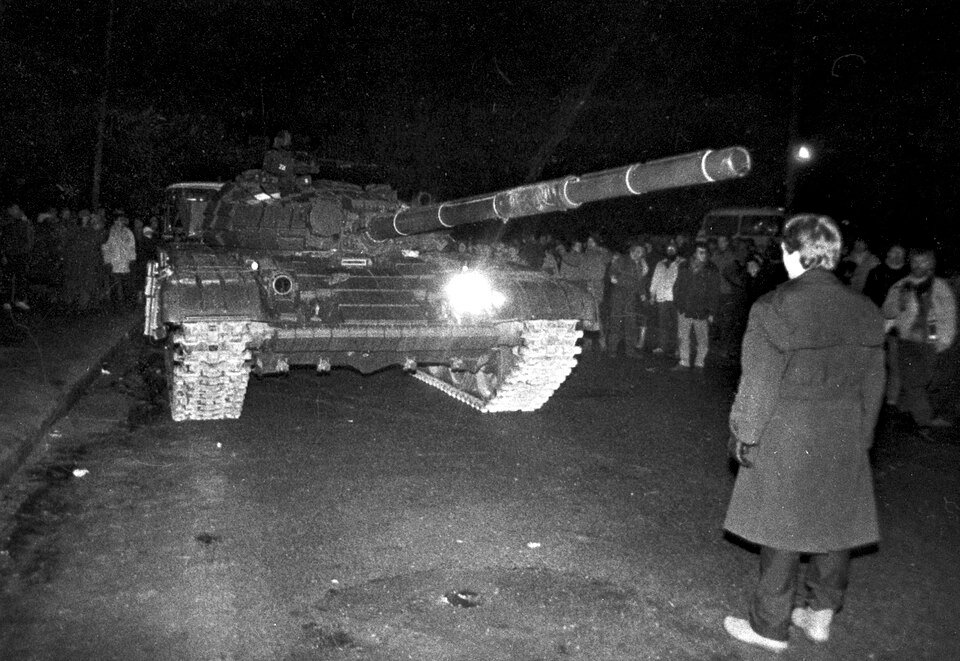
The massacre at the television tower produced the opposite of its intended effect. Rather than crushing the independence movement, it consolidated domestic support and galvanized international recognition. On February 9, 1991 — less than a month after the assault — Lithuania held a referendum on independence. Turnout was 84.73%, and 90.47% voted in favor. Iceland became the first country to formally recognize Lithuanian independence on February 4, 1991. Boris Yeltsin, then leader of the Russian SFSR, flew to Tallinn immediately after the January 13 events and issued a joint statement with the Baltic leaders recognizing the sovereignty of all three Baltic states — a direct challenge to Gorbachev from within the Soviet system.
Legal accountability came slowly but ultimately succeeded. Lithuanian prosecutors opened an investigation in 1992, but the case was not delivered to court until 2015. In March 2019, the Vilnius Regional Court convicted 67 Russian, Belarusian, and Ukrainian citizens of war crimes and crimes against humanity for their roles in the January 13 assault. Former Soviet Defence Minister Dmitry Yazov was sentenced to ten years in absentia. Only two defendants — former Soviet officers Yuri Mel and Gennady Ivanov — stood trial in person. Russia responded by opening criminal proceedings against the Lithuanian prosecutors and judges who handled the case, and continues to deny that Soviet forces used weapons against civilians.
Strategic Significance
The January Events are a textbook case of how unarmed civilian resistance mobilization can defeat a conventional military force by altering the political cost calculus. The Soviet army could have taken the Lithuanian parliament on January 13 — they had the firepower and the positioning. What they could not absorb was the political cost: international condemnation, the defection of Yeltsin, and the precedent of massacring civilians on live television. The decision not to storm the Seimas was not a military failure. It was a political defeat imposed by the resistance.
Lithuania’s experience also demonstrated the critical importance of controlling the information environment during a crisis. By pre-positioning emergency broadcast capability in Kaunas, the Lithuanian government ensured that the Soviet seizure of the Vilnius tower did not silence the national narrative. This is a principle that resonates in modern influence operations doctrine: the side that controls the story often determines the outcome.
The events of January 1991 directly enabled Lithuania’s subsequent integration into NATO and the European Union in 2004. The patterns of civilian defense, institutional resilience, and international coalition-building that Lithuania pioneered have since informed resistance planning across the Baltic region — and remain urgently relevant as European states reassess their vulnerability to hybrid threats, subversion, and coercive military pressure.
On January 13, 2026, Lithuania marked the 35th anniversary of Freedom Defenders’ Day. Commemorative bonfires were lit outside the Seimas and at the television tower in Vilnius. The anniversary carried particular weight in the context of Russia’s ongoing war in Ukraine — Lithuanian officials drew explicit parallels between the civilian resistance of 1991 and Ukrainian resistance since 2022.
Lithuania’s defense spending has risen to over 3% of GDP — among the highest in NATO — driven in part by the institutional memory of January 1991.
Recommended Reading
The following books provide essential context on Lithuanian resistance, Baltic independence, and the broader dynamics of Soviet collapse and post-Soviet sovereignty struggles.
- Forest Brothers: The Account of an Anti-Soviet Lithuanian Freedom Fighter, 1944–1948 by Juozas Lukša — A first-person memoir of the Lithuanian partisan war against Soviet occupation. Lukša, operating under the codename Daumantas, was one of the most prominent resistance leaders. Essential primary source material on guerrilla resistance in the Baltic context.
- The Baltic Revolution: Estonia, Latvia, Lithuania and the Path to Independence by Anatol Lieven — Written by the only Western journalist permanently stationed in the Baltics during the independence struggle. Winner of the 1993 George Orwell Prize for political writing. The definitive English-language account of the events covered in this article.
- The Gates of Europe: A History of Ukraine by Serhii Plokhy — Harvard historian Plokhy traces Ukraine’s position at the crossroads of empires. Provides the broader context for understanding why the Baltic and Ukrainian independence movements faced similar dynamics of Russian coercion.
- Red Famine: Stalin’s War on Ukraine by Anne Applebaum — Pulitzer Prize-winning journalist Applebaum documents the Holodomor and its role in shaping Ukrainian resistance identity. A companion piece to the Lithuanian experience of Soviet deportations and cultural suppression.
The story of Lithuania’s January Events is not merely a chapter in the history of the Baltic States. It is a case study in how organized, nonviolent civilian resistance can impose costs that conventional military force cannot overcome — and how the memory of resistance becomes, itself, a strategic asset for nations facing coercive pressure from authoritarian neighbors.
