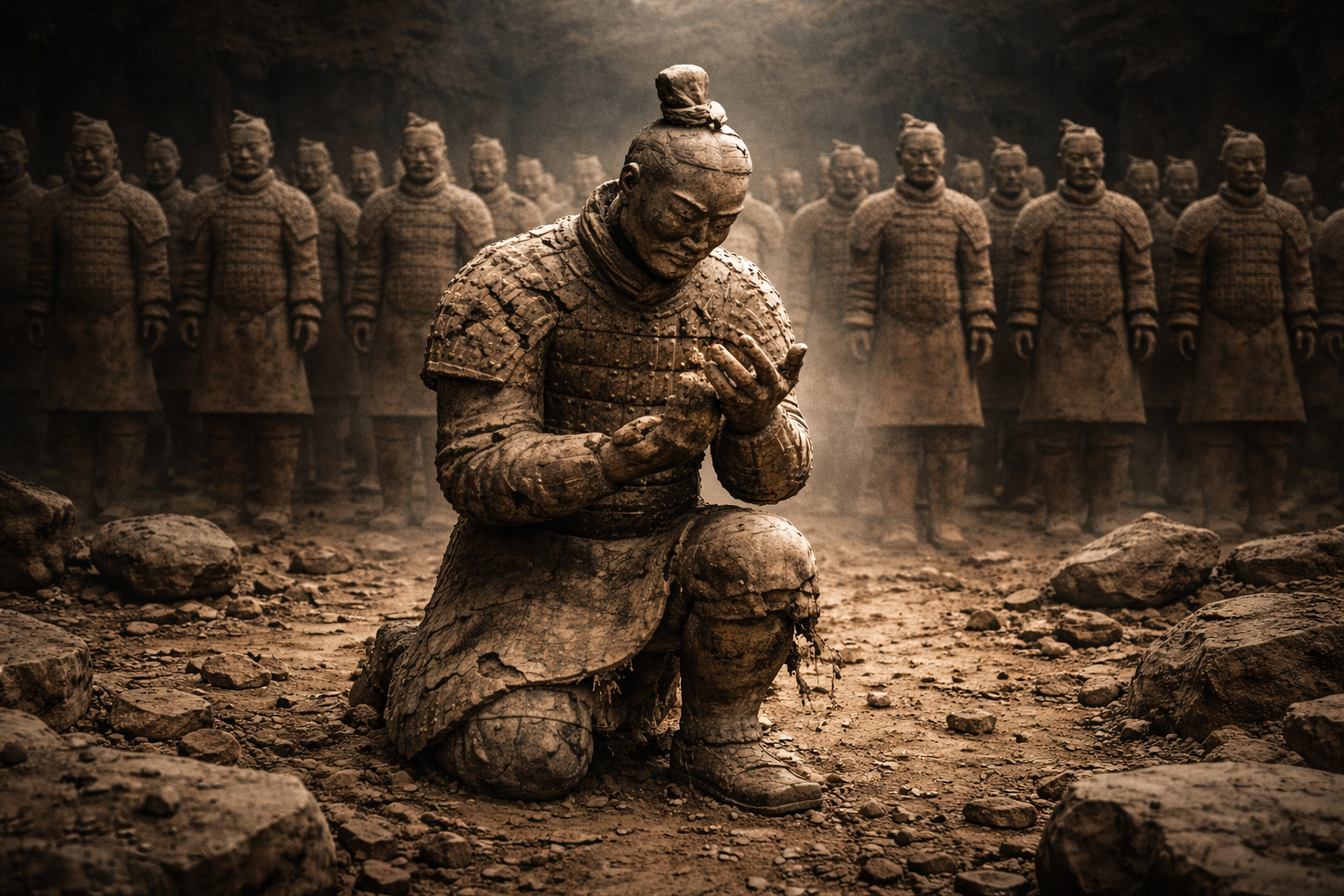
From the outside, authoritarian militaries project order, strength, and cohesion. Flags wave. Ranks shine. Parades thunder with disciplined force. But beneath the surface of tightly controlled structures like China’s People’s Liberation Army (PLA) and Russia’s Armed Forces lies a brittle foundation, one that irregular warfare is uniquely suited to exploit.
Despite overwhelming firepower and state control, these militaries are built on rigid command systems, service compartmentalization, and political oversight that suppress battlefield initiative and adaptability. In the age of distributed, hybrid, and irregular threats, such traits are less a strength than a liability.
This article explores why highly politicized and service-compartmented militaries like China’s and Russia’s are increasingly vulnerable to irregular warfare, not just tactically but structurally.
The Ukraine evidence base for this analysis has continued to accumulate. Fighting runs on into 2026 with no negotiated settlement. Two short truces were attempted and both failed: the Orthodox Easter truce of 11 to 13 April 2026 lasted roughly 32 hours before Ukraine reported 469 violations and full-scale fighting resumed, and a second truce from 9 to 11 May 2026, timed to Victory Day and paired with a prisoner exchange, ended the same way.
Nothing in that record contradicts the argument below. Four years of war have not produced the delegated, initiative-driven command culture Russia would need to fight a distributed adversary, which is the structural point this article makes.
Command by Loyalty: The Anatomy of Politicized Military Hierarchies
China’s Dual-Command System
The PLA is not simply a national army. It is the military arm of the Chinese Communist Party (CCP). The Central Military Commission (CMC), chaired by Xi Jinping, exercises direct control over all military branches. Political commissars are embedded at every level, from battalion to theater command, holding co-equal authority with operational commanders. This dual-command structure means operational decisions must satisfy both military logic and political orthodoxy, a tension that slows decision-making and discourages initiative. Officers are promoted based on political reliability as much as combat competence. Loyalty to the Party, not tactical innovation, drives career advancement. Corruption within the PLA, particularly within its logistics and procurement systems, has been a persistent weakness that Xi’s anti-corruption campaigns have only partially addressed. The result is a force optimized for internal control and regime survival, not for the fluid, decentralized operations that modern warfare demands.
Russia’s Legacy of Political Surveillance
Russia’s military inherited the Soviet tradition of political surveillance through the zampolit (political officer) system. Though formally restructured after the Soviet collapse, political oversight remains embedded in Russian military culture. The GRU (military intelligence), FSB, and other security organs monitor officer loyalty, creating an environment where initiative is risky and obedience is rewarded. Russia’s command structure is heavily centralized, with operational authority concentrated at senior levels. Junior officers and NCOs are given far less autonomy than their Western counterparts. This centralization was exposed catastrophically in Ukraine, where Russian battalion tactical groups proved unable to adapt to Ukrainian ambushes, drone strikes, and distributed resistance without direct orders from higher headquarters, orders that often came too late or not at all.
Silos and Silence: Compartmentalization as a Strategic Weakness
The PLA’s Walls Between Services
China’s 2015 to 2016 military reforms reorganized the PLA into five theater commands, ostensibly to improve joint operations. However, deep institutional rivalries between services, covering army, navy, air force, rocket force and strategic support force, persist. Intelligence sharing remains limited, and interoperability exercises have revealed significant coordination gaps. The PLA has not fought a major war since 1979 (the brief and costly border conflict with Vietnam), meaning its joint command structures remain untested under the stress of actual combat. Taiwan contingency planning requires seamless integration of amphibious, air, cyber, and missile operations, exactly the kind of complex joint action that compartmentalized structures struggle to execute under pressure.
Russia’s Dysfunctional Interoperability
Russia’s service compartmentalization has been even more damaging in practice. During the initial phase of the 2022 Ukraine invasion, Russian ground, air, and electronic warfare units repeatedly failed to coordinate, sometimes operating at cross purposes. Air support was absent when ground forces needed it most. Communication between units relied on unsecured channels that Ukrainian signals intelligence readily exploited. Wagner Group mercenaries and regular army units operated in the same battlespace with competing chains of command, leading to friendly fire incidents and strategic confusion. This interservice dysfunction is not new. It plagued Russian operations in Chechnya and Georgia as well, but Ukraine demonstrated that Russia’s reforms since 2008 failed to solve the underlying structural problem.
Russian Fragility in Ukraine, and Before It
Russia’s full-scale invasion of Ukraine in 2022 provides the clearest modern example of how a heavily centralized and politicized military can be outmaneuvered by a more agile, networked adversary using irregular methods. But Ukraine is not the first time Russia’s rigid military model collapsed under asymmetric pressure. It is only the most visible.
In Grozny, during both Chechen wars, in 1994 to 1996 and again in the 1999 to 2000 assault that opened the second war, Russian armored units were annihilated in urban environments after advancing without adequate infantry support or decentralized decision-making. Chechen fighters, lightly armed but highly mobile, exploited the gaps between services and overwhelmed Russian formations through ambushes, snipers, and IEDs. Russian command, rooted in vertical control, was slow to adapt and unable to empower junior leaders under fire.
In the 2008 Russo-Georgian War, despite achieving its strategic objectives, Russia’s military exposed severe coordination failures. Air and ground forces operated with minimal synchronization, resulting in friendly fire incidents. Communications infrastructure proved inadequate for real-time coordination, and logistics faltered within days of the offensive. These failures prompted the 2008 Serdyukov reforms, but those reforms were themselves undermined by institutional resistance and political interference.
In Ukraine, these same vulnerabilities resurfaced on a far larger scale. Ukrainian forces, trained in mission command principles by NATO advisors and equipped with distributed C4ISR capabilities, consistently exploited Russia’s centralized decision-making. Small Ukrainian units with Javelins, NLAWs, and commercial drones destroyed Russian columns that were waiting for orders rather than acting on initiative. Ukraine’s resistance mobilization, combining regular forces, territorial defense units and civilian intelligence networks, created a distributed threat that Russia’s top-heavy command structure could not process or respond to at the speed required.
China’s Unproven Readiness: When Scale Becomes a Liability
China presents a different but related vulnerability. The PLA is the world’s largest military by personnel, with approximately two million active-duty service members. It has invested heavily in modernization: advanced missile systems, fifth-generation fighters, aircraft carriers, and cyber capabilities. But the PLA has not conducted large-scale combat operations in over four decades.
This absence of combat experience is compounded by structural constraints. The political commissar system disincentivizes risk-taking and independent judgment. Training exercises, while increasingly sophisticated, cannot replicate the chaos and friction of actual combat, particularly the kind of distributed, adaptive warfare that a Taiwan defense scenario or South China Sea contingency would demand. Xi Jinping’s centralization of power within the CMC has further consolidated decision-making at the top, reducing the institutional space for the kind of bottom-up adaptation that irregular warfare exploits.
China’s military doctrine, rooted in “active defense”, emphasizes information dominance and system-of-systems warfare. This approach relies on seamless integration of sensors, networks, and strike platforms. But if an adversary can disrupt those networks through subversion, electronic warfare, or physical sabotage of communication nodes, the PLA’s sophisticated kill chain degrades rapidly. A military optimized for high-technology, centrally orchestrated operations is particularly vulnerable when forced to operate in degraded, contested or denied environments, precisely the conditions that irregular warfare creates.
Why Irregular Warfare Exploits Centralized Militaries
Authoritarian systems like those in China and Russia are built to prevent deviation, not to adapt under pressure. Each of their structural traits creates an opening that irregular actors can exploit:
Rigid command hierarchies create tactical paralysis. When decisions must flow vertically, even minor delays can paralyze a unit. Coordinated ambushes, drone strikes, or multi-domain attacks in dispersed locations force the enemy to wait for instructions rather than act independently, creating exploitable gaps in time and space.
Fear of initiative enables psychological exploitation. Officers who fear punishment for unauthorized action are less likely to improvise. This can be weaponized through feints, false flag operations, or simulated threats that force the enemy to seek permission before reacting, buying critical time for irregular forces.
Compartmentalized services create interstitial gaps. When ground, air, naval, and cyber forces operate in rigid silos, irregular actors can attack the seams between them. A drone swarm targeting air defenses while ground forces face guerrilla ambush creates a multi-domain problem that siloed commands struggle to solve in real time.
Political loyalty over competence weakens operational judgment. Politically appointed officers are optimized for upward reporting, not battlefield assessment. Influence operations that subtly disrupt information trust between command echelons can erode cohesion faster than kinetic strikes.
| Structural Trait | How It Manifests | Irregular Exploitation |
|---|---|---|
| Rigid command hierarchy | Decisions flow vertically; junior leaders wait for authority | Dispersed simultaneous attacks force serial decision cycles and open gaps in time and space |
| Fear of initiative | Unauthorised action is punished more reliably than inaction is | Feints, false signatures and simulated threats push commanders into seeking permission |
| Service compartmentalisation | Ground, air, naval and cyber elements plan and report in silos | Strikes aimed at the seams between services, which no single command owns |
| Loyalty over competence | Officers optimise for upward reporting rather than ground truth | Influence operations that corrode trust between echelons faster than fires do |
Strategic Implications
For Resistance Movements
Resistance cells must avoid mirroring the centralized structure of the enemy. Independent action, mission command principles, and horizontal intelligence sharing allow them to survive and outpace a slower, politically entangled force. Targeting enemy communication nodes and hybrid warfare vulnerabilities, not just frontline units, maximizes the asymmetric advantage that decentralization provides.
For Western Military Planning
Partner forces should be trained not only in combat but in adaptive planning, improvisation, and small-unit autonomy. Mission command is a strategic antidote to authoritarian rigidity. In places like Taiwan, the Baltic States, and Southeast Asia, irregular warfare capabilities must be embedded into civil defense, not as an afterthought but as a core component of deterrence. Modern defense must integrate SOF, cyber teams, and indigenous resistance networks into a layered architecture that presents adversaries with dilemmas they cannot solve through centralized command alone.
The Guerrilla Tactical Triad is the operational counterpart to this analysis: how raid, ambush and sabotage are sequenced to attack the seams that centralised command cannot close.
View on Amazon →Recommended Reading
Asmus, Ronald. A Little War That Shook the World: Georgia, Russia, and the Future of the West. St. Martin’s Press, 2010.
Grau, Lester W., and Michael A. Gress, eds. The Soviet-Afghan War: How a Superpower Fought and Lost. University Press of Kansas, 2002.
Kakar, Mohammed K. Afghanistan: The Soviet Invasion and the Afghan Response, 1979 to 1982. University of California Press, 1997.
Fravel, M. Taylor. Active Defense: China’s Military Strategy since 1949. Princeton University Press, 2020.
Scales, Robert H. Certain Victory: The U.S. Army in the Gulf War. Potomac Books, 1998.
