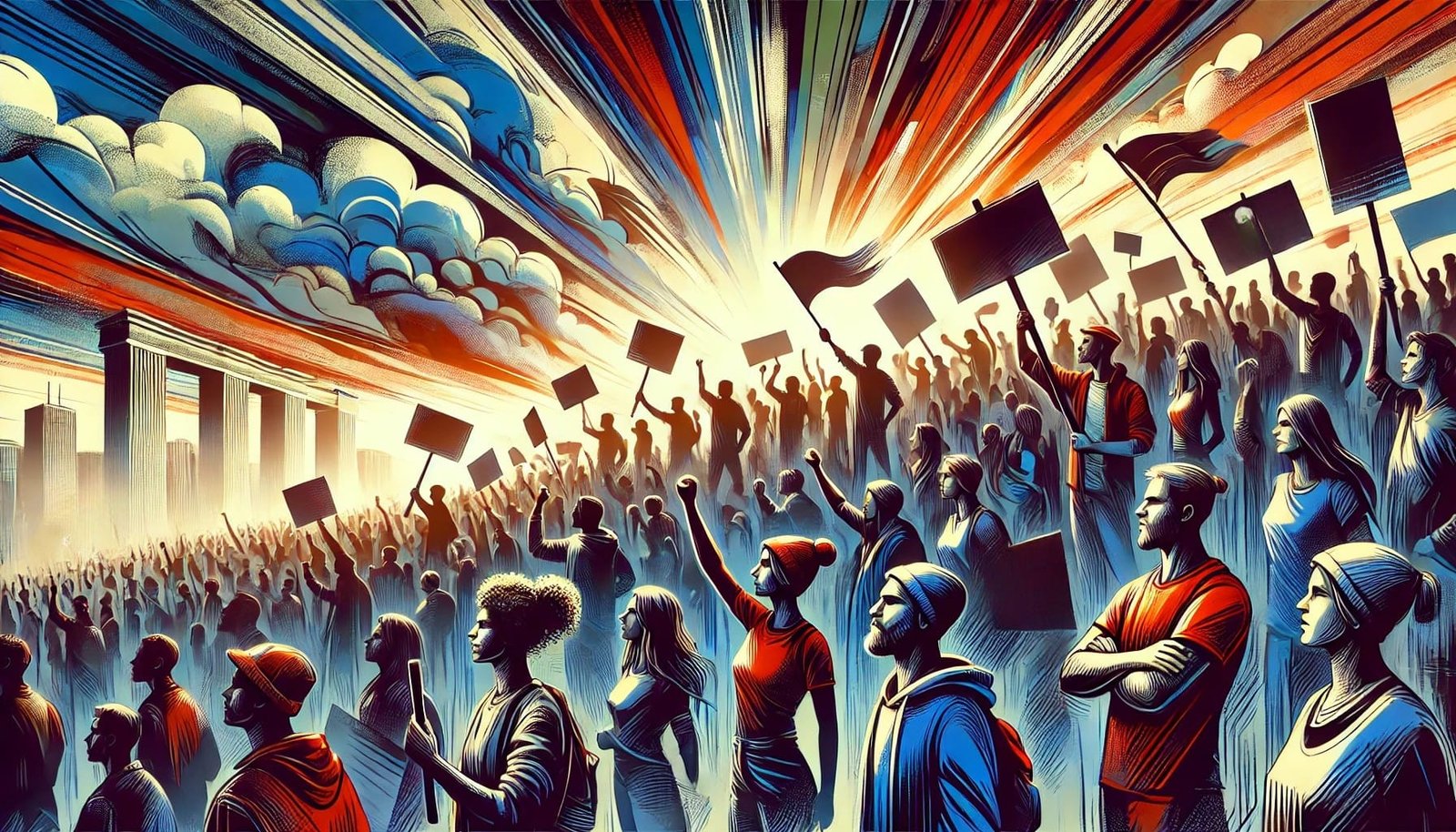
Social movement theory provides the analytical framework for understanding how ordinary people organize to challenge power structures, resist oppression, and force political change. For practitioners and analysts of irregular warfare, these theories are not abstract academic exercises — they are operational models that explain why some resistance movements succeed, why others collapse, and what conditions allow civil action to reshape states.
From the labor movements of the industrial era to the digitally coordinated uprisings of the 21st century, social movements follow identifiable patterns of emergence, mobilization, confrontation, and resolution. The theoretical traditions that study these patterns — political opportunity theory, resource mobilization, framing analysis, and nonviolent resistance doctrine — each illuminate different dimensions of how collective action works. Together, they form an essential toolkit for anyone seeking to understand resistance as a strategic phenomenon.
Why Movements Emerge

Movements do not appear spontaneously. They emerge from specific conditions that transform private grievance into collective action. Understanding these preconditions is essential for assessing the vulnerability of political systems to civil resistance — and for recognizing the early indicators of a movement before it becomes visible.
Relative deprivation describes the gap between what people expect and what they receive. Ted Robert Gurr argued that this perceived injustice — not absolute poverty alone — generates the frustration that fuels mobilization. When expectations rise faster than conditions improve, or when conditions deteriorate after a period of progress, the resulting anger creates a population primed for action.
Structural strain occurs when economic hardship, inequality, or political repression destabilizes the social order. Marxist and Durkheimian traditions both identify systemic pressure as a catalyst: workers facing exploitation, communities experiencing rapid social change, or populations subjected to authoritarian tightening. The Georgian protest movements of 2023–2025 illustrate how legislative overreach — in this case, the foreign agents law — can crystallize diffuse discontent into organized opposition.
Political opportunity structure, developed by Sidney Tarrow and Doug McAdam, explains why movements emerge at specific moments rather than whenever grievances exist. Movements advance when cracks appear in the system: a regime weakened by internal division, an election that opens political space, or an international shift that emboldens opposition. The Serbian resistance movement that overthrew Milošević in 2000 succeeded in part because it exploited a stolen election — a political opening that united a fragmented opposition and triggered defections within the security forces.
Collective identity transforms individuals into participants. Alberto Melucci argued that shared experiences of injustice create an “us versus them” consciousness that is essential for sustained action. Whether organized around ethnicity, class, religion, or political ideology, this sense of collective belonging gives movements their cohesion and emotional resilience — qualities tested severely when regimes respond with repression.
Mobilization: Turning Grievance Into Capacity

Grievance without organization produces protest. Grievance with organization produces a movement. The transition from discontent to coordinated action depends on the mobilization of resources, leadership, and networks capable of sustaining collective effort over time.
Resource mobilization theory, advanced by Mayer Zald and John McCarthy, rejects the assumption that movements arise from irrational collective behavior. Instead, it treats movements as rational enterprises that require funding, skilled organizers, communications infrastructure, and institutional support. Without these resources, even widely shared grievances remain diffuse and politically inert. Solidarity in Poland succeeded not only because of widespread discontent with Communist rule but because it built an organizational infrastructure — underground publishing networks, strike committees, and international Catholic Church support — that sustained a decade-long campaign.
Leadership shapes every phase of a movement’s lifecycle. Charismatic figures provide vision and public identity, but operational leaders — the organizers, logisticians, and strategists working behind visible leadership — determine whether a movement can sustain pressure beyond the initial wave of protest. In the irregular warfare context, the distinction between strategic leadership and tactical coordination is critical: movements that depend entirely on a single leader are vulnerable to decapitation, while those with distributed leadership structures — as Che Guevara learned in Bolivia — prove more resilient under state repression.
Networks connect participants across geographic, social, and institutional boundaries. Charles Tilly documented how pre-existing social networks — churches, unions, student organizations, professional associations — serve as mobilization infrastructure, providing trust relationships and communication channels that movements exploit. In the digital era, these networks extend through encrypted messaging, social media platforms, and diaspora communities, as documented in the information environment surrounding modern conflicts.
Framing: Controlling the Narrative
Movements succeed or fail in part based on how they define the problem, assign blame, and articulate a vision of change. Framing theory, developed by David Snow and Robert Benford, explains how movements construct narratives that resonate with cultural values and motivate participation.
Effective framing performs three functions: diagnostic framing identifies and names the injustice; prognostic framing proposes a solution; and motivational framing provides a rationale for action. The shift in LGBTQ+ rights from a marginal social issue to a mainstream civil rights cause illustrates how reframing can transform public discourse over time. Conversely, movements that fail to control their narrative — or that allow opponents to define them — struggle to build the broad coalitions necessary for sustained action.
Antonio Gramsci’s concept of counter-hegemony describes the deeper dimension of this contest. Dominant power structures maintain control not only through force but through cultural authority — shaping what society considers normal, legitimate, and possible. Movements that challenge these assumptions contest not just policy but the moral foundations of authority itself. This is why authoritarian regimes invest heavily in information and influence operations: controlling the narrative is as strategically important as controlling territory.
Tactics: The Repertoire of Contention
Charles Tilly’s concept of repertoires of contention describes the inherited toolkit of protest methods that movements adapt to their specific conditions. Tactics are not invented from scratch — they are inherited, refined, and transmitted across movements and generations. The sit-ins of the American Civil Rights Movement drew on Gandhian methods; Otpor’s humor-based resistance in Serbia was studied and replicated in Georgia, Ukraine, and Egypt.
Nonviolent resistance has emerged as the most empirically effective approach to regime change. Gene Sharp cataloged 198 methods of nonviolent action, while Erica Chenoweth’s landmark research demonstrated that nonviolent campaigns between 1900 and 2006 succeeded 53% of the time — more than twice the success rate of armed insurgencies. Nonviolent movements succeed in part because they lower the barriers to participation, broadening the coalition beyond those willing to take up arms, and because they increase the political cost of state repression by exposing it to domestic and international audiences.
Disruptive tactics — strikes, occupations, boycotts, blockades — function as the coercive edge of nonviolent resistance. Frances Fox Piven and Richard Cloward argued that marginalized groups, lacking institutional power, can only exert pressure by disrupting the systems on which elites depend. When formal channels are closed, disruption becomes the mechanism that forces negotiation. The Sudanese civilian resistance committees that organized neighborhood-level services during the 2023–2025 conflict demonstrate how tactical adaptation can sustain a movement even under conditions of total state collapse.
The State Response: Repression, Co-optation, and Adaptation
Every movement that challenges authority provokes a response. Understanding how states react to collective action — and how movements adapt to that reaction — is essential to assessing whether a campaign will endure or collapse.
Repression is the most visible state response. Tilly and James C. Scott documented how governments deploy surveillance, policing, legal constraints, and violence to disrupt coordination and deter participation. Yet repression is a double-edged instrument: heavy-handed crackdowns can generate a backfire effect, drawing public sympathy to the movement and undermining the regime’s legitimacy. The Georgian government’s violent dispersal of protesters in 2023 strengthened rather than weakened the opposition movement — a pattern observed repeatedly in authoritarian responses to civil resistance.
Co-optation is more subtle and often more effective. Regimes may absorb movement leaders into existing power structures, offer partial concessions that divide moderates from radicals, or reframe the movement’s demands in ways that neutralize their transformative potential. Recognizing co-optation as a strategic response — rather than a sign of victory — is critical for movement sustainability.
Cultural control operates beneath both repression and co-optation. Gramsci observed that power is maintained through dominance over media, education, and public narrative. When movements contest these spaces, they challenge not just policies but the ideological foundations that make existing arrangements appear natural and inevitable. This is why intelligence operations directed at civil society organizations, independent media, and cultural institutions are a consistent feature of authoritarian governance.
Measuring Outcomes: Success, Decline, and Legacy
Movement outcomes exist on a spectrum. Some achieve sweeping institutional reform; others reshape public consciousness without immediate policy change; many leave behind organizational networks, tactical knowledge, and ideological frameworks that inform future struggles.
Tarrow and McAdam demonstrate that movements succeed when they align with favorable political conditions and maintain coalitional discipline. The American Civil Rights Movement channeled moral pressure into legislative change by exploiting shifting public sentiment, Cold War-era international pressure, and political calculations within the Democratic Party. Conversely, movements decline through exhaustion, internal division, leadership fragmentation, or resource depletion — the pattern Mancur Olson described as the collective action problem, where individual costs begin to outweigh perceived collective benefits.
The history of resistance in occupied territories shows that even “failed” movements leave critical legacies. The organizational infrastructure, tactical repertoires, and collective memory they create become resources for subsequent generations. Poland’s Solidarity was crushed by martial law in 1981 but the networks it built survived underground and formed the basis of the democratic transition eight years later.
Transnational Movements and the Digital Era

Modern movements operate across borders with a speed and scale that earlier theorists could not have anticipated. Digital communication platforms enable real-time coordination across continents, while shared visual media — from citizen journalism to open-source intelligence — creates a global witness effect that constrains state violence and amplifies movement narratives.
Sidney Tarrow’s concept of transnational activism describes how movements now extend beyond the nation-state, linking local struggles to global coalitions. The Arab Spring demonstrated both the power and limitations of digitally networked protest: social media accelerated mobilization in Tunisia and Egypt but could not substitute for the organizational infrastructure needed to sustain political transformation. The same digital tools that empower movements also enable state surveillance and digital repression, creating an ongoing tactical competition between activists and authorities.
Intersectionality — the recognition that race, gender, class, and identity intersect to shape experiences of oppression — has expanded how movements define their constituencies and frame their demands. Nancy Fraser’s work on justice as both redistribution and recognition reflects the growing complexity of modern activism, where single-issue movements increasingly give way to coalitional campaigns that address multiple dimensions of inequality simultaneously.
Everyday Resistance: The Unseen Dimension
Not all resistance is visible. James C. Scott’s concept of everyday resistance describes the quiet, persistent acts through which ordinary people reject domination without open confrontation: slowing work under exploitative conditions, preserving banned languages and cultural practices, circulating forbidden ideas through informal networks, maintaining parallel social structures beneath the surface of authoritarian control.
These acts rarely make headlines, but they perform a critical function: they maintain the spirit of defiance, preserve collective identity, and sustain the social infrastructure that organized movements draw upon when political opportunities emerge. The resilience practices documented throughout this site — from identity discipline to economic self-sufficiency — represent the practical extension of this principle: building the capacity to endure and resist before a movement coalesces.
Frantz Fanon extended this analysis to colonial contexts, showing how imperial systems generate opposition even when open protest is impossible. Indigenous communities that continue speaking their languages, artists who preserve banned symbols, and networks that share forbidden knowledge all participate in a form of quiet rebellion that defends identity and autonomy under conditions of domination.
The Emotional Architecture of Movements
Social movements are driven as much by emotion as by strategy. Anger at injustice, hope for change, solidarity with fellow participants, and fear of repression all shape the trajectory of collective action. Durkheim’s concept of collective effervescence — the emotional energy generated by shared ritual and assembly — helps explain why mass gatherings produce a sense of power and purpose that individual action cannot.
Fanon argued that oppression works psychologically as well as physically, eroding confidence, dignity, and a sense of agency. Acts of resistance — whether public or symbolic — restore self-worth by rejecting imposed inferiority. Each gesture of defiance becomes an affirmation of identity. This psychological dimension explains why mental resilience is not merely a personal quality but a strategic resource for sustaining collective action under pressure.
The Enduring Power of Movements
Social movements are the mechanism through which societies renegotiate power. They give shape to the moral and political currents that drive historical change, translating collective frustration into organized pressure that formal institutions cannot ignore. Every generation inherits unresolved struggles and unanswered questions, and through collective action, it redefines what justice, freedom, and equality mean in its own time.
Their power lies in their ability to convert emotion into organization and organization into action. From neighborhood assemblies to transnational coalitions, movements connect people who share a conviction that change is both necessary and possible. Some change laws; others change minds. Some endure for decades; others flare briefly but leave behind ideas, networks, and tactical knowledge that ignite again later. Even when a movement appears to fade, the tools it builds, the alliances it forges, and the awareness it creates remain — available to the next generation that decides inaction is no longer acceptable.
For those who study, analyze, or participate in resistance, social movement theory offers something essential: a structured way to understand why movements emerge when they do, why some succeed while others fail, and how the contest between authority and collective action shapes the political landscape. These are not historical curiosities — they are live dynamics operating in every conflict, every contested election, and every authoritarian crackdown covered on this site.
Essential Reading
The following works represent the foundational texts in social movement theory. Each has shaped how scholars and practitioners understand the dynamics of collective action, resistance, and political change. Titles are linked for reference — specific editions may vary.
Why Civil Resistance Works — Erica Chenoweth and Maria Stephan. The landmark quantitative study demonstrating that nonviolent campaigns succeed more than twice as often as armed insurgencies. Essential reading for anyone analyzing resistance effectiveness.
View on Amazon →
The Politics of Nonviolent Action — Gene Sharp. The three-volume work that cataloged 198 methods of nonviolent resistance and established the theoretical framework for strategic nonviolent conflict. Sharp’s taxonomy remains the operational reference for civil resistance planning worldwide.
View on Amazon →
Power in Movement — Sidney Tarrow. The definitive account of political opportunity theory and how movements exploit institutional openings. Tarrow’s analysis of cycles of contention explains why movements cluster in certain historical periods.
View on Amazon →
From Mobilization to Revolution — Charles Tilly. Tilly’s foundational work on how collective action transforms into political movements, introducing the concepts of repertoires of contention and the polity model that remains central to the field.
View on Amazon →
The Wretched of the Earth — Frantz Fanon. The classic analysis of anti-colonial resistance, psychological oppression, and the role of violence and liberation in revolutionary struggle. Fanon’s work remains essential for understanding resistance in post-colonial contexts.
View on Amazon →
Weapons of the Weak — James C. Scott. Scott’s ethnographic study of everyday resistance in rural Malaysia, documenting how ordinary people resist domination through subtle, persistent acts that avoid open confrontation. The foundational text on everyday resistance theory.
View on Amazon →
Selections from the Prison Notebooks — Antonio Gramsci. Gramsci’s analysis of cultural hegemony and counter-hegemonic strategy, written from an Italian fascist prison. Essential for understanding how power operates through culture, ideology, and institutions — and how movements can contest it.
View on Amazon →
Masters of Resistance — The Distillery Press. Mao, T.E. Lawrence, and Che Guevara — three foundational thinkers on insurgency, guerrilla strategy, and revolutionary doctrine distilled into accessible volumes. The essential primer for connecting social movement theory to irregular warfare practice.
View on Amazon →