
Russian fighters have crossed into Estonian airspace, undersea cables and pipelines in the Baltic Sea have been cut and dragged, and Moscow has paired open threats over Kaliningrad with a steady grey-zone campaign of sabotage, arson, and disruption across NATO’s eastern flank that the alliance now describes as a standing shadow war. The three Baltic states read these moves against a living memory of what full occupation cost them, and their defense planners have gone back to the one campaign that tells them how a Baltic resistance actually fares when it is left to fight alone. That campaign happened in the forests, and it is the reason this history is being studied again now.
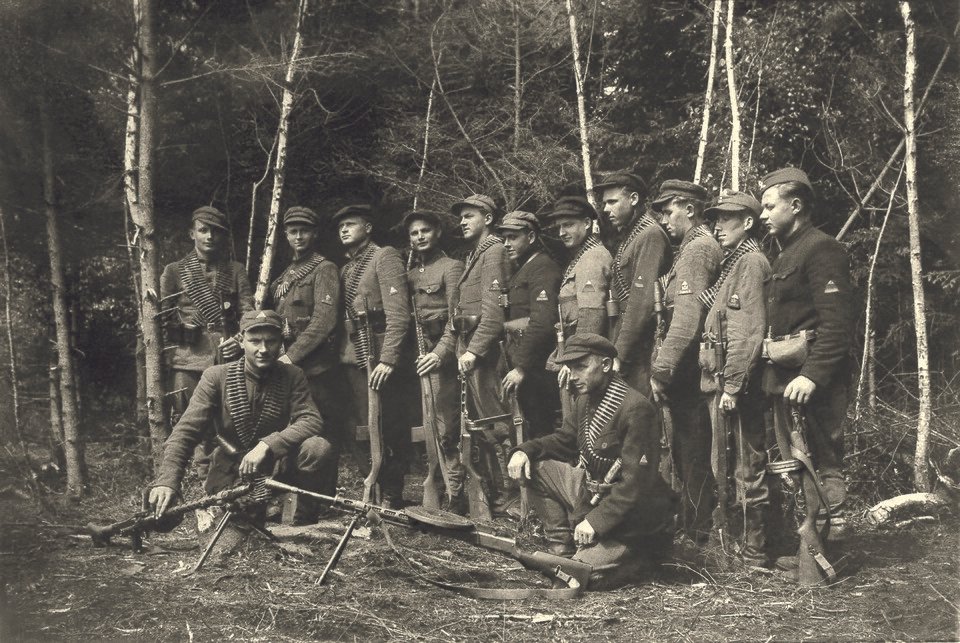
When the Second World War ended in Europe in May 1945, it did not end in the forests of Estonia, Latvia, and Lithuania. For nearly a decade after the German surrender, tens of thousands of Baltic men and women lived and fought in the woods against the Soviet state that had annexed their three countries. They called themselves the Forest Brothers, metsavennad in Estonian, meža brāļi in Latvian, miško broliai in Lithuanian. Their campaign was the largest and longest sustained armed resistance to Soviet power anywhere in the postwar USSR.
The Forest Brothers lost. The Soviet security apparatus broke the movement over roughly ten years and then wrote it out of the official record for two generations. The case still repays study because it is one of the cleanest examples available of a resistance with deep popular roots, real tactical competence, and almost no viable external sponsor, and of how a patient occupying power dismantles exactly that kind of movement. For the Baltic states it is also the founding experience of national defense, the campaign that shaped why they now insist a resistance must be organized before an occupation begins, with its authorities, command, and sponsors arranged while there is still time to arrange them.
The Forest Brothers movement ran from the Soviet reoccupation of the Baltic states in 1944 through the mid-1950s, with isolated holdouts surviving into the 1970s. This article traces how the resistance formed, why Soviet counterinsurgency eventually broke it, and why Baltic total-defense planning still runs through it today.
The occupation that built the resistance
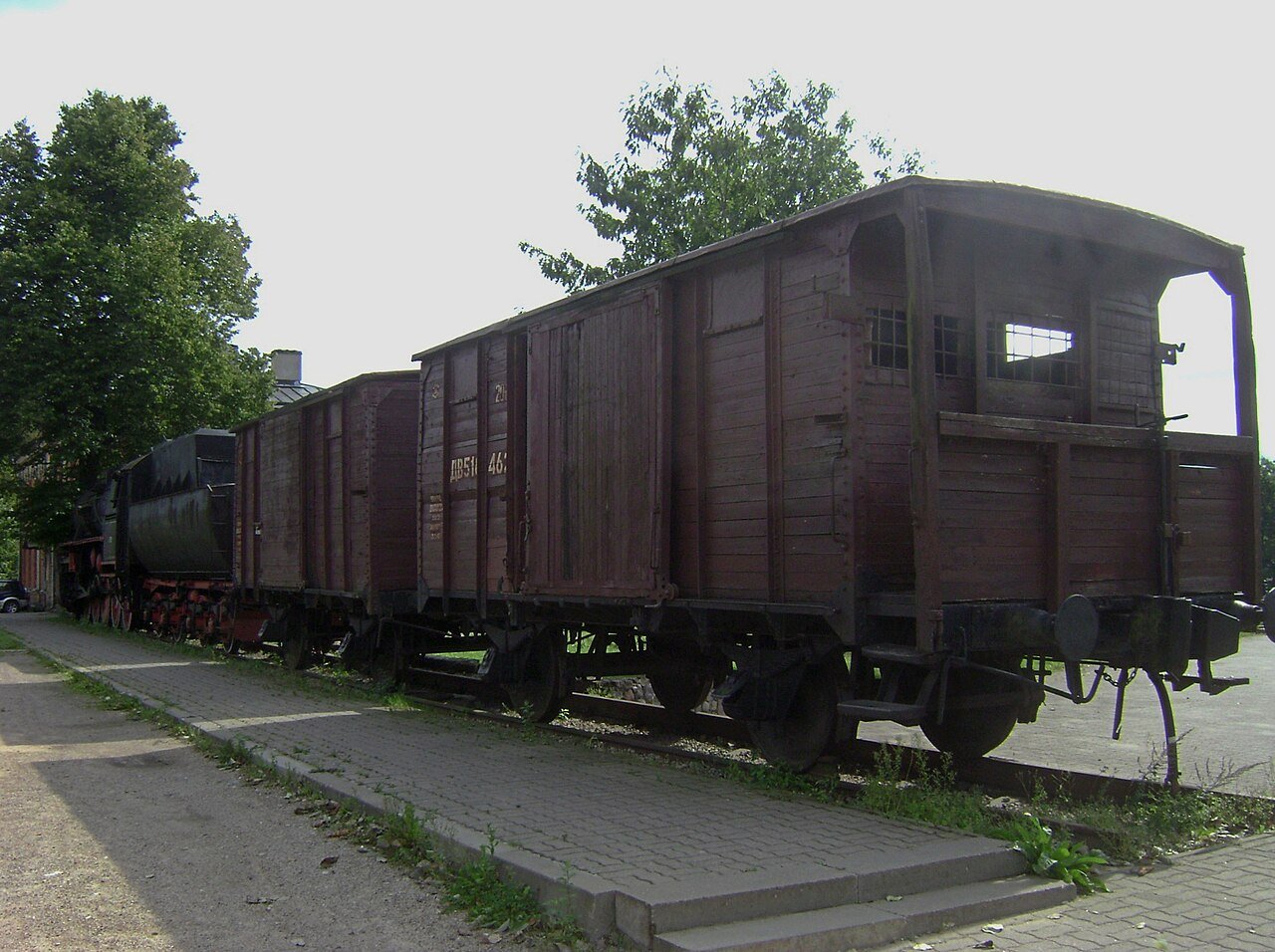
The resistance began with the occupation that produced it. Under the secret protocol of the 1939 Molotov-Ribbentrop Pact, the Soviet Union occupied and annexed Estonia, Latvia, and Lithuania in the summer of 1940. In June 1941, days before the German invasion, the NKVD carried out the first mass deportations, moving tens of thousands of Baltic citizens to Siberia and the Soviet interior in sealed rail cars. That single week converted a generation. When Germany invaded later that month, anti-Soviet risings broke out, most prominently the Lithuanian June Uprising organized by the Lithuanian Activist Front, which briefly declared a provisional government before the German occupation shut it down.
The decisive moment came in 1944, when the Red Army drove the Wehrmacht back out of the Baltics and Soviet rule returned. Men who faced conscription into the Red Army, arrest by the returning NKVD, or deportation of their families had a narrow set of choices. Large numbers chose the forest. The movement that resulted was never a single organization and never had a single plan, but across all three countries it drew on the same fuel: the certainty, learned in 1941, that Soviet rule meant the rail cars.
Three movements
Lithuania produced the largest and most organized resistance. At its height in the mid-1940s it fielded an armed strength in the tens of thousands, with a far larger number of people cycling through its ranks and support networks over the decade. It built military districts, ranks, field courts, and an underground press, and in February 1949 the surviving district commanders unified under Jonas Žemaitis, whose nom de guerre was Vytautas, as the Union of Lithuanian Freedom Fighters. Their declaration of 16 February 1949, dated deliberately to the anniversary of Lithuania’s 1918 independence, claimed the movement as the legitimate political authority of an occupied state rather than merely a band of fighters.
Estonia and Latvia ran smaller and more dispersed versions of the same war, each with many thousands of fighters operating in local groups rather than under a single national command. The tactical pattern was consistent across all three: ambushes of NKVD and locally recruited destruction battalions, attacks on collaborators and collective-farm officials, raids to recover deportation lists and warn families, and the maintenance of a shadow civil order in the countryside that the Soviet administration could not fully penetrate. For several years after 1945, in large parts of rural Lithuania especially, the night belonged to the partisans.
How the Soviets won
The Forest Brothers were not defeated in the field in any conventional sense. They were defeated by a counterinsurgency campaign that understood where the movement’s center of gravity actually sat, which lay with the rural population that fed and hid the fighters. The single most effective Soviet instrument was demographic. In March 1949, Operation Priboi deported roughly 90,000 people from the three republics in a matter of days, targeting precisely the farming families most likely to support the partisans, and forced collectivization followed close behind. A guerrilla depends on a population that can feed, hide, inform, and replace him. Remove that population to Siberia and collectivize the rest onto state farms under surveillance, and the guerrilla starves whether or not he is ever cornered.
The second instrument was penetration. The MGB built dense agent networks inside the resistance, ran staged amnesties that drew fighters out of the forest and then turned them, and operated fake partisan units to compromise real ones. By the early 1950s the intelligence environment had inverted, and it was the occupier who held the advantage in knowing who was who. The leadership was rolled up accordingly. Žemaitis was captured in 1953 and executed in Moscow in 1954; Adolfas Ramanauskas, known as Vanagas, was captured in 1956 and executed in 1957. The lesson that Baltic and allied planners draw from this is the one the ARIS literature returns to repeatedly: the decisive terrain in this kind of war is the population and the intelligence picture, and a counterinsurgent who controls both can defeat a movement he never beats in a firefight. Our analysis of the same dynamic across the wider Soviet periphery is in Effective Counter Unconventional Warfare.
The West that never came
The Forest Brothers fought in the expectation of a war that never happened. The Atlantic Charter and the rhetoric of national self-determination had led many to believe that the Western Allies would not accept the permanent Soviet absorption of the Baltic states, and that a US or British confrontation with Moscow was only a matter of time. It was a reasonable hope in 1945 and a fatal one by 1950. Western intelligence did try to work with the resistance. British SIS ran Operation Jungle from 1948, inserting Baltic agents by fast boat from the West German coast, and American services ran parallel efforts. Almost all of it was compromised. The networks were betrayed, most consequentially by the Soviet penetration of British intelligence associated with Kim Philby, and the MGB captured the agents and ran many of them back as double agents, feeding false reporting to the West for years.
The practical result was that the Forest Brothers received no external support that could change the strategic arithmetic, and the sponsorship that was attempted did more to expose them than to sustain them. This is the hard lesson at the center of the case. Courage, popular legitimacy, and tactical skill are not sufficient. A resistance movement needs a credible external sponsor and a realistic theory of how it reaches victory, and the Forest Brothers had neither. They were left to be ground down in place while the world they were counting on decided it would not come.
Why the Forest Brothers still matter
The movement the Soviets tried to erase has become the historical spine of how the Baltic states think about their own defense. Estonia, Latvia, and Lithuania have built national models of total defense that treat organized resistance as a standing capability rather than an improvisation, and the intellectual content of that approach is a direct answer to the Forest Brothers’ failures. The Resistance Operating Concept developed with US and allied special operations partners institutionalizes the point: a resistance has to be organized before an occupation, with legal authorities, command and communications, caches, and external support arranged in advance, so that a future resistance does not have to be invented in the woods and does not get quietly abandoned.
Estonia’s Defence League, Lithuania’s revived riflemen’s union, published civil-resistance guidance for the population, and NATO’s eastern-flank planning all trace their logic back to the forests. The Forest Brothers are why the Baltic states frame deterrence partly as the promise that occupation would be met by a resistance already built and already sponsored, facing the same adversary their grandparents fought. For the contemporary shape of that adversary’s pressure on the region, see our reporting on how the GRU has weaponized criminal networks for sabotage in Europe.
