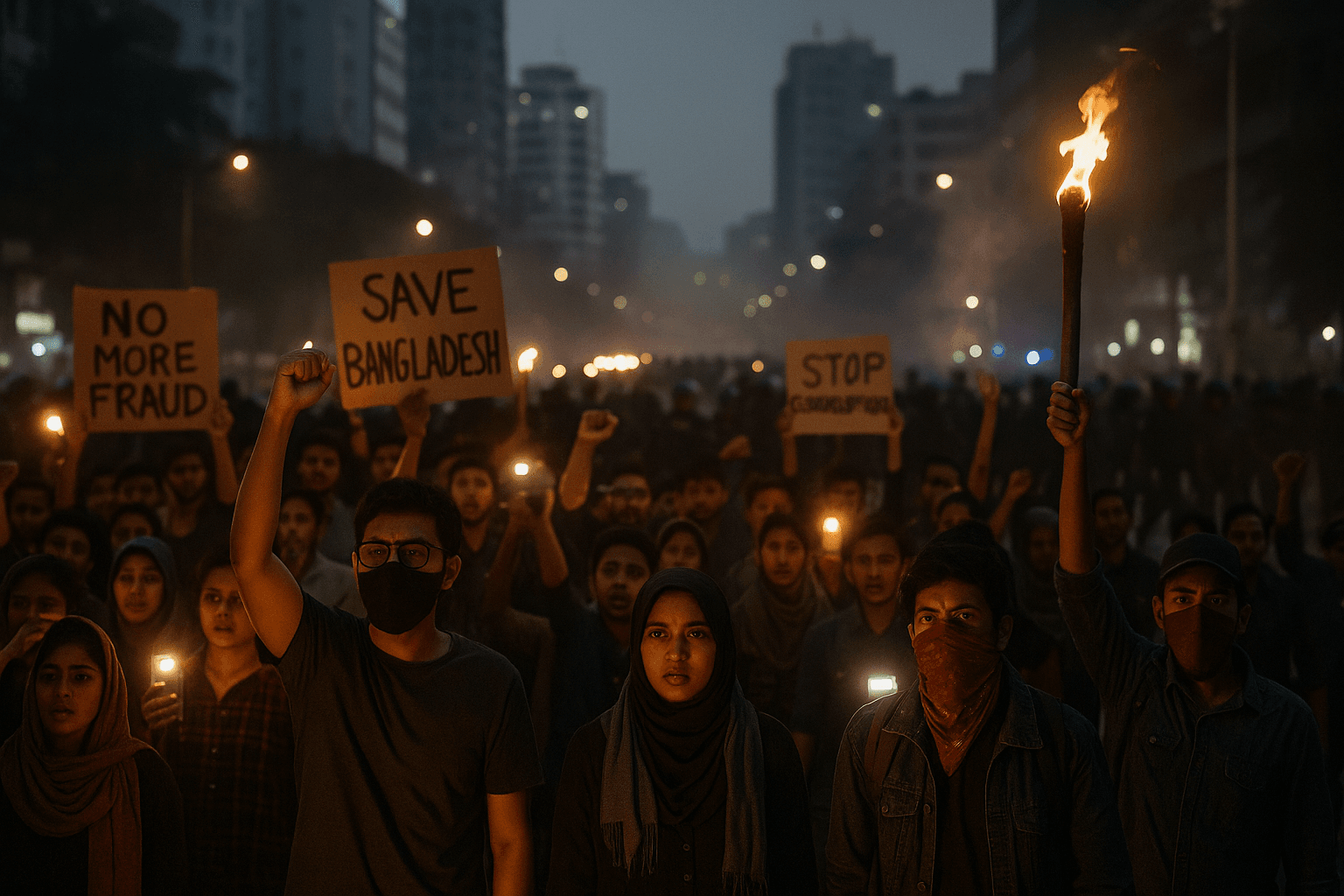
In the summer of 2024, Bangladesh experienced a dramatic political turning point. The July Revolution, a powerful uprising led by Gen Z activists, university students, and young professionals, erupted across the country. This movement was not spontaneous. It was the product of long-standing frustration with corruption, electoral fraud, and increasing political repression.
What set this revolt apart was its leadership. Young Bangladeshis, fluent in digital tools and globally connected, took center stage. Armed with smartphones, encrypted messaging apps, and a growing distrust of the political establishment, they challenged the entrenched elite who had ruled through manipulation and coercion for decades.
Despite facing widespread internet shutdowns, brutal police crackdowns, and targeted arrests, the protests endured. Activists sustained momentum by adapting their strategies, embracing decentralized tactics, and drawing international attention to their cause. Their efforts ultimately toppled a government and forced the most ambitious democratic transition in Bangladesh’s history.
This article examines the roots of the July Revolution, the digital and grassroots strategies that made it effective, and the broader consequences for Bangladesh’s political future.
Since this article was first published, the July Revolution achieved what few movements of its kind have: it toppled the government and launched a democratic transition.
August 5, 2024: Prime Minister Sheikh Hasina resigned and fled to India by helicopter after protesters stormed the Prime Minister’s residence in Dhaka. The 12th Jatiya Sangsad was dissolved. At the request of student leaders from Students Against Discrimination, Nobel laureate Muhammad Yunus was appointed Chief Adviser of an interim government, tasked with restoring democratic institutions and holding free elections.
Reform commissions: The Yunus administration established 11 reform commissions covering the constitution, judiciary, police, elections, and anti-corruption. Their work culminated in the July Charter, a framework of 84 proposals for restructuring Bangladesh’s democratic architecture, endorsed at the time by most major political parties.
Accountability: The International Crimes Tribunal tried former officials for the “July massacre.” In November 2025, Sheikh Hasina was convicted of war crimes and sentenced to death in absentia. The Awami League’s activities were banned under the amended anti-terrorism law in May 2025; the party itself was not dissolved.
February 12, 2026 elections: Bangladesh held its first genuinely contested elections in over a decade. The BNP won a landslide, securing two-thirds of seats. A constitutional referendum on the July Charter was held simultaneously, the largest democratic exercise of the year, with over 127 million eligible voters.
The Charter has since stalled: the February 2026 referendum approved the July Charter with roughly 68% voting yes and authorised parliament to sit as a constituent assembly, but the incoming BNP government has declined to act on it. BNP members refused to take their oaths on the Constitution Reform Council, and in an April 2026 address to parliament Home Minister Salahuddin Ahmed called the July National Charter Implementation Order an illegal order, saying the party had signed the Charter so that elections would not be obstructed. The BNP is pursuing constitutional change through its own 31-point outline instead. As of August 2026 the reform package that the revolution produced has a popular mandate and no government willing to implement it.
Original article follows with structural and editorial updates applied.
Bangladesh’s Political Landscape: A Struggle for Democracy
Bangladesh, home to more than 170 million people, has struggled with political volatility since gaining independence in 1971. Although the country holds regular elections and is classified as a democracy, power has largely remained concentrated in the hands of two dominant parties: the ruling Awami League (AL) and the opposition Bangladesh Nationalist Party (BNP). Both have faced allegations of election tampering, corruption, and authoritarian practices.
Over the last decade, warnings about democratic decline have grown louder. The 2018 general election, heavily criticized by international observers, ended in a sweeping victory for the Awami League. That win came amid widespread claims of ballot stuffing, voter intimidation, and suppression of opposition voices. At the same time, civil liberties eroded. Journalists faced censorship or harassment. Human rights groups reported arbitrary detentions, forced disappearances, and even extrajudicial killings targeting political dissidents. The regime’s methods of consolidating control, meaning co-opting institutions, silencing critics and manipulating information, reflect the broader patterns of state-directed subversion against democratic norms.
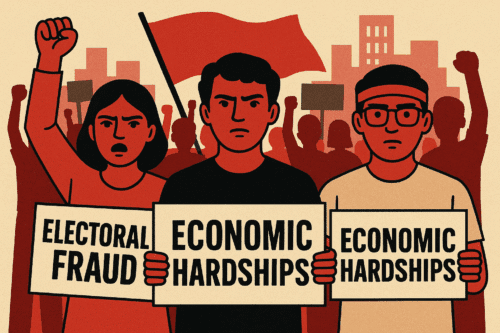
Public trust in the political system continued to erode, especially among young voters. The breaking point arrived in 2024, when reports of widespread electoral fraud during local elections surfaced just as the country’s economic crisis deepened. Soaring inflation, stagnant wages, and rising unemployment pushed frustration to a boiling point. Empowered by social media and frustrated by a lack of alternatives, thousands of young Bangladeshis began organizing digitally to demand meaningful change.
This growing wave of youth activism set the stage for the July Revolution, an eruption not just of anger, but of ambition: a call for a new democratic era free from political manipulation and economic despair.
Historical Context: Youth Activism in Bangladesh
The July Revolution was not an isolated event. It is the latest chapter in Bangladesh’s long history of youth-led resistance, a pattern well documented in social movement theory, where each generation of activists builds on the grievances, networks, and tactical lessons of its predecessors. Students and young activists have repeatedly stepped forward to defend national identity, fight injustice, and demand democratic reforms.
The 1952 Language Movement
Young Bengali students in Dhaka mobilized to demand that Bangla be recognized as the state language of Pakistan. Despite facing violent repression, their efforts succeeded and became a foundational moment in Bangladesh’s national identity. This was the first time youth activism reshaped state policy in the region.
The 1990 Anti-Autocracy Movement
In the face of military rule by General Hussain Muhammad Ershad, university students sparked a nationwide protest wave. Their coordinated demonstrations and mass mobilization forced Ershad to resign, paving the way for a return to electoral democracy.
The 2018 Road Safety Protests
After two students were killed by a reckless bus driver, school and college students launched protests demanding stricter traffic regulations. The movement, marked by its discipline and digital savvy, highlighted the growing political awareness of a new generation.
A Movement of a Different Scale
While earlier youth movements focused on specific demands, whether language rights, regime change or road safety, the July Revolution marked a broader call for systemic change. It was not only about voting rights or transparency. It was about reimagining governance itself: ending corruption, ensuring fair elections, and restoring civic freedoms. Unlike its predecessors, this movement was decentralized, urban, and digital, signaling a new kind of youth resistance fit for the 21st century.
The Spark: Electoral Fraud and Economic Hardships
The July Revolution did not erupt overnight. It was ignited by two powerful, interconnected forces, rigged elections and deepening economic despair, that pushed Bangladesh’s youth beyond a breaking point.
A Crisis of Electoral Legitimacy
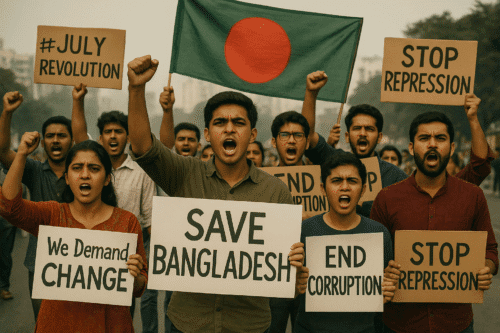
Allegations of widespread voter fraud during the 2024 local elections became the final straw for many young Bangladeshis. Reports circulated on social media of ballot stuffing, intimidation at polling stations, and manipulated voter rolls. In some districts, opposition candidates were allegedly blocked from even filing their paperwork. For a generation that had grown up under promises of reform, these repeated abuses shattered any remaining faith in the electoral process.
Young voters, who now make up over 40% of the electorate, realized that change would not come through traditional means. Their votes had been devalued by a system designed to exclude them. This awareness fueled a growing resolve: if elections could not deliver democracy, direct action would.
An Economy Failing Its Youth
At the same time, Bangladesh was grappling with an economic crisis that hit young professionals and graduates the hardest. Inflation surged, food prices soared, and job creation stalled. Even university-educated youth struggled to find employment that matched their qualifications. Many found themselves underemployed or stuck in informal jobs with little security.
The frustration was not just economic. It was emotional and existential. A generation that had played by the rules and invested in education now faced a future of stagnation and inequality. This sense of betrayal became the emotional fuel behind the protests.
Together, these two factors, electoral fraud and economic exclusion, created the perfect storm. The result was a nationwide movement led by a generation determined not to inherit a broken system.
How the Movement Unfolded
The July Revolution was unlike any previous protest in Bangladesh. It was decentralized, leaderless, and digitally coordinated, making it both agile and resilient. Instead of relying on political parties or formal organizations, the movement harnessed the power of social media, economic disruption, and global advocacy to sustain its momentum.
Social Media as a Mobilization Tool
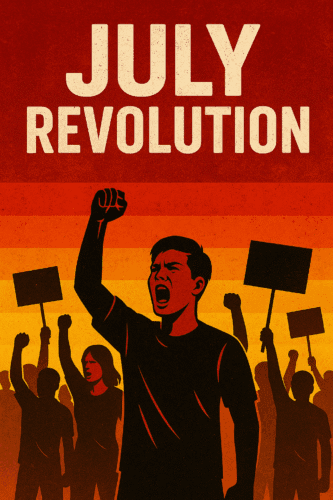
Young activists turned to encrypted platforms like Signal, Telegram, and WhatsApp to plan flash protests and share real-time updates. These tools helped organizers evade surveillance, coordinate actions, and alert participants to police movements. Hashtags such as #JulyRevolution, #SaveBangladesh, and #YouthUprising trended across Twitter and Instagram, attracting support from international journalists and advocacy groups.
Social media didn’t just inform. It inspired. Livestreams, protest footage, and viral infographics brought the movement to life and fueled emotional engagement among those unable to join in person.
Leaderless but United
By deliberately avoiding centralized leadership, the protesters protected themselves against the government’s standard crackdown strategy: arresting key figures. Local student groups, university unions, and neighborhood networks operated independently but aligned around shared principles. This leaderless resistance model, drawing on the same networked organizational logic studied in social network analysis, made the movement harder to infiltrate and dismantle.
Each group chose its tactics: some organized marches, others held teach-ins or community outreach, but all contributed to the broader uprising.
Economic Disruption as Leverage
Protesters understood that pressure required more than marching. It required leverage. University students staged campus sit-ins that shut down schools in Dhaka and other cities. Meanwhile, striking garment workers, vital to Bangladesh’s export economy, halted production and slowed international shipments.
These strategic disruptions sent a clear message: without reform, the country’s youth would bring the system to a standstill.
Advocacy on a Global Stage
The revolution didn’t stop at the country’s borders. Bangladeshi youth in the diaspora took to the streets in front of embassies in London, Washington, and Toronto, demanding global attention. They met with lawmakers, submitted petitions, and worked with human rights NGOs to amplify the message. This international advocacy and influence campaign helped legitimize the movement and put the ruling government on notice: the world was watching.
Government Crackdown and Resistance
The Bangladeshi government responded swiftly and brutally to the growing unrest. Riot police flooded major cities, armed with tear gas, batons, and rubber bullets. Authorities shut down internet access in protest zones, hoping to block coordination between activists. Despite these tactics, the resistance did not fade. Instead, it adapted.
State Repression and Digital Suppression
Security forces arrested thousands of protesters, many of them students and first-time activists. Some were detained without warrants or disappeared into a legal system lacking transparency. Footage of beatings and police violence circulated before the internet blackouts took effect, sparking public outrage both inside and outside the country.
In Dhaka, several universities were placed under surveillance. Protest camps were dismantled overnight. Encrypted communications became essential for survival, as government monitoring of traditional platforms like Facebook and mobile networks intensified. For a practical guide to the tools and practices that helped activists maintain operational security, see TRH’s Digital Security and Privacy resource.
Underground Networks Keep the Flame Alive
Even with leaders in jail and public demonstrations disrupted, organizing continued in secret. Small, cell-like groups met in person or communicated through secure apps. These groups distributed digital flyers via Bluetooth, created mesh networks, and held flash rallies that vanished before police could respond.
Activists outside Bangladesh provided another line of defense. Through coordinated global advocacy campaigns, diaspora communities published open letters, conducted interviews, and lobbied foreign governments to condemn the violence and push for reform.
The Tipping Point: August 5, 2024
Sustained pressure, both domestic and international, ultimately broke the regime’s grip. On August 5, 2024, as protesters stormed the Prime Minister’s residence in Dhaka, Sheikh Hasina resigned and fled to India by helicopter. The 12th Jatiya Sangsad was dissolved. At the request of student leaders, Nobel laureate Muhammad Yunus was appointed Chief Adviser of an interim government tasked with restoring democratic institutions and holding free elections. What had seemed impossible weeks earlier had become reality: a youth-led movement had toppled a 15-year government.
Implications of the Bangladesh July Revolution
The July Revolution has had far-reaching consequences, not only for Bangladesh but for the broader South Asian region. What began as a domestic protest against corruption and rigged elections evolved into a transformative political moment that toppled a government, restructured state institutions, and produced the country’s first credible elections in over a decade.
A Politicized Generation
The movement sparked a dramatic rise in political engagement among young Bangladeshis. Many who had never voted or participated in civic action found their voice through digital campaigns and street-level protests. Voter registration rates among Gen Z soared, particularly in university towns and urban districts. For the first time in years, political discourse moved beyond party loyalists and into classrooms, cafes, and online forums.
This surge in civic awareness signals a generational shift. Young voters now see politics not as a distant process but as something they can shape directly, through action, advocacy, and ultimately, the ballot box.
Fracturing of the Political Status Quo
The Awami League, long dominant in Bangladeshi politics, was banned and barred from the February 2026 elections. The BNP won a commanding majority, but new actors have also emerged. Grassroots reformist movements, the National Citizen Party (formed by former student protest leaders), and issue-based coalitions gained traction during the transition period. While still fragmented, this political diversification reflects a hunger for alternatives and could reshape Bangladesh’s electoral landscape for years to come.
Regional Resonance
The July Revolution has also sent ripples beyond Bangladesh’s borders. Youth-led groups in Myanmar, Sri Lanka, and even Pakistan have cited the uprising as a source of inspiration. In particular, activists in Myanmar facing military rule have drawn parallels with Bangladesh’s decentralized protest model and emphasis on digital organizing.
This cross-border resonance suggests the July Revolution is not just a national milestone. It is part of a wider wave of youth-led democratic activism across South Asia.
Masters of Resistance examines how movements convert street pressure into political power, which is precisely the transition Bangladesh is now struggling to complete.
View on Amazon →Strategic Lessons and the Road Ahead
The July Revolution succeeded in its immediate goal, toppling an authoritarian government. But the harder work of consolidating democratic gains is only beginning. The transition period under Yunus revealed both the promise and the fragility of post-revolutionary governance. Below are four strategic lessons from the movement and the challenges ahead.
1. From Protest to Governance
Several student leaders who organized the July protests transitioned into governance roles, but the shift from protest to policy is never seamless. The movement must now prove it can build institutions, not just challenge them. Supporting reformist candidates, developing policy platforms, and maintaining civic pressure on the new BNP government will be critical tests.
2. Protecting Digital Infrastructure
The internet shutdowns that nearly crippled the movement remain a live threat. Activists must continue investing in encrypted communications, mesh networking, and digital security practices that can survive government disruption. The lesson of July 2024 is that digital infrastructure is as essential to democratic movements as physical assembly.
3. Sustaining International Engagement
Global attention helped protect the movement during its most vulnerable moments. Maintaining ties with human rights organizations, diaspora communities, and foreign media outlets will remain essential, particularly as the new government faces its own accountability tests and the risk of democratic backsliding persists.
4. Bridging the Urban-Rural Divide
The July Revolution was strongest in cities and university towns. To become a truly national democratic force, its participants must extend organizing beyond Dhaka. Rural populations, factory workers, farmers, and low-income communities bore the brunt of bad governance for years. Their inclusion is vital for legitimacy, scale, and the long-term health of Bangladesh’s democracy.
Conclusion
The July Revolution permanently altered Bangladesh’s political landscape. It proved that a determined, digitally connected generation could not only shake the foundations of entrenched power. It could bring them down. In a country long dominated by political dynasties and manufactured elections, the youth stood up, the government fell, and a democratic transition followed.
The February 2026 elections, Bangladesh’s first genuinely contested polls in over a decade, represent the movement’s most tangible achievement. But elections alone do not guarantee democracy. That test is already being failed on one count. The July Charter carried the February 2026 referendum, but the BNP government has refused to implement it and is drafting constitutional change from its own 31-point programme instead. What remains open is whether the institutions built during the transition hold, and whether the generation that fought for change stays engaged long enough to force the reforms through.
One thing is certain: Bangladesh’s youth are no longer bystanders. They are no longer waiting for permission. They toppled a government, shaped a transition, and voted in a new era. What they build next will determine whether July 2024 is remembered as a revolution or as the beginning of one.
Sources
The International Republican Institute’s pre-election assessment mission (October 2025) provides a detailed evaluation of Bangladesh’s electoral preparations, reform commissions, and the July Charter framework. Al Jazeera’s assessment of the Yunus administration examines the tensions between reform ambitions and political realities during the 18-month transition period. Amnesty International documented the scale of state violence during the July 2024 crackdown, putting the death toll above 1,400 and verifying video evidence of unlawful lethal and less-lethal force used against largely peaceful protesters. Amnesty has also criticised the International Crimes Tribunal proceedings that followed for falling short of fair trial standards.
Student-Led Protests in Serbia: A Case Study in Resistance Mobilization →
Resistance Mobilization: Building Networked Movements →
Understanding Human Networks: Social Network Analysis →
