Through 2026 JNIM intensified its campaign in Mali, including a fuel blockade that squeezed Bamako and a wave of attacks in April 2026, per Chatham House and the Institute for the Study of War, escalating the threat described below.
In January 2026, fighters affiliated with the Islamic State Sahel Province (ISSP) struck the international airport in Niamey, Niger’s capital, marking the group’s first major attack on a hardened target near a Sahelian seat of government. Weeks later, Russia’s Defense Minister Yunus-bek Yevkurov arrived in Niamey to discuss expanding Africa Corps operations, the latest chapter in Moscow’s deepening military entanglement across the region. These two events capture the trajectory of Sahel irregular warfare in 2026: jihadi insurgencies growing bolder and more capable while the geopolitical contest between Russia and Western powers reshapes the security architecture of an entire continent.
The Sahel has become the world’s most active laboratory for hybrid warfare. Military coups, jihadi expansion, great-power proxy competition, mercenary deployment, resource extraction, and civilian displacement converge in a single theater. Understanding what is happening across Mali, Burkina Faso, Niger, and their neighbors requires the analytical frameworks of irregular warfare rather than conventional strategic studies, because nearly every actor in the region operates below the threshold of declared conflict.
The Sahel Crisis in Context
Between 2020 and 2023, military juntas seized power in Mali, Burkina Faso, and Niger, each citing the failure of civilian governments to contain jihadi insurgencies as justification. All three nations subsequently expelled French military forces and formed the Alliance of Sahel States (AES) under the Liptako-Gourma Charter on September 16, 2023, upgrading it to a confederation on July 6, 2024. Their withdrawal from the Economic Community of West African States (ECOWAS) took effect on January 29, 2025. Each has turned to Russia for security assistance, replacing French counterterrorism operations with mercenary deployments from the Wagner Group and its successor, the state-controlled Africa Corps.
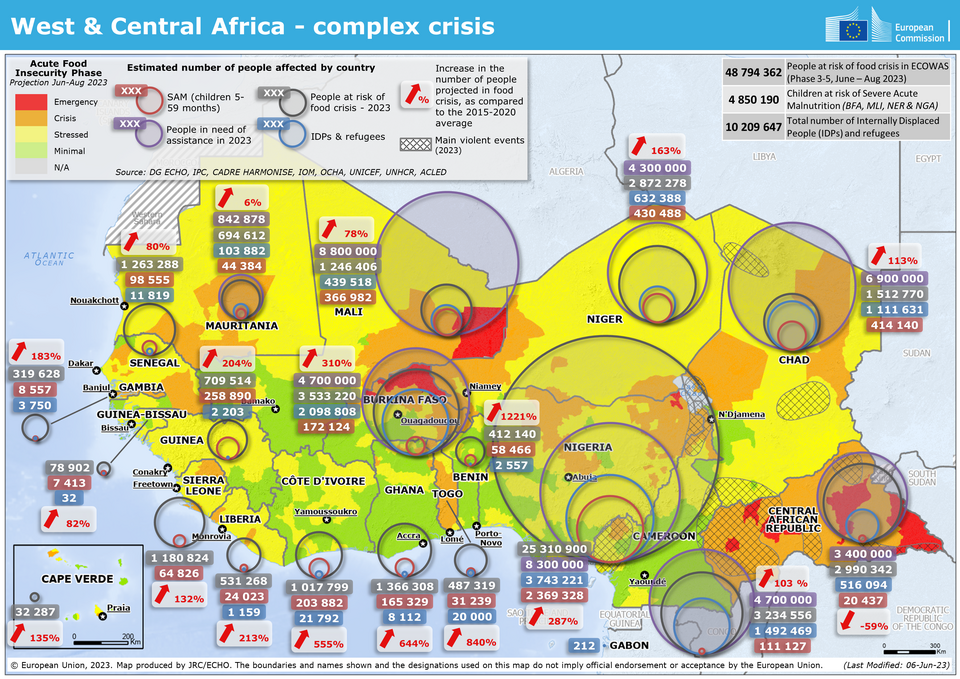
The scale of violence in the region is staggering. The Armed Conflict Location and Event Data Project (ACLED) has tracked a sustained escalation in both the frequency and lethality of attacks across all three AES states. The jihadi groups driving this violence, primarily Jama’at Nusrat al-Islam wal-Muslimin (JNIM, an al-Qaeda affiliate) and ISSP, have expanded their operational reach from rural areas into urban centers and are increasingly pressing south into the coastal states of Togo, Benin, and Ghana.
The Actors: A Fragmented Battlespace
Jihadi Insurgencies
JNIM and ISSP are the two dominant non-state armed groups in the Sahel, though they compete as much as they cooperate. JNIM, formed in 2017 as a merger of several al-Qaeda-linked factions, operates through a top-down command structure with regional and local commanders. Its strategy combines guerrilla raids on military outposts, the strategic use of mass-casualty attacks to destabilize regimes, and parallel governance structures in areas under its control. The group’s operational tempo has accelerated sharply: in 2024, JNIM and allied Tuareg rebels inflicted a major defeat on Wagner Group and Malian Army forces at Tinzaouaten, killing at least 46 mercenaries and 24 Malian soldiers in a single engagement.
JNIM’s most consequential campaign since then has been economic rather than kinetic. On September 3, 2025 the group declared a fuel blockade of Bamako and began systematically burning tanker convoys on the import corridors from Senegal and Cote d’Ivoire, which together carry roughly 95 percent of Mali’s fuel. More than 300 tankers have been destroyed. The blockade forced state fuel rationing, cut night-time power generation in the capital, closed schools and universities for two weeks from late October 2025, and prompted the United States and United Kingdom to tell their nationals to leave. Bamako pump prices rose roughly fivefold. The junta responded with escorted convoys backed by Russian and Turkish support, moving more than 1,000 tankers since late October 2025, but an attack on one convoy near the Senegalese border in February 2026 killed at least 15 people. The blockade was still in force as of June 2026.
The significance is doctrinal. JNIM has placed a capital city of nearly three million people under siege conditions without attempting to fight for it, using interdiction of a single commodity to degrade governance, services, and public confidence at once. That is a resource-denial campaign of the kind normally associated with state actors, executed by an insurgency that still cannot hold Bamako, and it is the clearest evidence in the region that these groups now think in terms of strategic effect rather than local control.
ISSP, loyal to the broader Islamic State network, operates primarily along the Mali-Niger border and has extended its reach into northwestern Nigeria through collaboration with local militant groups including the Lakurawa movement. ISSP’s January 2026 airport attack in Niamey signaled a new level of ambition: the willingness and capability to strike the most protected infrastructure in a national capital. The Critical Threats Project at the American Enterprise Institute has tracked how both groups are now deploying commercial drones for surveillance and targeted strikes, a technological escalation that mirrors developments in the Ukraine conflict.
Russia and the Africa Corps
Russia’s military presence in the Sahel has undergone a rebranding but not a fundamental transformation. The Wagner Group, which deployed roughly 2,000 fighters across Mali, Burkina Faso, and Niger, was formally reorganized under the Africa Corps following Yevgeny Prigozhin’s death in 2023. The Africa Corps falls under the Russian Ministry of Defense rather than private management, but analysts at the Combating Terrorism Center at West Point note that personnel, operational patterns, and human rights abuses have remained largely continuous. Russia has used Libya’s port at Tobruk to transport over 6,000 metric tons of weapons and materiel into the region.
The core function of Russian forces in the Sahel appears to be regime security rather than counterinsurgency. The Africa Corps has demonstrated limited effectiveness against JNIM and ISSP; Mali and Niger’s capitals have both come under direct threat since Russian forces arrived. Instead, Russian deployments serve to coup-proof the ruling juntas, provide intelligence and surveillance capabilities, and secure access to extractive resources including gold mines in Mali and Burkina Faso and uranium deposits in Niger. A February 2026 investigation by a consortium including Forbidden Stories revealed that Russia’s SVR foreign intelligence service has assumed control of Wagner’s influence operations across Africa, running disinformation campaigns and placing agents in strategic positions.
Sahel Security Landscape, 2024-2026
The Western Vacuum and Its Consequences
France’s Operation Barkhane, which at its peak deployed roughly 5,100 troops across the Sahel, was formally terminated in November 2022 after Mali forced the French contingent out. Separate bilateral drawdowns followed between 2023 and early 2025, ending French basing in Niger, Chad, Senegal, and Cote d’Ivoire. The United States, which had invested heavily in Niger’s Air Base 201 for drone surveillance and counterterrorism strikes, lost access after Niger’s junta revoked the military cooperation agreement in 2024. The United Nations peacekeeping mission in Mali (MINUSMA) withdrew in 2023 at the junta’s insistence.
The departure of Western and multilateral forces has produced a security vacuum that neither the AES militaries nor their Russian partners have been able to fill. Human Rights Watch documented that in the months preceding Wagner’s formal withdrawal from Mali, announced in June 2025, joint Wagner-FAMa operations were linked to deliberate killings of at least 32 civilians. Violence against civilians increased by roughly 280 percent after Wagner’s deployment in late 2021, according to data compiled by the Africa Center for Strategic Studies. The experience underscores a lesson visible in other theaters where Russian paramilitary forces have deployed: mercenary operations optimized for regime security tend to exacerbate rather than resolve underlying insurgencies.
The Sahel Irregular Warfare Dimension
What makes the Sahel crisis particularly relevant to the study of irregular warfare is the convergence of multiple IW modalities in a single theater. Each major actor is employing gray-zone tactics that blur the boundaries between war and peace, crime and statecraft.
Russia’s approach combines mercenary deployments, information warfare, resource extraction, and intelligence penetration into a package that analysts have termed a “regime survival model.” The SVR’s assumption of Wagner’s influence operations, documented through leaked internal files analyzed by the Dossier Center and Forbidden Stories, reveals a sophisticated infrastructure of disinformation campaigns, agent placement, and media manipulation operating across more than a dozen African countries. This approach mirrors the Russian hybrid warfare model observed in Europe, adapted for an African operational environment.
The jihadi groups, for their part, are evolving beyond classical guerrilla warfare. JNIM and ISSP are both deploying modified commercial drones for surveillance and strikes, a capability that was rare among non-state actors in Africa even two years ago. Both groups maintain parallel governance structures in controlled territory, providing basic services and dispute resolution that the absent state cannot. This governance function, a hallmark of successful insurgencies from Mao’s revolution to the Taliban, gives these groups social legitimacy that military operations alone cannot dislodge. Masters of Resistance from The Distillery Press examines how legitimacy and governance shape insurgent longevity.
Spillover and Regional Contagion
The instability in the central Sahel is no longer contained. JNIM has expanded operations into Benin and Togo, where it has established a growing presence in northern border regions. Arms trafficking corridors between the Sahel and Nigeria are strengthening, and militant groups are experimenting with complex raid tactics that resemble Sahelian playbooks. ECOWAS has announced plans to mobilize an initial 2,000-soldier standby force by the end of 2026, but the effort faces enormous challenges: funding shortfalls, political fragmentation caused by the AES departure, and the lack of unified intelligence and command structures.
Ghana has pursued a diplomatic track, with Foreign Minister Samuel Ablakwa signing seven bilateral security agreements with Burkina Faso in February 2026 aimed at cross-border cooperation and counter-narcotics coordination. But these efforts have not bridged the deeper regional divides. The AES states view ECOWAS with suspicion, and the coastal states face their own internal political pressures as terrorism-related violence creeps southward. The pattern of instability spreading from ungoverned spaces into previously stable states has been documented across multiple regions, from West African pipeline warfare to the Guinea-Bissau coup attempt.
Implications and Outlook
The Sahel in 2026 presents a worst-case convergence of irregular warfare dynamics: state fragility compounded by great-power competition, effective insurgencies expanding against weakening governments, and civilian populations trapped between collapsing infrastructure and multiple armed actors. Russia’s presence, far from stabilizing the region, has added another layer of complexity, as the Africa Corps prioritizes junta security over population-centric counterinsurgency.
For the international community, the Sahel is also a warning about what happens when counterinsurgency partnerships fail and alternative security providers move in. The French experience with Operation Barkhane, once the largest European military deployment since the Cold War, ended not because France lost on the battlefield but because anti-French sentiment, amplified by Russian information operations, made the political cost of staying untenable. Understanding how that sentiment was cultivated and exploited is essential to avoiding similar outcomes elsewhere.
The Guerrilla Tactical Triad, published by The Distillery Press, provides the doctrinal framework for analyzing the raid-ambush-reconnaissance cycle that JNIM and ISSP employ across this theater. The OSS: Combined & Remastered offers historical context for understanding how irregular warfare doctrine has been applied, and misapplied, across decades of African conflicts. The Sahel’s trajectory will remain one of the defining irregular warfare challenges of this decade.
