
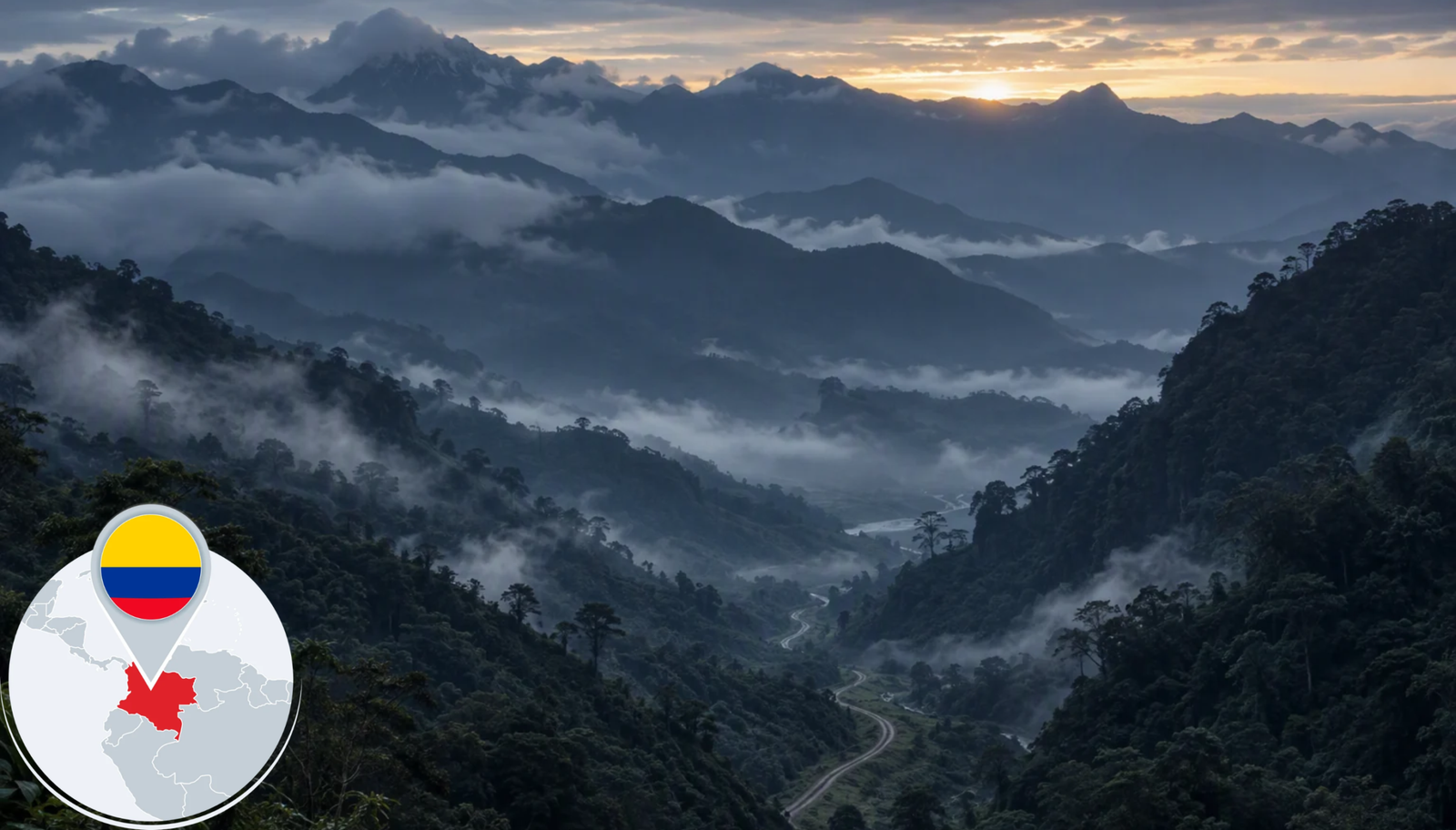
The Colombian conflict has the unfortunate distinction of being one of the longest-running civil wars in the modern world. Its conventional starting date is 1964, when government forces moved against a small communist self-defense enclave at Marquetalia in the Tolima mountains and the survivors regrouped under Manuel Marulanda, adopting the name Fuerzas Armadas Revolucionarias de Colombia in 1966. The deeper origin runs back at least to 1948 and the assassination of the Liberal presidential candidate Jorge Eliécer Gaitán, the catalyst for La Violencia, the partisan civil war that killed somewhere between 180,000 and 300,000 Colombians by the mid-1960s.
The ARIS case study Colombia 1964-2009, published by US Army Special Operations Command and authored at the Johns Hopkins University Applied Physics Laboratory, examines the conflict through the four armed actors that have defined it: the FARC, the National Liberation Army (ELN), the April 19 Movement (M-19), and the right-wing paramilitary umbrella the Autodefensas Unidas de Colombia (AUC). The full PDF lives on the ARIS resource page; this article distills its core arguments and carries the story forward to October 2026.
Part of The Resistance Hub’s ongoing walkthrough of the ARIS case studies (Assessing Revolutionary and Insurgent Strategies), published by US Army Special Operations Command with the Johns Hopkins University Applied Physics Laboratory. The full set is collected on the ARIS resource page linked in the further reading below.
The setting: La Violencia and the National Front
Colombia’s Liberal and Conservative parties were founded in 1848 and 1849, nearly two decades after Simón Bolívar’s Gran Colombia dissolved in 1831. The case study takes care to emphasize that nineteenth-century Colombian partisanship looked nothing like contemporary American political parties. Affiliation was a social identity, often inherited, that overlapped with religious, regional, and class divisions. The system rested on patronage: the party that controlled the presidency controlled appointments down to municipal level. Every presidential transition was therefore also a redistribution of patronage, and those redistributions produced violence.
The 1948 Gaitán assassination triggered the Bogotazo riots and the rural civil war that followed. La Violencia killed somewhere between 180,000 and 300,000 Colombians between 1948 and the mid-1960s and produced two structures that would shape everything that came next. The first was the armed self-defense group, formed by peasants in regions where neither the state nor the dominant party could protect them; the FARC, the ELN, and the right-wing paramilitaries are all institutional descendants of these groups. The second was the National Front, the 1958 power-sharing pact that ended La Violencia by alternating the presidency between Liberals and Conservatives for sixteen years and excluding minority parties from the legislature. The pact bought peace between the two factions of the elite and locked everyone else, particularly the rural poor and the political left, out of the system.
By 1964, when government forces moved against the Marquetalia enclave, the conditions the case study identifies as the proximate causes of the FARC and the ELN were all in place: rural insecurity, political exclusion, an absent state, profound land inequality, and a Cuban Revolution five years in the past that demonstrated what could be done with a few dozen committed cadres in the right terrain. For the wider analytical framework on how exclusionary political settlements generate insurgent mobilization, see TRH on resistance mobilization.
Four armed actors
The case study’s structural contribution is its decision to treat the conflict as a four-party problem. The more common framing reduces Colombia to the government against the FARC. Each of the four groups had a distinct ideology, recruiting pool, operational signature, and trajectory.
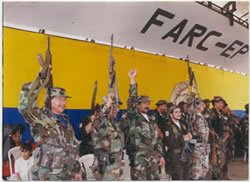
The FARC-EP emerged from the Marquetalia survivors in 1964 and operated initially as the rural armed wing of the Colombian Communist Party. It built its base among the rural poor, gradually professionalized its command structure across multiple “Guerrilla Conferences,” and by the 1990s had matured into the largest insurgent force in Latin America. Its 1982 Seventh Conference produced the “Strategic Plan for Taking Power” and added Ejército del Pueblo, “People’s Army,” to its name, signaling the transition from defensive guerrilla force to revolutionary army with national ambitions. The FARC was the first of the leftist groups to enter the cocaine trade, initially as a tax on coca farmers in its zones, eventually as a more direct participant. By the late 1990s it controlled territory across substantial portions of southern Colombia.
The FARC also tested the political route, and the result shaped every negotiation that followed. The 1984 La Uribe accords with the Betancur government produced a ceasefire and, in 1985, the Unión Patriótica (UP), a legal party built from FARC and Communist Party cadres. The UP won seats in Congress and on municipal councils within a year. It was then destroyed. Two of its presidential candidates, Jaime Pardo Leal in 1987 and Bernardo Jaramillo Ossa in 1990, were assassinated, and the Special Jurisdiction for Peace has since documented 5,733 UP members murdered or forcibly disappeared between 1984 and 2018 by paramilitaries, drug traffickers, and state agents. In January 2023 the Inter-American Court of Human Rights held the Colombian state responsible for what it called a systematic plan of extermination, carried out with the participation of state agents. For the FARC leadership, the UP settled the question of whether disarmed participation in politics was survivable.
The ELN was founded in 1964 by Cuban-trained students who took the town of Simacota in early 1965 in their first armed action. Its identity was always more ideological than the FARC’s, blending Marxism with the liberation theology of Catholic priests like Camilo Torres, who joined the group and was killed in a firefight in 1966. The ELN reoriented in the late 1970s, after its membership collapsed to roughly thirty cadres, around the strategy of seizing resource-rich regions to fund operations and provide leverage. Oil pipeline attacks became its operational signature; the October 1998 attack on the pipeline at Machuca killed more than seventy villagers, many of them children, when the resulting oil spill caught fire, an event that punctured the ELN’s claim to political legitimacy among the rural communities it claimed to represent.
The M-19 was the political and operational outlier among the leftist groups. Founded in 1970 in response to what its members alleged was the fraudulent denial of electoral victory to the populist National Popular Alliance, M-19 was urban, educated, theatrical, and explicit that its aim was democratic and structural reform of the existing system. The 1974 theft of Simón Bolívar’s sword from a Bogotá museum produced one of the most effective propaganda actions in the comparative literature. The 1980 occupation of the Dominican Republic embassy held more than a dozen ambassadors hostage for sixty-one days. The November 1985 occupation of the Palace of Justice ended catastrophically: Colombian army units retook the building, roughly a hundred people died including eleven Supreme Court justices, and the group paid heavily in public standing. M-19 still negotiated its way out of the war. It signed a peace agreement in March 1990; its commander, Carlos Pizarro, was assassinated as a presidential candidate seven weeks later; and in December 1990 its successor party, the Alianza Democrática M-19, won nearly a million votes and 19 of the 70 seats in the Constituent Assembly that wrote the 1991 constitution. It is the only one of the four groups in the case study that achieved its core political objectives. Three decades later a former M-19 militant, Gustavo Petro, was elected president.
The AUC was the right-wing paramilitary umbrella formed in 1997 by combining smaller groups like the Castaño brothers’ ACCU and similar formations. Its stated purpose was to combat the FARC and ELN where the state could not or would not. Its actual operations were more ambitious. The AUC ran civilian massacres against suspected guerrilla supporters, displaced populations from land in cocaine-producing regions and resource-extraction zones, and collaborated with elements of the Colombian military and police. More than 30,000 people passed through its eventual demobilization, a figure analysts consider inflated by non-combatants presented as fighters. The case study is direct about state collusion: available evidence points to systematic cooperation between paramilitaries, the military, and the police in operations against leftist guerrillas, including in the displacement of civilian populations.
Cocaine and the funding problem
The financialization of the conflict is one of the most distinctive features of the Colombian case and one of the case study’s most useful contributions to the comparative literature on insurgent financing. Through the 1970s and into the early 1980s, the FARC and the ELN funded operations through traditional insurgent channels: kidnapping for ransom, extortion of landowners and businesses in their zones of operation, and external sponsorship including from Cuba and the Soviet bloc. Drug revenue began as a tax on coca producers in FARC zones in the late 1980s and grew rapidly through the 1990s as the Medellín and Cali cartels weakened and the production side of the cocaine economy decentralized into the zones the guerrillas already controlled.
By the late 1990s, the FARC was operating laboratories, transport routes, and processing facilities directly. The ELN entered the trade more reluctantly and on a smaller scale. The AUC, financially, was a cocaine enterprise with a counterinsurgent ideology grafted on top: paramilitary groups in the Magdalena Medio, the Caribbean coast, and the Pacific coast taxed and operated cocaine economies and used the revenue to field forces against the leftist groups. The criminalization of all four armed actors in different ways had two consequences the case study emphasizes. First, it made the conflict harder to end, because the armed groups had standing economic interests in continued instability. Second, it eroded the political legitimacy of all the armed actors among the rural populations they claimed to represent or protect. Cocaine money does not generate the kind of ideological commitment that won wars in earlier insurgencies. For the wider treatment of how illicit markets shape armed political movements, see TRH on the market forces of war.
Loading podcast player…
Plan Colombia and the Uribe campaign
The hard turn of the 2000s grew out of a failed negotiation. In November 1998 President Andrés Pastrana ceded the FARC a demilitarized zone of roughly 42,000 square kilometers around San Vicente del Caguán as the venue for peace talks. The FARC used the zone to rest, recruit, hold hostages, and expand coca processing while the talks stalled. Pastrana ended the process in February 2002 after the FARC hijacked a domestic flight and kidnapped Senator Jorge Gechem Turbay; days later the FARC kidnapped presidential candidate Íngrid Betancourt. The collapse of the Caguán talks discredited negotiation with the FARC for a decade and handed the campaign that followed its political mandate.
Plan Colombia, the US-funded counterinsurgency assistance package, began in 2000 under Pastrana with $1.3 billion appropriated by the US Congress and grew over the following decade into one of the largest sustained American security cooperation programs in Latin American history. The plan combined coca eradication, military professionalization, judicial reform, and human-rights-conditioned assistance, and it transformed the operational capacity of the Colombian armed forces. The case study notes that by the mid-2000s, Colombian Special Forces and the National Police were running effective intelligence-led operations against FARC leadership for the first time.
Álvaro Uribe, who took office in August 2002 while FARC mortar rounds fell around the presidential palace during his inauguration, ran the most aggressive counterinsurgency campaign of the conflict. His Democratic Security Policy and Plan Patriota deployed more than 18,000 troops into the FARC heartland in southern Colombia. The strategy combined sustained military pressure with high-value-target operations against FARC senior commanders. In 2008 alone the FARC lost Secretariat member Raúl Reyes in a cross-border raid into Ecuador, its founder Manuel Marulanda to a heart attack, and its most valuable hostages, Betancourt among them, to the Operation Jaque deception rescue. The case study’s analysis of the campaign is balanced. It acknowledges the operational gains: FARC strength fell from a peak of roughly 17,000 fighters in 2001 to around 8,000 by 2009, and the group lost most of its uncontested rural sanctuaries. It also documents the costs, including the “false positives” scandal in which Colombian Army units killed civilians and presented their bodies as guerrillas killed in combat to inflate body counts and qualify for performance incentives. The Prosecutor General’s office identified roughly 3,000 civilian victims of the practice; the Special Jurisdiction for Peace later put the figure at 6,402 for 2002 to 2008 alone.
The AUC demobilization between 2003 and 2006 was a parallel track of the same broader campaign. Roughly 31,000 paramilitary combatants demobilized under the Justice and Peace framework. The case study notes the limits: many demobilized AUC fighters reformed almost immediately into successor criminal organizations, the so-called bandas criminales or BACRIM, that retained the cocaine economies the AUC had run but shed the ideological framing. For the broader pattern of state-paramilitary collusion as a counterinsurgent instrument, see our overview of major counterinsurgency thinkers, several of whom anticipate this dynamic explicitly.
What the case study could not yet see: the 2016 Havana accord and after
The ARIS case study’s narrative ends with FARC negotiations underway in Havana under the Santos administration that took office in 2010. By the time the case study was finalized, the talks had produced an initial accord on land reform but had not yet concluded. The final agreement was signed in November 2016, weeks after voters narrowly rejected an earlier version in an October plebiscite; Santos received the Nobel Peace Prize the same year. The agreement covered land reform, political participation, illicit drugs, victims’ rights, and disarmament, and it created a transitional justice system built around the Special Jurisdiction for Peace (JEP) and a Truth Commission. The FARC handed nearly 9,000 weapons to a UN mission in 2017 and re-formed as a legal political party, later renamed Comunes, with ten congressional seats guaranteed for two terms.
The transitional justice track produced the first full accounting of the war. The Truth Commission’s 2022 final report estimated 450,664 people killed between 1985 and 2018, more than 121,000 forcibly disappeared, more than 50,000 kidnapped, and more than 7.7 million displaced. In September 2025 the JEP issued its first sentences: eight years of restorative sanctions, including demining and searching for the disappeared, for seven members of the former FARC Secretariat, among them top commander Rodrigo Londoño, for kidnapping as a war crime; and five to eight years for twelve former officers of the army’s La Popa Battalion for false positive killings.
The political track fared worse. More than 500 former combatants who signed the agreement had been killed by August 2026. With its guaranteed seats expiring, Comunes contested the March 2026 legislative elections in coalition with Fuerza Ciudadana, fell short of the three percent threshold, and won no Senate seats. In October 2026 the National Electoral Council formally stripped the party of its legal status. The FARC’s transition into electoral politics, the outcome the 2016 agreement was built to deliver, ended in under a decade.
The armed landscape reconstituted around the agreement. FARC dissidents who rejected the deal formed the Estado Mayor Central, which split in 2024 between a faction under Iván Mordisco that stayed at war and a bloc under alias Calarcá that kept negotiating. Iván Márquez, the FARC’s chief negotiator in Havana, returned to arms in 2019 at the head of the Segunda Marquetalia; prosecutors have since sought his arrest over the assassination of senator and presidential hopeful Miguel Uribe Turbay, shot at a Bogotá campaign event in June 2025 and dead two months later. The ELN never demobilized. In January 2025 it launched an offensive against FARC dissidents in Catatumbo that killed dozens, displaced more than 50,000 people, and led the government to suspend talks with the group. The largest successor to the AUC, the Clan del Golfo, now calls itself the Ejército Gaitanista de Colombia, borrowing the name of the man whose 1948 assassination started La Violencia. The Fundación Ideas para la Paz estimated combined membership across Colombia’s armed groups at more than 27,000 at the start of 2026, up nearly a quarter in a single year.
Total peace and its reversal, 2022 to 2026
Gustavo Petro, the first leftist president in modern Colombian history, took office in August 2022 promising “total peace”: simultaneous negotiations with the ELN, the FARC dissident factions, the Clan del Golfo, and urban criminal structures. The talks produced ceasefires, partial agreements, and some local surrenders, and none reached a final settlement. Relations with Washington deteriorated in parallel. The United States decertified Colombia’s counternarcotics cooperation in September 2025, and the UN’s 2024 survey recorded a record 261,000 hectares of coca under cultivation.
Two events in 2026 reset the conflict. On 3 January, US forces struck Venezuela and captured Nicolás Maduro, removing the government that had tolerated ELN and FARC dissident sanctuaries along the 2,219-kilometer border. On 21 June, Abelardo de la Espriella, a right-wing lawyer endorsed by Donald Trump, defeated Senator Iván Cepeda, the Pacto Histórico candidate pledged to continue Petro’s policies, in a runoff decided by roughly one percentage point. Cepeda is the son of Manuel Cepeda Vargas, the Unión Patriótica senator assassinated in 1994, a measure of how long the conflict’s memory runs.
De la Espriella took office on 7 August 2026, declared dialogue with armed groups exhausted, and ended the total peace processes. His government has pledged a return to aerial eradication, a US-backed military campaign supported by a proposed $1 billion US security package, and a surrender bill, introduced in October 2026, that offers sentence reductions of up to half in exchange for disarmament, asset forfeiture, and cooperation. A military strike in El Tambo, Cauca, has since killed at least ten ELN members, including two senior commanders of the group’s southwestern front, which the president called the ELN’s worst setback in eight years. Washington kept Colombia decertified in September 2026 while signaling confidence in the new government. Colombia has now run the full cycle the case study describes, from negotiation to collapse to military pressure to negotiation, and in 2026 it turned back toward military pressure.
The structural arguments the ARIS authors made hold up well a decade later. The conflict’s underlying drivers, particularly land inequality, weak state presence in the periphery, and the cocaine economy, were never fully addressed. The 2016 deal closed the FARC chapter without closing the conflict. Insurgencies end in one of three ways: the insurgents win, the state wins, or the two settle into stalemate. In Colombia the political conditions that produced the original insurgencies have outlasted each partial ending.
Why this case still matters
Three observations from the Colombian case continue to shape contemporary debate about counterinsurgency. The first is that the multi-actor conflict is the normal pattern. The standard government-versus-insurgency model assumed by much of the early counterinsurgency literature does not describe Colombia and does not describe most contemporary cases. Multiple armed actors with distinct ideologies operating in overlapping geographies under varying degrees of state collusion is the more typical pattern. For comparative material, see state and insurgent strategic competition for governance.
The second is that the financialization of the conflict matters more than the ideological framing in determining whether a settlement is durable. The M-19 demobilized successfully in 1990 because its leadership had not built a standing economic interest in continued conflict. The FARC’s 2016 demobilization required a vastly more complicated agreement on illicit drugs, land restitution, and rural development because by 2016 the FARC’s economic base was inseparable from the conflict it had been waging, and the dissident factions that kept that economic base kept fighting. The ELN remains at war in 2026 partly because its position in the oil-pipeline regions and along the Venezuelan border generates revenue that funds continued conflict regardless of political content. Whether the fall of Maduro erodes that border sanctuary is the open question of the next several years; for the Venezuelan side of the equation, see TRH on the Venezuela contingency operation and irregular warfare risk.
The third is the durability of the underlying political grievances. The 1991 constitution that M-19 helped draft did genuinely democratize the system that had been frozen by the National Front. Thirty-five years on, however, rural Colombians are roughly three and a half times as likely as urban Colombians to live in multidimensional poverty, according to 2025 government figures; the land question remains unresolved despite the 2011 Victims and Land Restitution Law; and the structural conditions that produced the original insurgencies persist in the regions where the new armed actors now operate. The implication is one the ARIS authors are direct about: counterinsurgency that does not address the political conditions that produced the insurgency rarely produces durable peace, and Colombia is one of the clearest illustrations available. For an adjacent treatment of how the same dynamic plays in other contexts, see TRH on the Karen National Union case study.
Further reading
Related Articles on The Resistance Hub
- ARIS · Assessing Revolutionary and Insurgent Strategies (resource hub)
- The Most Influential Thinkers in Counterinsurgency Theory
- Che Guevara and the Foco Theory
- State and Insurgent Strategic Competition for Governance
- Venezuela Contingency Operation: Resistance Potential and Irregular Warfare Risk
- Karen National Union (KNU) Case Study
Recommended Reading
- The Guerrilla Tactical Triad: Distillery Press treatment of the operational logic that integrates ideology, organization, and irregular tactics.
- Masters of Resistance: The Distillery Press anthology of foundational thinkers behind modern unconventional warfare and resistance doctrine.
- OSS: Combined & Remastered: The canonical OSS field manuals on simple sabotage, intelligence, and underground organization, distilled and annotated.
The full ARIS study, Case Studies in Insurgency and Revolutionary Warfare: Colombia (1964-2009) (USASOC), is available on the ARIS resource page alongside the rest of the case study collection.
