

This case study applies the War Marketplace Framework (WMF) across three analytical levels — competition, structure, and strategy — to one of the world’s longest-running insurgencies: the conflict between the Karen National Union (KNU) and the Myanmar state. Rather than treating the Karen war as an ethnic rebellion, a counterinsurgency campaign, or a peripheral civil conflict, this study interprets it as a sustained contest over governance under conditions of institutional breakdown.
Moe Gyo is a writer and consultant working with ethnic organizations in Myanmar. Writing from the Thai–Myanmar borderlands, he draws on years of direct engagement with communities shaped by conflict and disrupted health systems. His work captures firsthand how resilience and informal support networks develop under prolonged irregular warfare. His writing has appeared in the Small Wars Journal and the Journal of Special Operations Medicine, among others.
Part I conceptualizes the KNU as a governance competitor. It examines how the organization entered degraded institutional space after independence, constructed parallel administrative systems, and retained market share by supplying security, justice, public goods, and legitimacy more credibly than the incumbent state in many Karen-populated areas. The KNU’s durability is shown to rest not on military parity with the Tatmadaw, but on its ability to substitute for state authority.
Part II shifts from actors to structure. Applying the Porter’s Five Forces framework, it explains why the Karen conflict repeatedly regenerated, fragmented, stabilized, and re-escalated. Low entry barriers in peripheral regions, cross-border supplier autonomy, fluctuating civilian bargaining power, dense substitute institutions, and shifting rivalry conditions created a competitive environment that favored endurance over resolution. What appeared as tactical oscillation was, in structural terms, predictable equilibrium behavior.
Part III examines strategy as an effort to reshape these structural forces. Both the Myanmar state and the KNU attempted to manipulate entry barriers, civilian leverage, supplier networks, substitutes, and rivalry. Neither achieved a full monopoly. The state prevented insurgent consolidation through fragmentation but failed to restore its own governance dominance. The KNU preserved survival through institutional continuity but could not eliminate substitutes or internal competition permanently.
Across seven decades, including the post-2021 coup environment, the KNU case demonstrates the WMF’s central proposition: wars persist when governance markets remain contestable. Authority endures where compliance is institutionalized. Violence matters, but only insofar as it reshapes governance competition.
This case study therefore presents the Karen conflict not as an anomaly but as a clear illustration of how insurgency functions when understood as structured, strategic competition for authority.
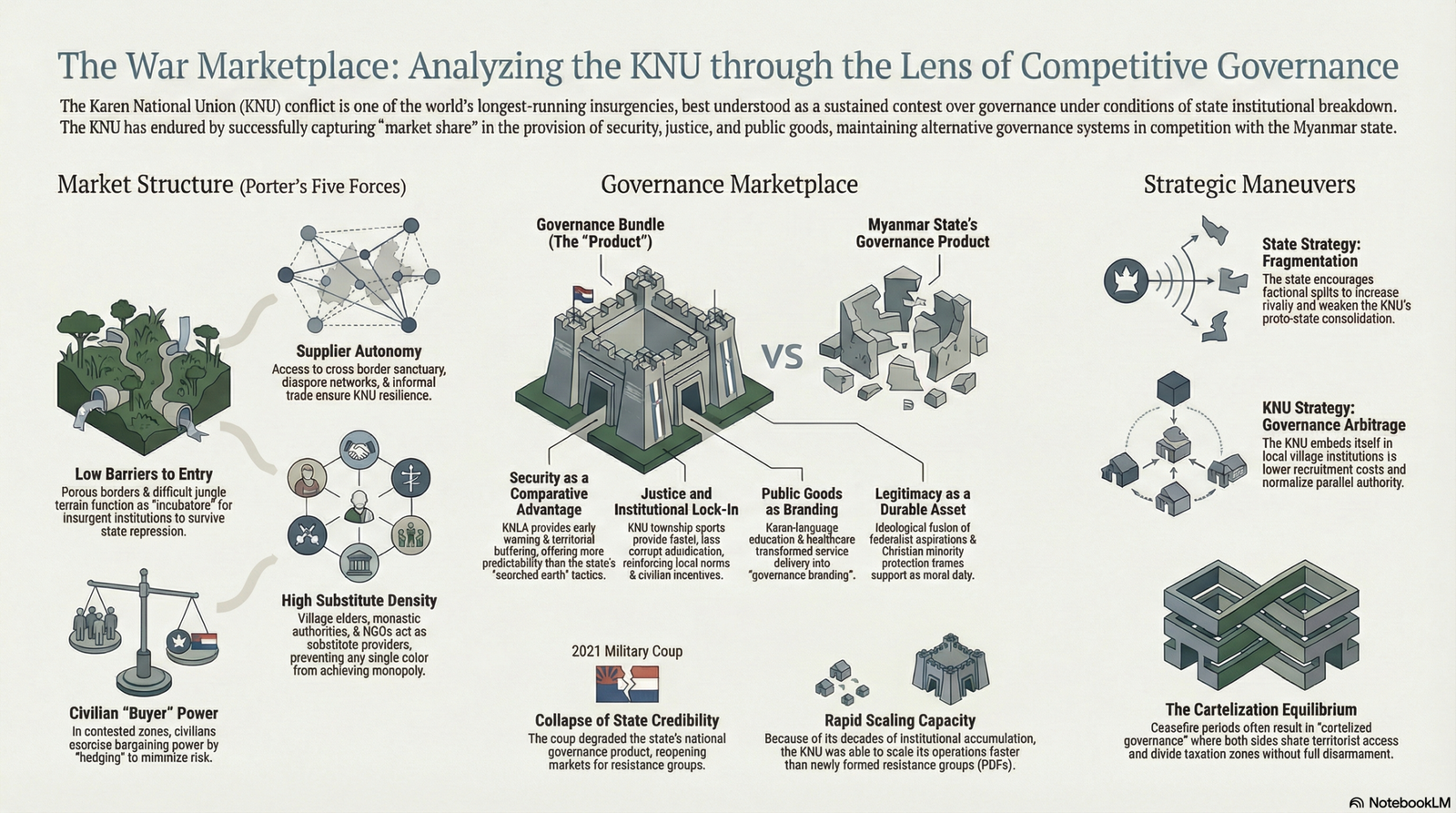 Click to enlarge
Two developments postdate this analysis. ISP-Myanmar now assesses KNU and KNLA control at roughly 61 percent of Karen State, with influence reaching into parts of Tanintharyi and Bago Regions, a stronger territorial position than Section IX describes. Separately, the junta ran a phased general election from December 2025 into early 2026 and declared a USDP victory, giving the regime a nominally civilian claim to legitimacy that the market analysis below does not yet weigh.
War Marketplace Framework
I. Market Entry: Insurgency as Governance Substitution
The Karen conflict in southeastern Myanmar offers a paradigmatic illustration of insurgency as competitive governance provision under conditions of institutional exclusion and repression. Founded in 1947, the Karen National Union (KNU) did not merely mobilize armed resistance against the central state; it constructed a parallel governance system that sought to substitute for the authority of successive Burmese regimes.
Following independence in 1948, the postcolonial state, dominated by Burman elites, failed to accommodate Karen demands for autonomy within a federal framework. As civil war erupted in 1949, the KNU transitioned from political advocacy to insurgent governance. Over time, it developed an institutional ecosystem including taxation, courts, education systems, health services, and local administration across substantial swathes of Karen-inhabited territory.
Within the War Marketplace Framework (WMF), the KNU’s endurance is best explained not by battlefield parity with the Tatmadaw (Myanmar’s armed forces), but by its ability to secure governance market share among Karen populations over decades. This pattern of resistance mobilization — anchored in institutional provision rather than ideology alone — distinguishes the KNU from many shorter-lived insurgent movements.
II. Governance as a Composite Product
The KNU’s competitive position rested on its provision of the four governance components identified in the WMF:
Security
The KNU’s armed wing, the Karen National Liberation Army (KNLA), provided localized protection against state incursions, forced labor, village destruction, and predatory taxation — particularly during the high-intensity counterinsurgency campaigns of the 1970s–1990s.
Even when unable to defeat state forces conventionally, the KNLA offered early warning networks, territorial buffering in jungle and border areas, and community-level defense coordination. For many Karen villagers, KNU-administered zones offered greater predictability than Tatmadaw-controlled areas characterized by forced relocation and scorched-earth tactics. In WMF terms, the KNU did not need to provide absolute security — only comparatively superior and more predictable security.
Justice
The KNU established formalized legal structures, including township courts and village-level dispute resolution bodies. These institutions adjudicated land disputes, family law issues, commercial disagreements, and criminal conduct. Justice was faster and often perceived as less corrupt than state mechanisms. The Tatmadaw’s presence frequently blurred coercion and adjudication, undermining rule credibility. By contrast, KNU justice institutions reinforced local norms and Karen customary law, strengthening identity-based legitimacy.
Justice provision anchored compliance. Civilians who relied on KNU courts had incentives to pay taxes and avoid collaboration with the state, reinforcing governance lock-in.
Public Goods
Despite limited resources, the KNU invested in schools teaching Karen language and history, basic healthcare clinics, agricultural coordination, and cross-border humanitarian access via Thailand. Education was particularly strategic. By institutionalizing Karen-language instruction and nationalist narratives, the KNU transformed schooling into both a service and a branding mechanism. Governance provision became inseparable from identity reproduction.
The Myanmar state’s historical underinvestment in peripheral ethnic areas created a governance vacuum. The KNU did not need to outperform the state nationally — only within Karen-majority regions.
Legitimacy
Legitimacy was the KNU’s most durable asset. It fused ethno-national identity, narratives of historical betrayal, Christian minority protection (in many Karen communities), and federalist political aspirations. This ideological branding lowered compliance costs. Supporting the KNU was framed not merely as instrumental survival but as moral duty and communal solidarity.
Under the WMF, this represents high-differentiation governance branding: legitimacy compensated for resource scarcity and military inferiority. The role of influence — both as a tool of persuasion and a mechanism of institutional embedding — was central to the KNU’s capacity to sustain compliance across generations.
III. Civilians as Constrained Consumers
Karen civilians operated under intense coercion from both sides. They paid taxes to the KNU, provided recruits and porters, shared intelligence, and sometimes dual-complied with the state. Compliance was often hedged. In mixed-control zones, villagers engaged in strategic ambiguity, cooperating with whichever actor was present while attempting to minimize exposure.
Market share fluctuated with Tatmadaw offensives, ceasefire arrangements, cross-border sanctuary access, and fragmentation within Karen factions. The WMF highlights that civilian behavior was not fixed loyalty but risk-managed allocation of compliance under uncertainty. This dynamic mirrors patterns observed in resistance movements in occupied territories worldwide, where civilian populations navigate between competing authorities under threat.
IV. The State as Fragmented Incumbent
The Myanmar state, particularly under military rule, functioned less as a coherent monopoly and more as a predatory conglomerate. Tatmadaw units operated with high autonomy, often engaging in forced labor, land confiscation, extrajudicial violence, and resource extraction. Such practices degraded the state’s governance product. Even when militarily dominant, the state undercut its own market position by reducing governance quality below that offered by the KNU.
Principal–agent failures were central. Central authorities sought territorial control; local commanders often prioritized extraction. Civilians evaluated the state based on local behavior, not national claims. Understanding this fragmentation requires attention to the dynamics of politicized militaries and their vulnerability to irregular warfare.
V. Violence as Price and Signal
Both sides used violence strategically. The Tatmadaw employed scorched-earth campaigns — a form of systematic sabotage directed at civilian infrastructure — to raise the cost of KNU support. The KNLA conducted targeted assassinations and ambushes to signal enforcement capacity. Under the WMF, Tatmadaw violence frequently collapsed governance credibility. Indiscriminate tactics increased civilian churn toward KNU-controlled or cross-border areas. By contrast, when KNLA violence was disciplined and targeted, it reinforced authority; when factional infighting emerged, compliance eroded.
VI. Fragmentation and Competitive Saturation
The KNU’s dominance was not uncontested. Splits such as the formation of the Democratic Karen Buddhist Army (DKBA) in 1994 illustrate internal market competition. The DKBA, aligned with the Tatmadaw, captured segments of the Karen population by reframing legitimacy along Buddhist rather than Christian-nationalist lines. This demonstrates a key WMF insight: insurgent organizations themselves are subject to competitive entry when governance bundles fail to satisfy sub-constituencies.
Factional fragmentation reduced the KNU’s governance monopoly and enabled state penetration into former strongholds, including the fall of Manerplaw in 1995. The dynamics of subversion — both by the state against the KNU and by the KNU against state-aligned militias — shaped the rhythm of fragmentation and reconsolidation across decades.
VII. Ceasefires and Cartelization
Ceasefire periods, particularly after 2012, illustrate negotiated coexistence as a market equilibrium. The KNU retained influence in certain administrative domains while the state expanded infrastructure and formal political inclusion mechanisms. Rather than decisive monopoly restoration, a form of cartelized governance emerged: shared territorial access, divided taxation zones, parallel judicial authority, and political negotiation without full disarmament.
Under the WMF, such arrangements represent competitive saturation. Neither actor could eliminate the other’s governance supply without prohibitive cost.
VIII. Why the KNU Endured
The KNU survived more than seven decades of conflict despite overwhelming asymmetry in firepower. The WMF explains this endurance through localized comparative governance superiority, strong identity-based legitimacy, cross-border sanctuary and revenue channels, adaptive decentralization, and state self-undermining predation.
The Tatmadaw could seize territory, but it struggled to monopolize governance demand in Karen areas. Without eliminating the KNU’s institutional ecosystem, military gains proved reversible. This pattern echoes Mao Zedong’s protracted warfare logic: insurgent survival through institutional depth, not conventional parity.
IX. Post-2021 Coup: Market Reopening
Following the 2021 military coup in Myanmar, governance competition intensified nationwide. The KNU expanded operations and reasserted territorial control in parts of Karen State. The coup degraded the state’s national governance credibility, reopening governance markets not only in Karen areas but across the country. The KNU’s long-standing institutional infrastructure provided rapid scaling capacity compared to newly formed resistance groups.
This reinforces a core WMF claim: governance institutions built during insurgency create durable competitive advantages when central authority collapses. International observers, including the International Crisis Group and the UN Human Rights Council’s Fact-Finding Mission on Myanmar, have documented how post-coup institutional collapse accelerated the reassertion of ethnic armed organization governance across Myanmar’s periphery.
X. Strategic Implications
For the State: Military offensives without institutional reform consistently failed to collapse KNU governance supply. Development initiatives not anchored by credible protection mechanisms invited hedging behavior. Fragmentation management was more effective than direct annihilation attempts — a lesson explored extensively in counterinsurgency theory.
For the KNU: Legitimacy and justice provision were more decisive than battlefield victories. Over-fragmentation reduced governance credibility. Institutional continuity mattered more than territorial maximalism.
Conclusion: War Marketplace Framework
The Karen National Union exemplifies insurgency as competitive governance rather than episodic rebellion. Its endurance demonstrates that wars persist when challengers successfully enter and sustain alternative governance markets. The conflict in Karen State was never solely about territorial control or military attrition. It was a prolonged contest over who could protect communities, adjudicate disputes, structure economic life, and define legitimate authority.
Within the War Marketplace Framework, the KNU did not survive because it defeated the Myanmar state militarily. It survived because it consistently retained enough governance market share to prevent monopoly restoration. The decisive terrain was institutional. The decisive weapon was governance.
Porter’s Five Forces: Structure of the War Marketplace
The Karen conflict provides a longitudinal illustration of how the Porter’s Five Forces structure insurgent competition over governance. The KNU’s endurance since 1949 cannot be explained solely by battlefield adaptation or ideological cohesion. It reflects a competitive environment that repeatedly favored insurgent governance in Karen-populated borderlands.
Force 1: Threat of New Entrants
From independence onward, the Myanmar state struggled to consolidate authority in peripheral ethnic regions. In Karen areas, security provision was inconsistent and often predatory, justice systems were distant or culturally alien, ethnic exclusion weakened legitimacy, and terrain combined with cross-border access to Thailand to reduce state penetration.
These conditions sharply lowered barriers to insurgent entry. The KNU did not create demand for alternative authority; it entered a governance vacuum shaped by institutional neglect and coercive overreach. Border geography was decisive — jungle terrain and porous borders functioned as incubators, allowing early-stage insurgent institutions to survive repression and experiment with parallel governance.
Structural Effect: The low effectiveness of state governance reduced entry barriers and made insurgent emergence highly probable. Even when the Tatmadaw achieved temporary territorial gains, underlying entry conditions remained permissive, enabling regeneration.
Force 2: Bargaining Power of Buyers (Civilians)
Civilian bargaining power varied dramatically across Karen areas. In contested or border zones, villagers could hedge between KNU and state authorities, exit was possible via migration into Thailand, and information asymmetries limited both sides’ surveillance capacity. Under these conditions, the KNU invested in courts, education, taxation regularization, and administrative discipline. Governance became institutionalized because civilians possessed some ability to withdraw compliance.
In heavily militarized zones, Tatmadaw collective punishment reduced switching capacity, forced relocation restricted exit, and surveillance networks increased retaliation risk. In these areas, governance shifted toward coercive extraction by all actors.
Structural Effect: Where civilian bargaining power was higher, the KNU developed stronger institutional governance. Where it collapsed, both insurgent and state behavior became more extractive.
Force 3: Bargaining Power of Suppliers
The KNU’s durability depended heavily on supplier structures: cross-border sanctuary in Thailand, informal taxation of border trade, timber and natural resource revenues, diaspora networks, and independent recruitment pipelines. These supplier networks reduced the KNU’s exclusive dependence on civilian taxation. Unlike insurgencies reliant solely on local extraction, the KNU maintained diversified inputs.
High supplier power generated organizational resilience despite battlefield losses, reduced vulnerability to counterinsurgency attrition, and capacity to survive strategic setbacks — including the 1995 fall of Manerplaw. However, supplier autonomy also reduced internal accountability and contributed to factional tensions, including the 1994 split that produced the DKBA.
Structural Effect: Autonomous supplier networks were central to insurgent endurance — a primary determinant of durability and resistance to military defeat.
Force 4: Threat of Substitute Governance Providers
The KNU did not compete solely with the state. Substitute providers included Karen Buddhist monastic authorities, village elders and customary law systems, local militias aligned with the Tatmadaw (DKBA, KNU/KNLA Peace Council, Karen Border Guard Force), and humanitarian NGOs operating cross-border.
High substitute density diluted the KNU’s monopoly aspirations. In areas where traditional or religious authorities retained credibility, insurgent governance layered over, rather than replaced, existing structures. NGOs also acted as partial substitutes by delivering health and education services independent of both the state and insurgents.
Structural Effect: Substitute governance providers limited consolidation and encouraged patchwork sovereignty — reducing insurgent appeal while increasing fragmentation of authority.
Force 5: Rivalry Among Existing Competitors
Rivalry levels shifted across decades. Prior to 1994, the KNU functioned as the primary Karen insurgent authority. Hierarchical discipline enabled institutional development and governance investment. After the DKBA split, competition for territory and taxation zones intensified, tactical alliances between splinter groups and the Tatmadaw emerged, and violence increased while governance coherence declined.
Structural Effect: Increased rivalry degraded governance capacity and reinforced fragmentation. Lower rivalry enabled institutionalization and durability.
Structural Configuration and Recurring Equilibria
// Five Forces Structural Analysis
Karen Conflict: Structural Forces Across Three Phases
How Porter’s Five Forces shifted across seven decades of governance competition in southeastern Myanmar.
KNU Cohesion
Fragmentation
Coup & Reopening
Across decades, the Karen conflict exhibited recurring structural patterns. Low entry barriers combined with strong supplier networks produced protracted insurgency. Moderate civilian bargaining power with low rivalry yielded institutionalization. High rivalry with high substitute density drove fragmentation. Ceasefire periods reflected structural saturation — cartelized governance where neither side could monopolize supply.
The 2021 coup degraded state legitimacy nationwide and reopened governance markets. For the KNU, decades of institutional accumulation provided structural advantage relative to newly formed groups. The coup did not create insurgency in Karen areas; it reactivated a competitive structure long embedded in the governance marketplace.
Conclusion: Porter’s Five Forces Structure
The conflict between the KNU and the Myanmar state illustrates the central claim: competitive outcomes are structured. Military offensives failed when entry barriers remained low. Governance reforms faltered when rivalry and substitute density diluted authority. Fragmentation emerged when supplier and legitimacy networks rebalanced. A durable monopoly never emerged because structural conditions consistently prevented it.
The Karen insurgency endures not because of tactical brilliance or ideological rigidity alone, but because the war marketplace in southeastern Myanmar has repeatedly favored challengers over monopolists. Understanding this structure clarifies why decades of counterinsurgency produced oscillation rather than resolution — and why any durable settlement must alter the Five Forces environment rather than merely suppress its most visible competitors.
Masters of Resistance collects Mao, T.E. Lawrence and Che Guevara in one volume, the protracted-war doctrine that shaped the KNU’s decision to build governance instead of chasing decisive battle.
View on Amazon →Strategy and Structure in the War Marketplace
The Karen conflict offers a multi-decade illustration of how both state and insurgent actors attempt to reshape Porter’s Five Forces of the war marketplace. The interaction between the KNU and successive Myanmar regimes reveals not simply tactical oscillation but repeated efforts by both sides to manipulate entry barriers, civilian bargaining power, supplier networks, substitute authorities, and rivalry.
State Strategy Against the KNU
Successive Myanmar governments — parliamentary, socialist, and military — entered the conflict as incumbents seeking to restore monopoly authority over Karen areas.
Raising Barriers to Entry: Repression Without Governance
The Tatmadaw attempted to raise insurgent entry costs through large-scale counterinsurgency campaigns, village relocation and “Four Cuts” strategies, collective punishment, and surveillance expansion. These measures increased the immediate risk of insurgent participation. However, they did not improve governance provision. Structurally, this produced a paradox: short-term repression increased startup risk, but long-term governance deficits lowered entry barriers. Because coercion was not paired with credible, protected institutions, repression often regenerated insurgent demand.
Managing Civilian Bargaining Power: Collapse Through Coercion
In heavily militarized Karen zones, the state drastically reduced civilian bargaining power through informant networks, restricted mobility, forced labor, and collective punishment. This produced compliance without loyalty. During ceasefire periods, particularly post-2012, the state shifted to infrastructure investment, limited political participation, and negotiated autonomy discussions. This temporarily increased civilian bargaining power and reduced insurgent exclusivity — but the reforms were not anchored by consistent institutional protection, limiting structural transformation.
Disrupting Supplier Power: Partial Success, Structural Limits
The state targeted KNU supplier networks by pressuring Thailand to limit sanctuary, seizing territorial strongholds (including Manerplaw in 1995), and targeting administrative cadres. The fall of Manerplaw demonstrated that supplier disruption can materially degrade insurgent capacity. Yet the KNU retained cross-border mobility, informal trade taxation, and diaspora support. Supplier disruption was incomplete — as long as cross-border inputs remained available, the KNU avoided total civilian dependence.
Managing Substitute Governance: The Delegation Strategy
The most structurally effective state move was fostering insurgent fragmentation. The 1994 split that produced the DKBA illustrates this strategy. By tolerating or tacitly supporting DKBA operations, rivalry increased, KNU monopoly claims weakened, and governance coherence declined. This was fragmentation as strategy — rather than defeating the KNU outright, the state reshaped rivalry conditions to prevent consolidation. However, the state prevented an insurgent monopoly but did not restore its own.
Insurgent Strategy: The KNU’s Structural Manipulation
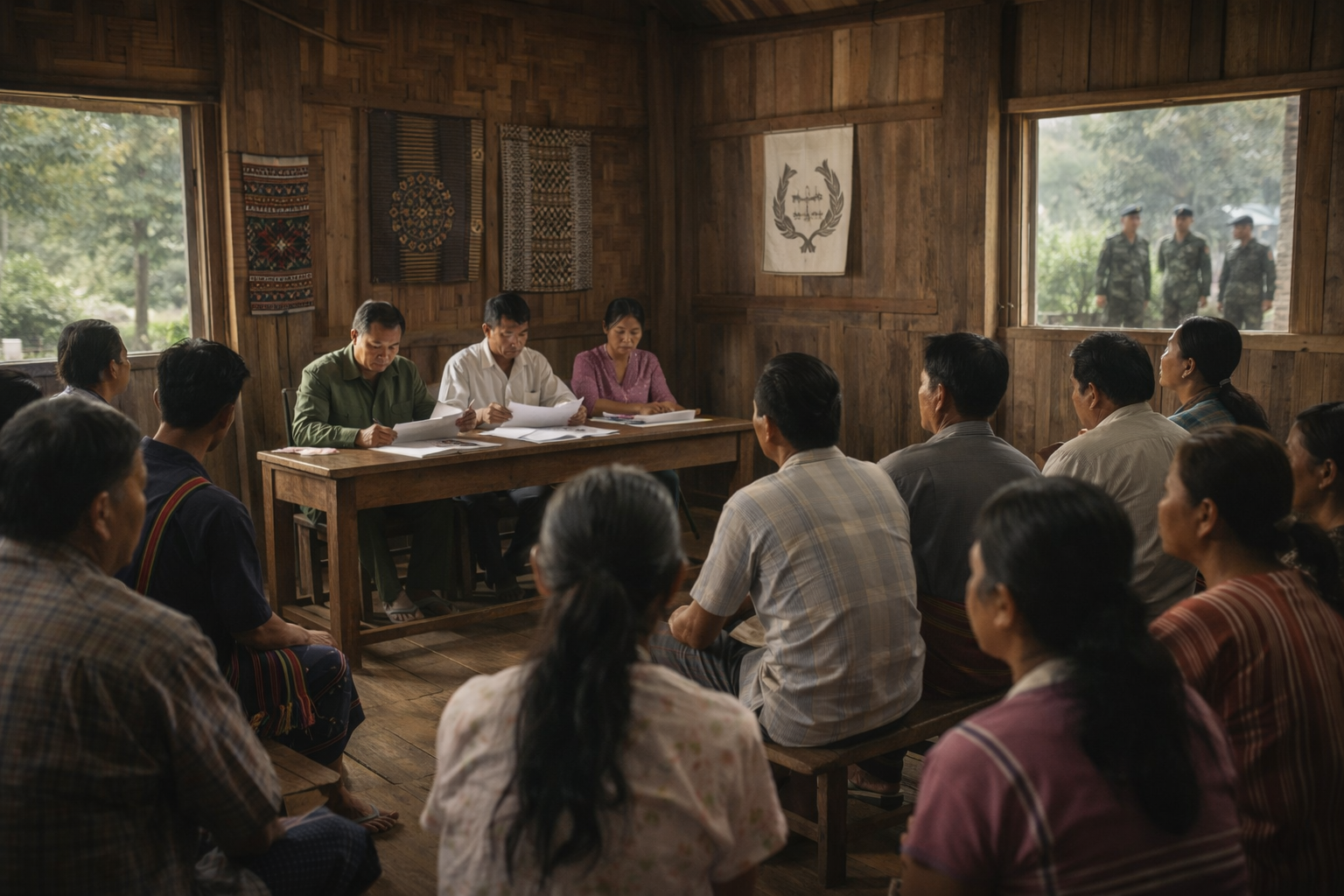
The KNU’s strategic behavior evolved across phases: entry, consolidation, fragmentation, and adaptive survival.
Lowering Barriers to Entry: Quiet Governance Arbitrage
The KNU initially entered through governance substitution rather than open warfare — dispute resolution, community defense, identity mobilization, and informal taxation. This reduced participation risk. Insurgency began as local governance provision before scaling into armed resistance. By embedding itself in village institutions, the KNU lowered recruitment costs and normalized parallel authority.
Manipulating Civilian Bargaining Power: Phased Control
During early and mid-phases, the KNU tolerated civilian hedging — neutrality often allowed, discipline enforced against arbitrary violence, courts and education institutionalized. This relatively high bargaining power incentivized governance investment and strengthened legitimacy. As territorial control consolidated, exclusivity increased: tax compliance enforced more strictly, collaboration criminalized, surveillance networks expanded. This shift reflects monopoly logic. Where fragmentation later reduced KNU control, bargaining power re-expanded, compelling renewed governance discipline.
Securing Supplier Independence: Survival Strategy
Supplier autonomy was central to KNU endurance. Key strategic priorities included cross-border sanctuary in Thailand, resource taxation, diaspora engagement, and independent recruitment networks. Supplier independence allowed survival after major defeats. However, autonomy also reduced accountability, encouraged internal factionalism, and contributed to the DKBA split. The KNU repeatedly faced the insurgent dilemma: govern well or preserve survival capacity. It often prioritized survival.
Eliminating Substitute Governance: Partial Success
The KNU attempted to subordinate village authorities, religious leaders, and local militias. But complete elimination proved difficult due to religious diversity within Karen communities, persistent customary institutions, and humanitarian NGO presence. Unlike more centralized insurgencies, the KNU governed through layered authority rather than absolute exclusivity — limiting proto-state consolidation but preserving community embeddedness.
Strategic Symmetry in Practice
The Karen conflict reveals the symmetry: the state sought to raise entry barriers but coercion often lowered them; the state exploited rivalry but fragmentation prevented insurgent takeover while blocking monopoly restoration; the KNU built supplier autonomy but survival outpaced battlefield success; the KNU initially expanded civilian bargaining power and later constrained it as consolidation progressed. Both actors manipulated the same structural forces, but with different leverage. The state possessed scale but suffered from internal fragmentation and principal–agent failures. The KNU possessed adaptability but lacked scale and external legitimacy. Neither achieved full structural dominance.
Post-2021 Coup: Structural Reopening
Following the 2021 coup, governance credibility collapsed nationally. Structural shifts included lower entry barriers across ethnic and Burman-majority regions, expanded insurgent supplier networks, and increased rivalry among resistance actors. For the KNU, long-standing institutional infrastructure enabled rapid re-expansion. Unlike emergent groups, it already possessed courts, taxation systems, and administrative cadres. The coup did not create KNU strategy; it validated decades of structural positioning.
Conclusion
The history of the Karen insurgency demonstrates that neither battlefield attrition nor episodic reform determined outcomes. What mattered was each actor’s ability to reshape structural forces. The state prevented insurgent monopoly by fostering rivalry but failed to restore its own. The KNU prevented state monopoly by maintaining supplier autonomy and governance credibility but failed to eliminate substitutes or rivalry permanently. The result was not decisive victory but recurring equilibrium: fragmentation, ceasefire, re-escalation, and partial cartelization.
Viewed in totality, the history of the Karen National Union reveals insurgency not as episodic rebellion but as durable governance competition embedded in a permissive structural environment. The conflict endured not because one side failed to win battles, but because neither side successfully monopolized the governance marketplace.
The post-2021 coup environment reinforces the broader argument. When state legitimacy collapsed nationally, governance markets reopened. The KNU’s institutional depth — courts, education systems, and administrative cadres — provided immediate scaling capacity. Insurgency institutions built under constraint became strategic capital when central authority faltered.
The decisive terrain in southeastern Myanmar was never jungle or river valley. It was institutional space. The decisive contest was not over territory alone but over who could define, administer, and enforce legitimate order. Where governance markets remain open, war persists. Where monopoly over authority is achieved, war ends.
// Further Reading
Strategic Competition for Governance →
Moe Gyo’s foundational analysis of how states and insurgents compete over governance. This is the theoretical framework applied in this case study.
Civilian Health Defense: A Strategic Framework →
How disrupted health systems become a dimension of irregular warfare, with direct parallels in Myanmar’s ethnic borderlands.
Recognizing Authoritarianism →
How states slide from democratic governance into authoritarian control, and the institutional conditions that generate insurgent demand.
Masters of Resistance: Distillery Press →
Mao, T.E. Lawrence, and Che Guevara in one volume. The foundational texts on insurgent strategy that shaped movements like the KNU.
The Guerrilla Tactical Triad: Distillery Press →
Raid, ambush, and reconnaissance: the operational pillars of the irregular warfare the KNLA waged for seven decades.
More on The Resistance Hub
