
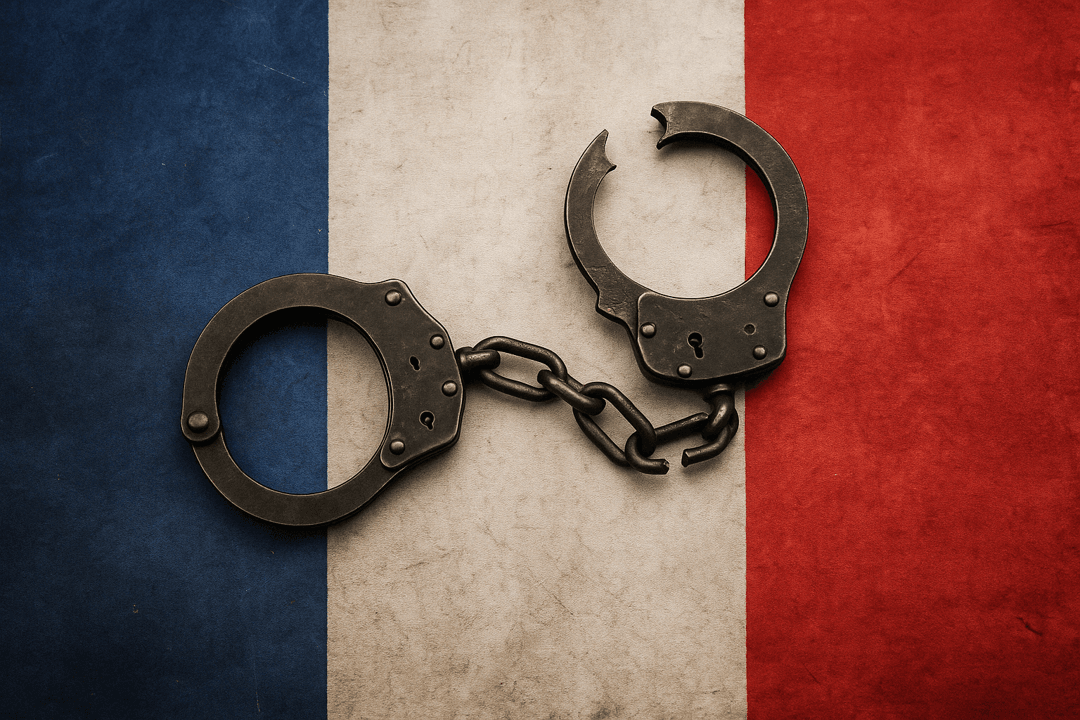
Developments since publication: French anti-terrorism prosecutors dropped the terrorism investigation in May 2025, concluding the attacks were directed by drug trafficking networks — not anarchist or left-wing groups. Thirty suspects were arrested, 21 charged (including two minors), and the alleged DDPF Telegram creator was identified as an inmate connected to the DZ Mafia narcotics gang in Marseille. The investigation found that traffickers adopted anti-prison ideology as operational cover, commissioning attacks from inside prison walls. France subsequently passed sweeping counter-narcotics legislation creating a national organized crime prosecutor and authorizing high-security isolation units for drug kingpins. The case underscores how criminal networks can co-opt ideological framing to disguise strategic objectives — a recurring pattern in hybrid warfare.
In April 2025, France witnessed an alarming series of attacks against its prison system. Coordinated arson and gunfire incidents struck multiple correctional facilities across the country, leaving fires raging, personnel shaken, and public officials scrambling for answers. A group identifying itself as the Groupe de Défense des Droits des Prisonniers Français (DDPF) claimed responsibility, citing the defense of political prisoners and broader opposition to state authority.
Some dismissed these events as vandalism or mischief. But a closer look reveals a more complex and troubling reality. These incidents show a pattern of domestic actors adopting irregular warfare tactics — targeting institutional symbols to destabilize governments from within. France’s prison attacks are a warning: asymmetric violence is no longer limited to distant battlefields. It has reached the core of Europe’s internal security infrastructure.
The French Prison System Under Siege
The attacks began almost simultaneously across multiple locations, starting on April 13, 2025 at the National School of Prison Administration in Agen, where seven vehicles were set ablaze. Over the following 48 hours, the scope widened dramatically. The Toulon-La Farlède prison was struck with automatic weapons fire — roughly fifteen rounds from an AK-47 — while arson attacks hit prisons in Nanterre, Aix-Luynes, Valence, the Sud Francilien facility, and Tarascon. In Marseille, vehicles belonging to prison guards were torched in the parking lot of social housing where they lived. The total toll: at least 24 vehicles destroyed, one prison facade riddled with bullets, and the DDPF acronym spray-painted across nearly every scene.
This was not random opportunism. The simultaneity of the strikes, the geographical spread across southern France and the Paris region, and the consistent branding all pointed to centralized coordination. The DDPF Telegram channel — created one day before the first attack — rapidly gained over 1,000 followers, broadcasting threats against prison guards and their families. Messages declared: “Guards, resign while you still can if you care about your families and loved ones.” A video followed showing the identification of a specific guard’s home.
The attacks escalated through April 21, when homes in Villefontaine, Isère were targeted with heavy gunfire and Molotov cocktails — though investigators later found the residences were not inhabited by prison staff, suggesting intelligence failures within the attack network itself.
Analyzing the Attacks Through the Lens of Irregular Warfare
Viewed through the framework of irregular warfare, the prison attacks exhibit several key characteristics. The selection of targets followed a logic of asymmetric leverage: prisons are symbols of state authority but lack the layered security of airports, embassies, or government ministries. Striking them generates outsized fear while exploiting predictable vulnerabilities.
The use of Telegram for both operational coordination and information warfare mirrors tactics employed by both militant organizations and hybrid threat actors globally. The channel functioned as a propaganda platform, a recruitment tool, and a targeting mechanism — broadcasting guard identities and home addresses while framing the violence within a prisoners’ rights narrative.
Most significantly, the investigation revealed a critical lesson for analysts: the ideological framing was a facade. While the DDPF brand invoked anarchist and prisoners’ rights rhetoric, French anti-terrorism prosecutors concluded by May 2025 that the attacks were orchestrated by drug trafficking networks retaliating against Justice Minister Gérald Darmanin’s crackdown on narcotics kingpins operating from inside prison walls. The alleged creator of the DDPF Telegram group was himself awaiting trial for offenses linked to the DZ Mafia drug gang in Marseille.
This disconnect between ideological presentation and operational reality is a hallmark of sophisticated subversive operations. Criminal networks co-opted the language of political resistance to broaden sympathy, confuse attribution, and complicate the law enforcement response — a tactic with clear parallels to state-sponsored hybrid warfare.
Anarchist and Left-Wing Urban Guerrilla Context
The initial attribution confusion was not unreasonable. The attacks occurred against a broader European backdrop in which anarchist and ultra-left-wing groups have exhibited renewed willingness to engage in violent direct action. In Italy, anarchist cells have targeted infrastructure projects. In Spain, leftist militants have clashed with police over evictions and migrant rights. Greece has long harbored active urban guerrilla movements, including Revolutionary Struggle and Conspiracy of Fire Nuclei.
Prisons represent powerful symbolic targets for these groups. They are seen as manifestations of systemic oppression, racial injustice, and class hierarchy. Attacking them allows militant groups to tap into broader social grievances, especially in societies where marginalized populations are disproportionately incarcerated. France’s prison occupancy stood at 131% at the time of the attacks — a fact the DDPF channel exploited.
Yet the investigation’s conclusion that drug traffickers — not ideological militants — directed the campaign underscores a persistent analytical challenge: the difference between what an attack claims to be and what it is. The DDPF case demonstrates how criminal actors can weaponize genuine grievances as operational camouflage, borrowing the aesthetics and language of political influence operations to shield their true objectives.
State Vulnerabilities and the Law Enforcement Response
The French state’s response was rapid but exposed significant vulnerabilities. Nearly 200 investigators were mobilized. The national anti-terrorism prosecutor’s office (PNAT) initially led the case, assisted by the DGSI domestic intelligence service. Within two weeks, 30 suspects were arrested in coordinated raids across Paris, Marseille, Lyon, and Bordeaux. Twenty-one were formally charged, including four minors. Seven of those arrested were already serving prison sentences — suspected of directing attacks from their cells.
By May 2, the PNAT formally transferred the case to the JUNALCO organized crime office, stating: “It does not appear that these coordinated actions stem from a terrorist enterprise. No radical violent ideology, no foreign interference, both leads that were deeply investigated, could be found.” The reclassification from terrorism to organized crime was itself a significant moment — demonstrating both the maturity of the investigation and the difficulty of initial attribution in an era of deliberately blurred boundaries.
The legislative response was equally swift. French lawmakers approved a major counter-narcotics bill authorizing the creation of a national organized crime prosecutor, the construction of high-security isolation units to separate drug kingpins from the general prison population, and new tools for counter-network operations. Justice Minister Darmanin’s plan to isolate 200 of France’s 700 most dangerous drug traffickers in dedicated facilities — the very policy that likely triggered the attacks — moved forward on an accelerated timeline.
Implications for European Security and Beyond
The French prison attacks serve as a case study in the evolving nature of hybrid threats facing European governments. Several implications stand out for security practitioners and policymakers.
First, soft targets demand hardened approaches. Prisons, social service offices, judicial buildings, and correctional staff housing exist outside traditional security perimeters. Investing in physical security and crisis response capabilities for these non-traditional targets is no longer optional — the DDPF campaign proved they are viable attack surfaces.
Second, attribution is an analytical battleground. The gap between the DDPF’s ideological framing and the organized crime reality took weeks to resolve, during which public discourse, media coverage, and policy responses were shaped by the false narrative. In an era of instant amplification through encrypted platforms, distinguishing genuine ideological movements from criminal or state-sponsored false-flag operations is a core intelligence challenge.
Third, prison systems are strategic terrain. Drug trafficking networks demonstrated they could project force from inside correctional facilities, commissioning attacks through Telegram, identifying targets, and coordinating multi-site operations — all while their leadership remained behind bars. This represents a form of infrastructure vulnerability that extends well beyond the physical security of prison walls.
Fourth, ideological co-optation is a force multiplier. By wrapping criminal objectives in the language of prisoners’ rights, the DDPF operation attracted sympathetic media coverage, confused early attribution, and tapped into genuine public anger about prison conditions. Security services must develop frameworks that evaluate the operational signature of attacks separately from their claimed motivation — a distinction that applies equally to state-sponsored hybrid campaigns and non-state criminal enterprises.
Conclusion
The April 2025 attacks on France’s prison system mark more than a series of criminal acts. They represent a case study in how organized crime networks can adopt the toolkit of irregular warfare — coordinated multi-site operations, information warfare via encrypted platforms, ideological camouflage, and deliberate targeting of state infrastructure — to pursue strategic objectives. The DDPF campaign was not a protest movement that turned violent; it was a narcotics enterprise that dressed itself in the language of resistance.
For European security establishments, the lesson is clear: the boundaries between terrorism, organized crime, and political extremism are increasingly fluid. Analytical frameworks, intelligence collection priorities, and counterinsurgency doctrine must adapt to adversaries who deliberately exploit these seams. The French prison attacks will not be the last time criminal networks weaponize social grievances as operational cover — and the speed of the next attribution cycle may determine whether the state’s response is shaped by reality or by narrative.
Recommended Reading
Aust, Stefan. Baader-Meinhof: The Inside Story of the R.A.F. Oxford University Press, 2009.
Gurr, Ted Robert. Why Men Rebel. Paradigm Publishers, 2010.
For additional reading on irregular warfare, hybrid threats, and resistance movements, see the Essential Books on Resistance collection.