

Between January 2025 and February 2026, the German Navy faced a series of alarming sabotage attempts on its vessels. These incidents have raised significant concerns about maritime security in the region. Sabotage has targeted ships under construction and those already in active service, revealing major gaps in naval protection measures.
Investigations suggest both state and non-state actors may be involved. These groups exploit weaknesses in shipyard security and cyber defense systems. Some attacks appear coordinated, pointing to broader efforts to weaken NATO’s maritime capabilities.
German defense officials have responded by calling for tighter coordination with allies and better counterintelligence. They also recommend investing in sabotage-resistant naval technologies and improving security across all phases of ship deployment.
In February 2026, German authorities arrested two suspects, a 37-year-old Romanian and a 54-year-old Greek, in connection with the sabotage incidents described in this article. Both men worked at the Blohm+Voss shipyard in Hamburg and allegedly dumped over 20 kg of abrasive material into engine blocks, punctured freshwater supply lines, removed fuel tank caps, and deactivated electronic safety switches on K130-class corvettes. The arrests were coordinated by Eurojust, with operations in Hamburg, Romania, and Greece. The sabotage was discovered during routine pre-departure inspections, preventing major damage. German Navy Vice Admiral Jan Christian Kaack had previously warned publicly that the incidents represented a testing of NATO’s resolve, stating that Russia could be capable of seeking military confrontation with the alliance by 2029. The investigation into who commissioned the sabotage is ongoing.
As of May 2026 the picture had hardened. Ten suspected sabotage incidents have hit the German Navy since early 2025, and prosecutors have discontinued every case except the Emden, including the Hessen water contamination, the severed cable looms and the February 2026 slit in the fuel line of the frigate Rheinland-Pfalz. No instigator has been identified. German security services, the BfV and the BKA, warn of so-called disposable agents: petty criminals recruited over social media and paid in cryptocurrency, from a few hundred euros for minor acts to tens of thousands for sabotage of NATO equipment.
Sources: Eurojust, Bild, Greek City Times, The Maritime Executive, UNITED24 Media
Frigate Hessen Contamination Attempt
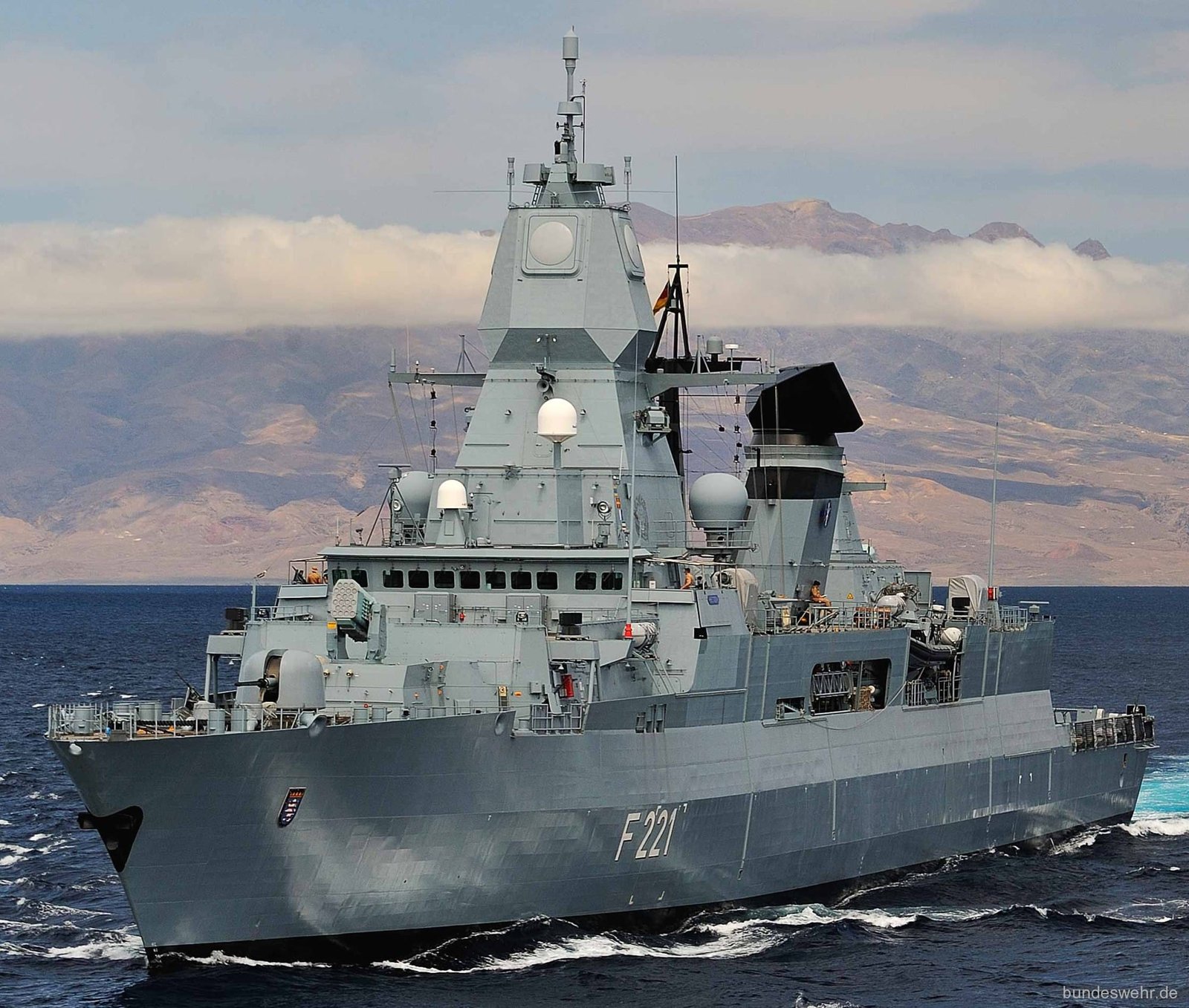
In February 2025, while docked at the Wilhelmshaven naval base for scheduled maintenance, the frigate Hessen was the target of a sabotage attempt. Perpetrators sought to contaminate the ship’s potable water system by introducing waste oil into the tanks. Alert personnel detected the contamination early, preventing potential health hazards and operational disruptions. German prosecutors have since discontinued this case. As reported in May 2026, the used-oil-in-the-water-system file was closed without a suspect being identified.
Corvette Emden Engine Sabotage
The Emden, a newly constructed K130-class corvette awaiting deployment, experienced the most serious sabotage incident. During a routine inspection at the Blohm+Voss shipyard in Hamburg in January 2025, several kilograms of abrasive grit were discovered in the vessel’s engine system. Had this contamination gone unnoticed, it could have led to catastrophic engine failure during operations. The Hamburg regional prosecutor’s office, alongside local criminal police, launched an investigation that ultimately led to the February 2026 arrests of two shipyard workers who had allegedly dumped over 20 kg of abrasive material into the engine blocks.
Minehunter Cable Severing
Another incident involved a German Navy minehunter stationed in Rostock. Unknown individuals severed multiple cable harnesses aboard the vessel, impairing its operational capabilities. Prosecutors discontinued this case as well. The cut cable looms were closed out without a named perpetrator, one of several German Navy sabotage files shelved by May 2026.
These three were not the whole of it. Ten suspected sabotage incidents have targeted the German Navy since the start of 2025. The most recent came in February 2026, when a two-centimetre slit was found in the fuel line of the frigate Rheinland-Pfalz at Wilhelmshaven. The Bundeswehr judged the cut deliberate, but prosecutors closed that file too, unable to separate sabotage from ordinary wear. The pattern holds across the series: only the Emden case has produced arrests, and the rest have been discontinued without a named suspect.
Incident Summary: German Naval Sabotage Campaign
Vessel
Location
Method
Status
Corvette Emden
Blohm+Voss, Hamburg
20+ kg abrasive material in engines; fuel caps removed; safety switches deactivated
2 arrested (Feb 2026)
Frigate Hessen
Wilhelmshaven
Waste oil introduced into potable water system
Investigation discontinued (2026)
Minehunter (unnamed)
Rostock
Multiple cable harnesses severed
Investigation discontinued (2026)
Sources: The Maritime Executive · Greek City Times
Broader Maritime Sabotage Context
The recent sabotage attempts against German naval vessels are part of a broader pattern of maritime threats escalating in the Baltic Sea. These incidents underscore the region’s growing vulnerability, where heightened geopolitical tension has made naval infrastructure a key target for hybrid operations.
Hostile actors may aim to disrupt military readiness, test NATO cohesion, or pressure regional governments through targeted acts of sabotage. Attacks on ships, whether under construction or in active service, threaten both national defense and broader alliance security. These threats include physical sabotage, cyber-physical interference, and covert reconnaissance of military ports.
Naval officials have responded by increasing inspections, hardening access controls, and conducting background checks on shipyard personnel and contractors. Baltic states are also expanding maritime domain awareness initiatives, including drone patrols and seabed sensor networks. The goal is to detect and deter hostile activities before they escalate into larger security crises. The German naval incidents sit alongside a broader pattern of Baltic infrastructure targeting, including rail signaling attacks in Finland and the systematic sabotage of undersea cables, that collectively suggest a coordinated campaign to test and erode Western military infrastructure.
As threats evolve, German and allied naval forces recognize that deterrence now requires both traditional defenses and rapid, integrated counter-sabotage capabilities. Without these adaptations, naval operations in the Baltic risk disruption, delay, or degradation, vulnerabilities adversaries are likely to exploit.
Undersea Cable Disruptions
In February 2025, Swedish authorities reported damage to an undersea telecommunications cable near Gotland. This incident is not an isolated occurrence but rather part of a broader trend of disruptions to undersea infrastructure. These cables serve as critical communication lifelines, supporting civilian and military operations, and their compromise poses a significant security risk.
The nature of these disruptions suggests deliberate interference, as accidental damage from fishing activity or natural phenomena is relatively rare. The Baltic region, which hosts extensive undersea fiber-optic networks and military communication links, has become a focal point for suspected sabotage operations. The difficulty in monitoring and securing vast underwater expanses makes these cables highly vulnerable targets for adversaries seeking to disrupt communications and intelligence-sharing among NATO allies.
Russian Naval Sabotage in Kherson
Similar sabotage patterns have been observed in other maritime theaters beyond the Baltic Sea. During the Russian withdrawal from Kherson in November 2022, Russian forces were widely reported to have scuttled or disabled their own river craft rather than let them fall to advancing Ukrainian units. This form of self-sabotage reflects a strategic calculation wherein naval assets are deemed more valuable incapacitated than in enemy hands.
Historical precedents show that self-sabotage has been employed in past conflicts to deny opponents access to critical military resources. In the modern context, these actions reinforce the notion that naval sabotage is not limited to external threats but can also be executed as a deliberate military tactic.
Potential Actors and Motivations
While definitive attribution of the recent German naval sabotage incidents remains complex, several key indicators suggest potential actors and their motivations:
State-Sponsored Espionage and Hybrid Warfare
The sophistication and coordination of these attacks suggest that they are unlikely to be the work of independent actors or rogue elements. Instead, they may be part of a broader strategy that state-sponsored operatives employ to undermine NATO naval readiness. Given the ongoing geopolitical tensions in the region, Russian intelligence and special operations units are considered prime suspects. German Navy Vice Admiral Kaack stated publicly that the incidents represented a testing of NATO’s resolve, warning that the growing threat from Russia at the start of 2025 was “more pressing than it was two years ago.”
Hybrid warfare tactics, which integrate conventional military actions with cyber warfare, psychological operations, and sabotage, have been widely observed in modern conflicts. The pattern of deliberate interference with undersea cables, naval vessels, and strategic maritime infrastructure aligns with past Russian activities aimed at destabilizing Western military operations and exerting pressure on European allies.
Insider Threats and Industrial Sabotage
The February 2026 arrests confirmed what investigators had long suspected: the insider threat was real. Both arrested suspects, a Romanian and a Greek national, had authorized access to the Blohm+Voss shipyard through their employment at the port facilities. The nature of the sabotage, particularly incidents occurring within secured maintenance facilities, demonstrated that individuals with legitimate access had facilitated the operations.
Enhanced security protocols within shipyards, including stricter background checks, increased surveillance, and controlled access to sensitive equipment, are being implemented to mitigate these threats. However, the insider element significantly complicates efforts to prevent future sabotage attempts, requiring continuous vigilance and intelligence cooperation among NATO allies. The investigation into who commissioned the sabotage, the question of state sponsorship, remains open.
Strategic Assessment
Recent sabotage attempts against German naval ships highlight a wider maritime security problem that crosses national borders. Attacks on undersea cables, self-sabotage in war zones, and espionage by state actors show rising risks to navies. These evolving threats place ships and critical systems in danger during both peace and conflict. To counter this, countries must boost security, share intelligence, and build better tools to detect and stop sabotage early.
OSS Simple Sabotage Field Manual: Combined & Remastered is the original tradecraft for exactly this kind of attack: cheap, deniable damage inflicted by insiders with legitimate access.
View on Amazon →Historical Parallels
Sabotage in naval contexts has deep historical precedents.
World War II
Both Allied and Axis forces used sabotage to weaken enemy fleets and delay shipbuilding efforts. The British conducted Operation Source in 1943, using X-class midget submarines to disable German battleships, including the Tirpitz. These operations involved high-risk underwater approaches, explosive charges, and specialized crews trained for covert insertion.
The Axis powers also launched sabotage missions. German agents attempted to disrupt British naval operations by planting explosives in ports or infiltrating supply chains. Italian naval commandos pioneered frogman attacks, using human torpedoes to strike Allied ships in heavily guarded harbors.
Cold War Era
During the Cold War, sabotage took a quieter but equally dangerous form: espionage and covert disruption of naval capabilities. The Soviet Union and the United States both targeted undersea cables, surveillance equipment, and naval shipyards. Intelligence agencies inserted moles and hackers into military-industrial networks to gather information or subtly degrade systems.
In one notable example, U.S. operatives allegedly inserted manipulated software into Soviet systems, causing technical failures without direct confrontation. Similarly, suspected Soviet operatives were linked to port sabotage and equipment tampering in NATO-aligned countries. These actions often blurred the lines between sabotage, subversion, and electronic warfare.
Implications and Countermeasures
The recent sabotage attempts have profound implications for maritime security. Repeated sabotage can erode naval forces’ operational capabilities, leading to increased maintenance costs and reduced fleet availability. Targeting under-construction vessels and critical infrastructure exposes vulnerabilities that adversaries may exploit to gain strategic advantages.
Enhanced Security Protocols
In response to the recent sabotage incidents, naval forces and shipbuilding facilities are implementing stricter security protocols to mitigate insider threats and external breaches. Key measures include multi-layered authentication systems, biometric access points, and restricted access zones to ensure only authorized personnel can enter sensitive areas.
Shipyards are significantly increasing surveillance to protect key assets. Security teams are installing advanced CCTV systems with facial recognition and motion detection. These systems actively monitor movements around ships and sensitive equipment to detect suspicious behavior and prevent sabotage. Security patrols have also been intensified, with random inspections and increased presence of armed security personnel to deter potential saboteurs.
Another crucial aspect involves conducting thorough background checks and continuous vetting of personnel working on naval vessels and military projects. Governments and military agencies are reinforcing their vetting procedures by collaborating with intelligence agencies to screen employees, contractors, and subcontractors for potential security risks. Regular security audits and psychological assessments are also being introduced to detect anomalies indicating insider threats.
International Collaboration
Given the transnational nature of maritime threats, NATO allies and partners have prioritized deeper security collaboration. They are refining intelligence-sharing systems to deliver real-time alerts on sabotage threats and emerging malicious activity patterns. NATO and European defense institutions are developing a centralized maritime threat database to help member states detect and respond to sabotage attempts quickly. The February 2026 arrests demonstrated this collaborative approach in action. Eurojust coordinated simultaneous operations across Germany, Romania, and Greece to apprehend the suspects.
Joint naval exercises now include expanded counter-sabotage training. These drills simulate real-time scenarios where forces must detect and neutralize sabotage threats immediately. The exercises also improve coordination between navies, coast guards, and intelligence agencies. Cybersecurity cooperation is increasing as well, focusing on defending ship systems from cyber-physical attacks.
Another area of collaboration is rapid response team development. These teams specialize in counter-sabotage and deploy quickly to affected maritime sites. They include maritime security, cyber defense, and counterintelligence experts. Once deployed, they conduct forensic investigations and implement countermeasures in partnership with host nations.
Technological Investments
Investments in cutting-edge technology are critical for countering maritime sabotage. Naval forces now deploy autonomous underwater drones with sonar and AI-driven anomaly detection to patrol harbors and shipyards, scanning for sabotage attempts like explosive devices or tampering with ship hulls. Navies are also integrating sensor networks across critical maritime infrastructure for real-time threat detection, including hydrophones to detect unusual underwater sounds and infrared cameras to track nighttime ship movements.
Predictive analytics and machine learning models are being developed to identify sabotage risks before they occur. These systems analyze past sabotage attempts, geopolitical tensions, and insider threat indicators to issue early warnings to naval commanders for proactive action. Shipbuilders are also enhancing vessel designs to resist sabotage. New warships feature redundant systems, tamper-proof controls, and built-in diagnostic tools that reduce vulnerability and help isolate damage quickly.
Conclusion
The wave of sabotage incidents targeting the German Navy underscores the evolving nature of threats in the maritime domain. The February 2026 arrests of two shipyard insiders demonstrated that the threat was real, the methods were sophisticated, and the insider vector was as dangerous as external penetration. Yet the question of who commissioned these acts, and whether they connect to the broader pattern of hybrid sabotage campaigns across the Baltic, remains unanswered.
To counteract these challenges, naval forces and defense organizations are adopting a multi-pronged approach emphasizing enhanced security protocols, international collaboration, and technological advancements. By implementing these measures, nations can better safeguard their naval assets, critical infrastructure, and strategic capabilities against future sabotage attempts.
This analysis draws on reporting from the Maritime Executive, The Defense Post, Reuters, Greek City Times, and UNITED24 Media.
// Related Reading on The Resistance Hub
Undersea Sabotage
How submarine cables and seabed infrastructure have become the new frontline in hybrid conflict.
Rail Signaling Attacks in Finland
Another Baltic infrastructure target: rail sabotage near NATO bases as part of the same hybrid campaign.
Sabotage in Hybrid Warfare
The strategic framework behind sabotage as a tool of state competition below the threshold of war.
History of Sabotage
From the Luddites to modern hybrid warfare: how sabotage has evolved as a strategic tool across centuries.
