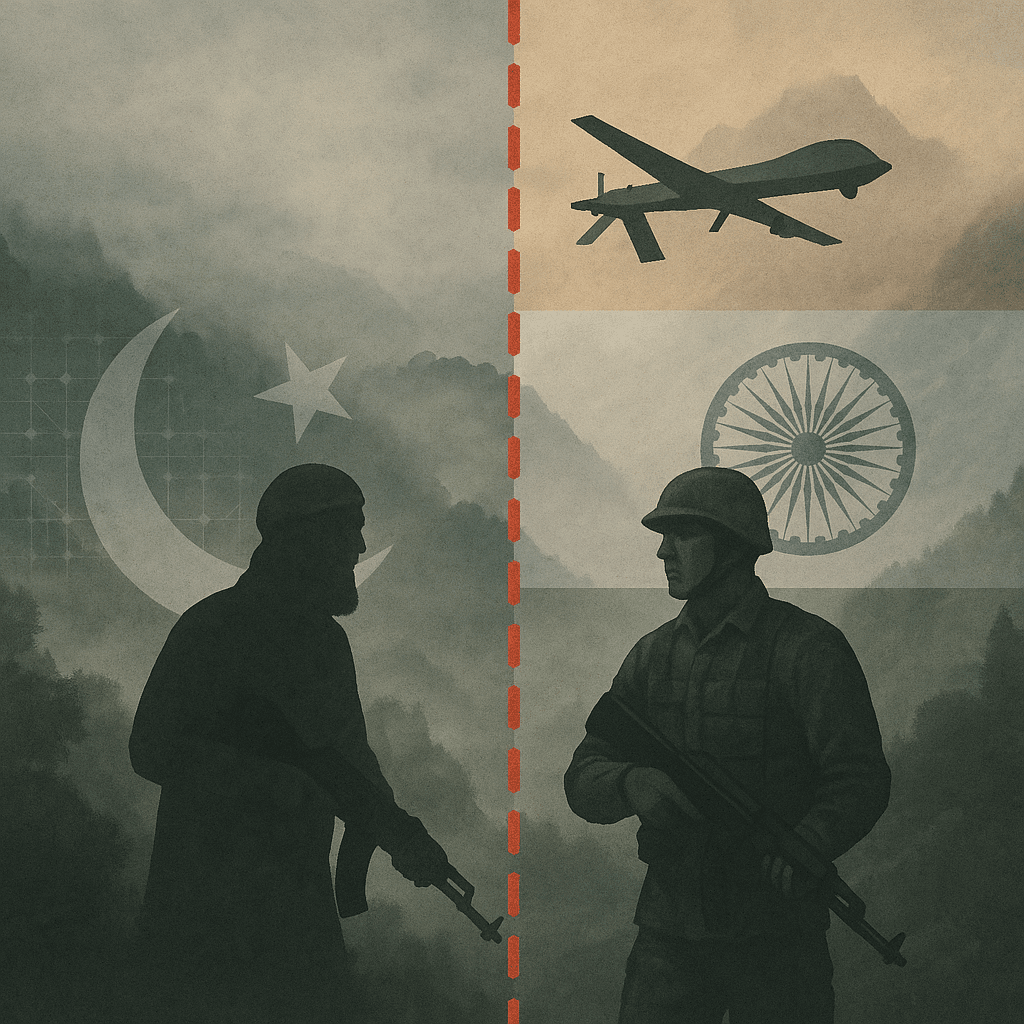
The Resistance Hub does not take positions on the India–Pakistan conflict or advocate for the use of force by any actor. This article analyzes irregular, asymmetric, hybrid, and unconventional warfare dimensions of the 2025 India-Pakistan confrontation. All assessments are based solely on publicly available information. The goal is to understand how non-conventional strategies were used to manage, contain, or shape the battlefield below the threshold of full-scale war.
A Flashpoint Rekindled
Tensions between India and Pakistan have defined one of the world’s most dangerous fault lines for decades. Both possess nuclear weapons, have engaged in multiple conventional wars, and maintain contested territorial claims that evoke deep national pride and identity. In April–May 2025, that fault line cracked open in ways that validated the most alarming predictions of irregular warfare analysts, and exceeded many of them.
Full-scale war is not the only path forward between nuclear-armed adversaries, and it is not the most likely. In today’s security environment, where the cost of total confrontation is politically and economically intolerable, nations increasingly turn to tools of non-conventional warfare: asymmetric operations, proxy violence, psychological manipulation, cyberattacks, and deniable sabotage. These tactics can shape the battlefield, influence perception, and inflict costs, all while attempting to avoid clear violations of the rules-based order or triggering nuclear escalation.
This article, originally published as speculative analysis on May 8, 2025, examines the use of irregular and hybrid tactics in the India-Pakistan confrontation, drawing from history, doctrine, and the events that unfolded in real time as this piece went live.
This article was published on May 8, 2025, one day after the scenarios it analyzed became reality. On April 22, 2025, gunmen killed 26 civilians in the Pahalgam attack in Indian-administered Kashmir, selectively targeting Hindu men. India accused Pakistan of harboring the responsible groups. After two weeks of escalating cross-border firing, India launched Operation Sindoor on May 7, with missile strikes targeting nine JeM and LeT sites across Pakistan and Pakistan-administered Kashmir. It was the first Indian strike on Pakistan’s Punjab province since the 1971 war. The five-day conflict that followed featured the first drone battle between nuclear-armed states, the largest fourth-generation fighter engagement in recent history (125+ jets from both sides), Pakistani retaliation under Operation Bunyan-un-Marsoos, Indian naval repositioning within range of Karachi, and intense information warfare on both sides. A ceasefire took effect on May 10. India’s Chief of Defense Staff later described the operation as establishing a “new normal” in which no distinction would be made between terrorists and their state sponsors.
The flashpoint has since moved to water. The May 2025 ceasefire has held, but India’s suspension of the Indus Waters Treaty hardened rather than lapsed. New Delhi confirmed on March 20, 2026 that the treaty remains in abeyance until Pakistan ends support to terrorism. On June 20, 2026 Pakistan’s defence minister Khawaja Asif said water security is inseparable from national security and that Pakistan would go to war against India the moment it judged that security threatened. Pakistan-administered Kashmir then saw its deadliest unrest in years: 11 killed and more than 70 injured at Rawalakot on June 8, 2026 in clashes between security forces and the banned Jammu Kashmir Joint Awami Action Committee, at least 24 dead across June, and a protest-group count above 30 by the July 27 legislative elections. The escalation ladder below still describes the 2025 sequence accurately. The trigger it now sits under is the river system rather than the Line of Control.
Sources: Carnegie Endowment, War on the Rocks, Al Jazeera, CFR Global Conflict Tracker, OHCHR, Government of India PIB
A Brief History of Regional Irregular Conflict
While India and Pakistan have fought openly in 1947, 1965, 1971, and during the 1999 Kargil conflict, much of their post-2000 confrontation has shifted toward less visible domains. The 2025 crisis did not emerge from a vacuum. It followed a clear escalatory arc that revealed how irregular methods channel confrontation between nuclear-armed states.
The Kargil conflict (1999) saw Pakistani forces and militants infiltrate Indian positions along the Line of Control (LoC) in a bid to recast the status quo without triggering nuclear war. Though repelled, the episode became a textbook case of irregular warfare under a nuclear umbrella. The Mumbai attacks (2008) were a well-coordinated terrorist operation by Lashkar-e-Taiba operatives that exploited maritime infiltration, urban terrain, and media manipulation, exposing the blurred lines between state tolerance of militant groups and plausible deniability. The Balakot airstrike (2019) marked a rare Indian strike across the LoC targeting a JeM training camp; Pakistan’s retaliation and subsequent aerial dogfights signaled both a willingness to escalate and the dangers of tit-for-tat logic.
Operation Sindoor (2025) took this evolutionary arc to its logical conclusion. As War on the Rocks analyst David Kilcullen observed, the most strategically significant evolution from Uri to Balakot to Sindoor lies in what India attempted to achieve at each iteration, testing and pushing the boundaries of what it could do without triggering a war, and expanding the space for conventional operations under the nuclear umbrella.
Each of these incidents reflects the same underlying trend: neither side desires total war, but both engage in calculated provocations primarily through unconventional means. Investments in cyber capability, information warfare cells, intelligence networks, and local proxy influence have made this logic increasingly operational.
Asymmetric Warfare: The Art of Uneven Engagement
At its core, asymmetric warfare involves a weaker party using unequal tools, tactics, or strategies to exploit vulnerabilities in a stronger adversary. In the India-Pakistan context, this does not always mean one state is weaker than the other. Instead, it refers to areas where one side chooses to exploit low-cost, high-impact tools.
Cyberattacks and Infrastructure Disruption
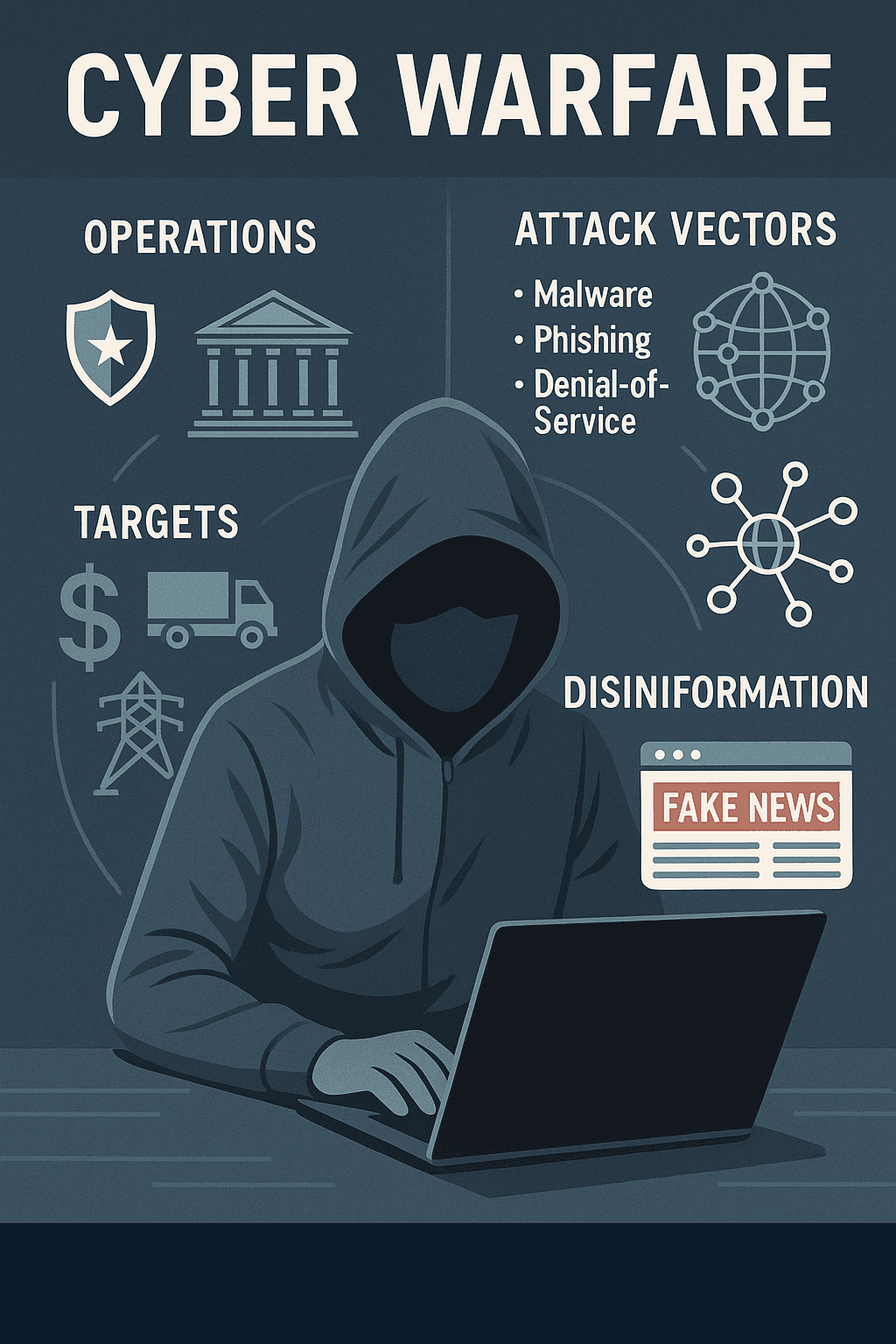
India’s critical infrastructure, from its electrical grid to financial services, has become a frequent target for cyber intrusions. In 2021, a suspected China-linked malware attack on a Mumbai power grid hub briefly disrupted electricity across parts of the city. During the 2025 crisis, both sides engaged in aggressive digital operations. India suspended the Indus Waters Treaty and closed the Attari-Wagah border, measures that functioned as asymmetric economic warfare, imposing immediate pressure on Pakistan’s already fragile economy without firing a shot. Pakistan threatened to suspend the Simla Agreement in response. Both sides targeted each other’s information systems, and the conflict’s information warfare dimension, with dueling claims about aircraft shot down, civilian casualties and strike effectiveness, demonstrated that the battle for narrative dominance was as intense as the kinetic exchanges.
Economic Leverage and Soft Sabotage
The 2025 crisis validated economic targeting as a frontline tool. India’s suspension of bilateral trade, visa revocations, and deportation of Pakistani nationals created immediate pressure without kinetic escalation. Given India’s growing global investment profile and Pakistan’s reliance on IMF support and Chinese capital, both are vulnerable in different ways to economic targeting that avoids overt military action. The economic dimension of the 2025 confrontation, meaning trade suspension, border closure and treaty leverage, functioned as a hybrid warfare layer operating in parallel with the missile strikes.
Non-State Actor Activation
Both sides have been accused, often credibly, of supporting or tolerating militant proxies. Pakistan-based groups like Jaish-e-Mohammed (JeM) and Lashkar-e-Taiba (LeT) have operated in Kashmir and beyond. India, for its part, has been accused by Pakistan of supporting Baloch separatists and TTP-linked elements in border regions. The Pahalgam attack demonstrated the continuing lethality of proxy activation: the selective targeting of Hindu men by gunmen operating in Indian-administered Kashmir triggered the entire escalatory sequence that followed. JeM chief Maulana Masood Azhar later acknowledged that family members and aides were killed in the Indian strikes, confirming the operational connection between proxy groups and state-level military response.
Irregular Warfare: Weaponizing Disorder
Irregular warfare (IW) refers to sustained, population-centric conflict waged by, with, or through irregular forces such as militias, partisans and non-state actors. Unlike hybrid or asymmetric strategies, IW focuses on influencing populations and delegitimizing authority rather than inflicting battlefield damage.
The Kashmir Battleground
Kashmir remains the epicenter of irregular conflict in South Asia. While the intensity of insurgency has fluctuated, the region continues to host a robust security presence from the Indian Armed Forces and paramilitaries, local grievances tied to political representation, autonomy, and religious identity, and a youth demographic vulnerable to recruitment, especially amid economic stagnation. The Pahalgam attack, and the communal dimension of its targeting, demonstrated how proxy operations can exploit these fault lines to provoke state-level responses with potentially catastrophic consequences.
Information Operations and Psychological Manipulation
Control of the narrative proved to be a battlefield of its own during the 2025 crisis. Both India and Pakistan deployed their information warfare capabilities at unprecedented scale. India immediately released video evidence of effective strikes and briefed 13 of 15 UN Security Council member states. Pakistan claimed to have shot down five Indian aircraft and accused India of targeting mosques and civilian areas. Both sides conducted aggressive social media campaigns targeting domestic and international audiences. The Indian government described its strikes as “focused, measured, and non-escalatory”, a framing designed to occupy the moral high ground while Pakistan was compelled to respond, creating a dynamic where retaliation appeared escalatory regardless of its proportionality.
Urban Unrest and Mass Mobilization
Irregular warfare doesn’t always come from across the border. Domestic instability, fueled by perception, misinformation, or historical grievances, can be a critical pressure point. India has seen protests over CAA/NRC policies and farmer rights. Pakistan continues to face unrest in Balochistan and Khyber Pakhtunkhwa, along with economic protests. During the 2025 crisis, reports emerged of anti-Muslim mob violence in India, while an academic at Ashoka University was arrested for social media posts questioning the optics of Operation Sindoor, illustrating how domestic information spaces become contested terrain during cross-border confrontation.
// Escalation Ladder: The 2025 India-Pakistan Confrontation
Apr 22
Pahalgam Attack
26 civilians killed in Kashmir. Gunmen selectively targeted Hindu men. TRF initially claims responsibility. India blames Pakistan-backed groups.
Apr 23–May 6
Diplomatic and Economic Escalation
India suspends Indus Waters Treaty, closes Attari-Wagah border, halts bilateral trade, revokes Pakistani visas, deports Pakistani nationals. Cross-LoC firing and artillery shelling intensifies.
May 7
Operation Sindoor
India strikes 9 JeM/LeT sites with long-range stand-off weapons and loitering munitions. First Indian strikes on Pakistan’s Punjab since 1971. 125+ fighter jets from both sides in largest 4th-gen aerial engagement.
May 7 to 9
Tit-for-Tat Escalation
Pakistan retaliates with drone and missile strikes on Indian targets. First drone battle between nuclear powers. India repositions Western Fleet within range of Karachi. Both sides wage aggressive information warfare.
May 10
Operation Bunyan-un-Marsoos and Indian Counter
Pakistan launches Operation Bunyan-un-Marsoos targeting Indian military bases. India expands Sindoor to strike Pakistani air defenses, C2 centers, and airfields. At least 5 Pakistani jets reported destroyed.
May 10, 17:00 IST
Ceasefire
Pakistan DGMO calls Indian DGMO. Ceasefire agreed. Post-ceasefire drone incursions by Pakistan intercepted. India’s CDS declares operations a “new normal” with no distinction between terrorists and state sponsors.
9
Sites struck (Sindoor)
125+
Fighter jets engaged
5
Days of conflict
1st
Nuclear-state drone battle
Sources: Carnegie · War on the Rocks · Al Jazeera · Carnegie (Military Lessons)
Hybrid Warfare: Combining Tools for Strategic Effect
Hybrid warfare blends elements of conventional military force with cyberattacks, psychological operations, economic pressure, and irregular tactics, all to achieve political objectives without formal war. It thrives in gray zones, where attribution is difficult and escalation is ambiguous.
The 2025 India-Pakistan confrontation was a textbook hybrid conflict. India simultaneously employed diplomatic isolation (visa revocations, treaty suspension), economic warfare (trade suspension, border closure), precision missile strikes (Operation Sindoor), drone and loitering munition operations, naval power projection (fleet repositioning near Karachi), and aggressive information operations (video evidence release, UNSC briefings). By engaging across multiple domains, India sought to frame the conflict as counterterrorism rather than interstate war, making it harder for Pakistan to justify its retaliation as self-defense without appearing to shelter the very groups India was targeting.
Unconventional Warfare: Subversion from Within
As practiced by states, unconventional warfare (UW) focuses on organizing, training, and equipping resistance or insurgent forces inside an adversary’s territory. While more often associated with great power strategy, India and Pakistan possess the capacity, if not always the political appetite, to employ UW. India might foster ethnic or nationalist dissent in Sindh or Gilgit-Baltistan. Pakistan could exploit communal tensions in Indian border states or energize radical networks in megacities. These activities rely on deep intelligence penetration, covert logistics, and long-term strategic patience. If activated, they could provoke internal security crises that stretch state capacity during high-stress periods, precisely the kind of compounding pressure that makes hybrid conflicts so difficult to manage.
Deterrence, Deniability, and the Nuclear Question
The specter of nuclear weapons hovers over every India-Pakistan confrontation. But rather than making conflict impossible, nuclear parity channels confrontation into lower-intensity arenas. Irregular and hybrid warfare offer both states tools to inflict punishment without crossing red lines, maintain plausible deniability before global audiences, avoid direct attribution that could trigger nuclear retaliation, and sustain long-term competition without immediate collapse into total war.
The 2025 conflict tested the boundaries of this logic more severely than any previous crisis. India’s Chief of Defense Staff later argued that Operation Sindoor demonstrated that significant space for conventional operations exists beneath the nuclear threshold, citing India’s no-first-use policy, the fact that Pakistan was the first to hit military targets, and that India’s initial strikes targeted only terrorist infrastructure. This framing represents a doctrinal evolution: the assertion that precision, restraint, and narrative control can expand the operational space between proxy warfare and nuclear exchange.
However, this strategy carries risk. The tit-for-tat escalation from May 7 to 10 demonstrated that even “measured” strikes can trigger spiraling retaliation. If non-conventional operations go too far, whether a cyberattack that cripples a hospital system or a proxy attack that kills civilians in a way that cannot be contained, miscalculation and escalation remain very real dangers.
Global Stakes: External Powers in the Shadows
Neither India nor Pakistan operates in isolation. The consequences of irregular escalation ripple outward. China may back Pakistan quietly while securing CPEC corridors and watching India’s Quad alignment with suspicion. The United States pressured restraint while enhancing intelligence support to India. With large diaspora populations and critical economic ties, the Gulf states positioned themselves as potential mediators. Russia, already entangled in other conflicts, attempted to maintain a quiet balance to preserve defense ties with both states.
The 2025 confrontation disrupted global markets, raised fears of nuclear escalation, and demonstrated that a hybrid conflict between nuclear-armed states can produce consequences far beyond the subcontinent. The longer such confrontations simmer, the greater the risk that local dynamics outpace the ability of external powers to manage them.
The Guerrilla Tactical Triad collects the ambush, raid and sabotage doctrine that underpins the proxy activation and infrastructure targeting described above, and it is the practical companion to this analysis of how irregular methods carry a nuclear-armed rivalry below the threshold of open war.
View on Amazon →Conclusion: Between War and Peace
The 2025 India-Pakistan confrontation represents the most dangerous crisis between these two nuclear-armed states since Kargil in 1999, and in many respects it exceeded Kargil’s intensity and strategic implications. The scenarios this article originally analyzed as speculative possibilities materialized within hours of publication, validating the framework while raising profound questions about where the escalatory logic leads next.
Asymmetric, irregular, hybrid, and unconventional warfare offered both sides options that prevented missiles from leaving nuclear silos, but they were not without cost. These tactics prolonged instability, generated blowback, and empowered actors that neither state can fully control. The first drone battle between nuclear powers, the largest aerial engagement in decades, and the economic warfare measures deployed in parallel all point to a future where the space between peace and total war is contested with increasing sophistication and increasing risk.
The durable resolution remains diplomatic, and both sides have to manage the shadows carefully for that window to stay open. As of August 2026 it has narrowed rather than widened. The Indus Waters Treaty is still in abeyance, water has displaced Kashmir as the loudest escalation trigger, and structured dialogue has not resumed. How India and Pakistan wield, or restrain, their non-conventional arsenals will decide whether the subcontinent edges toward the next confrontation or finds a path back from the brink.
This analysis draws on reporting and assessments from the Carnegie Endowment for International Peace, War on the Rocks, Al Jazeera, the CFR Global Conflict Tracker, and the Government of India Press Information Bureau. Additional context from the Institute for Defence Studies and Analyses (IDSA), the Stimson Center, RAND Corporation, and the Lowy Institute.
// Related Reading on The Resistance Hub
Tragedy in Pahalgam
The attack that triggered the 2025 India-Pakistan crisis, with analysis of the event and its immediate aftermath.
Sabotage in Hybrid Warfare
When sabotage becomes a tool of state competition, the framework that defined the 2025 crisis.
Weaponization of Information
How disinformation and narrative manipulation shaped both sides’ strategies during Sindoor.
Urban Resistance Tactics
How urban terrain shapes irregular conflict, relevant to the Kashmir theater and beyond.
// Further Reading
The Kill Chain: Defending America in the Future of High-Tech Warfare. Christian Brose examines how the convergence of sensors, networks, and precision weapons is transforming military competition, the exact dynamic that played out in the stand-off engagements of Operation Sindoor.
Hybrid Warfare: Fighting Complex Opponents from the Ancient World to the Present. Williamson Murray and Peter Mansoor trace the blend of conventional and irregular methods across history, providing essential context for understanding how the 2025 India-Pakistan confrontation combined precision strikes, proxy warfare, and information operations.
