
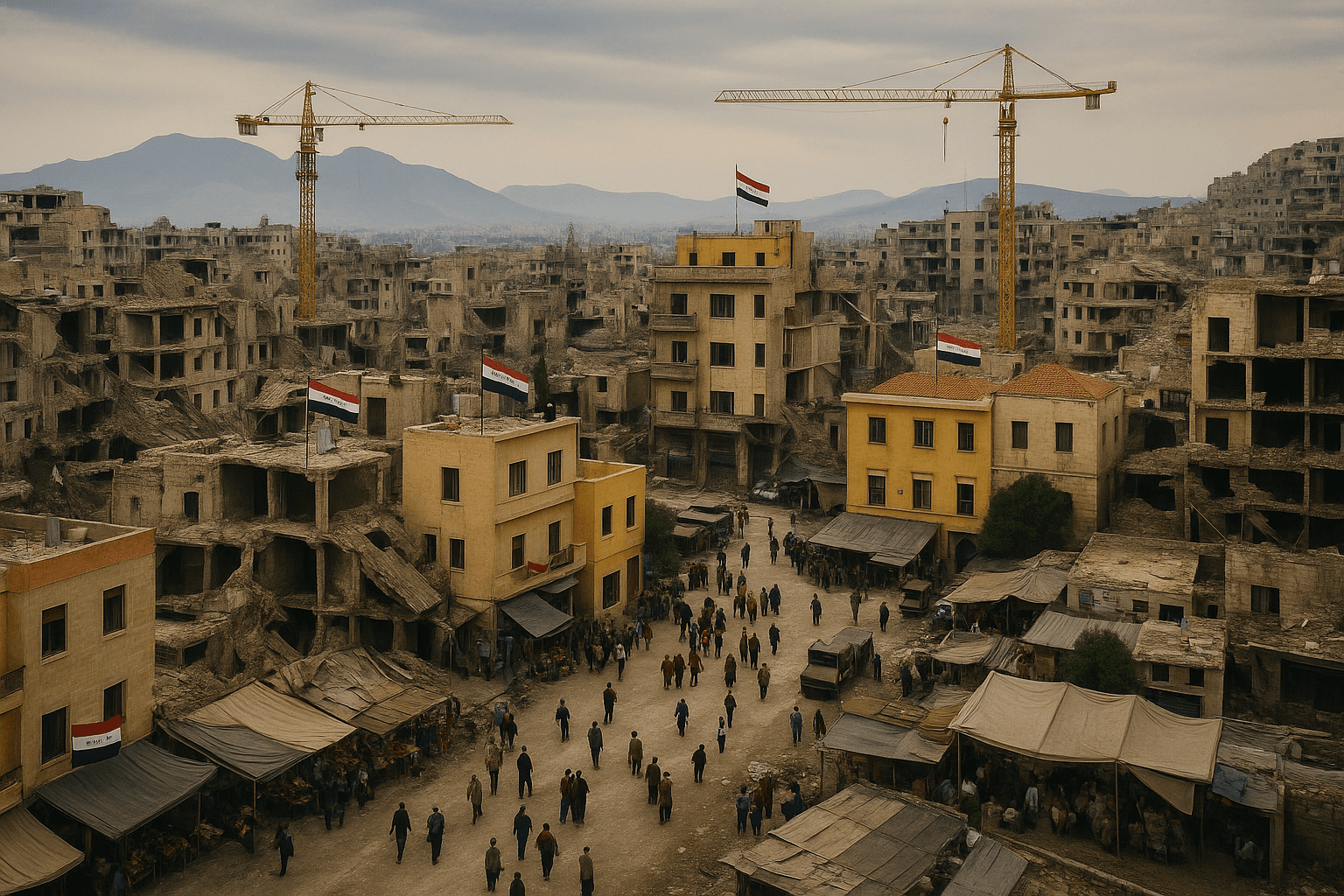
When the guns fall silent, the battle for a country’s future begins. The record of post-conflict transitions shows that what happens after the fighting can be as decisive as the war itself. Poorly managed transitions produce chaos, extremist resurgence, and renewed bloodshed. Well-structured ones stabilize a nation and open a path to lasting peace.
Syria is the live test. Bashar al-Assad fled Damascus on 8 December 2024, and the twenty months since have put every proposition below under load. Studying post-conflict transitions elsewhere, the failures as much as the successes, is how you tell a durable settlement from a pause. Six precedents follow, each with its lesson, and the closing sections measure what Syria has actually done against them.
Iraq (2003 to 2011): The Dangers of Power Vacuums
The U.S.-led invasion of Iraq in 2003 dismantled Saddam Hussein’s Ba’athist regime in a matter of weeks. What followed was a rapid and sweeping policy of de-Ba’athification, which removed thousands of civil servants, military officers, and local administrators from their positions. The intent was to break ties with the old order, but the result was an administrative collapse.
The absence of functioning institutions and inclusive governance created a vacuum. Sectarian divisions deepened as rival militias filled the gap, triggering years of violence and insurgency. By 2014, this instability paved the way for the rise of the Islamic State (ISIS). The failure was as much doctrinal as administrative, and it is the case study that reshaped Western thinking on counterinsurgency theory.
Lesson: Transitions must preserve essential state functions while introducing reforms. Removing an entire governing class without a replacement plan can accelerate instability and empower extremist factions.
Libya (2011 to present): Fragmentation After Gaddafi

In 2011, NATO-backed rebels toppled Muammar Gaddafi’s four-decade rule. However, the victory quickly gave way to political fragmentation. Multiple militias, each with different loyalties and regional bases, vied for power. The absence of a unified post-Gaddafi roadmap meant no single authority could consolidate control.
Years later, Libya remains divided between rival governments in Tripoli and Benghazi. Foreign powers back different sides, further complicating efforts at national reconciliation.
Lesson: Disorganized opposition coalitions may succeed in removing a dictator but fail to govern effectively. A coordinated and inclusive transition plan is essential to prevent long-term instability and outside manipulation.
Lebanon (1975 to 1990): Sectarian Power Sharing
Lebanon’s civil war, fueled by sectarian and regional rivalries, ended with the 1989 Taif Agreement. This accord introduced a sectarian-based power-sharing system, allocating political offices by religious affiliation.
Initially, the system reduced violence and allowed for reconstruction. However, it also institutionalized divisions, making national politics hostage to sectarian bargaining. Over time, the arrangement hindered governance and perpetuated political paralysis.
Lesson: Power-sharing can be a stabilizing force in fractured societies, but if it locks communities into rigid sectarian roles, it risks entrenching divisions and obstructing reform.
Afghanistan (1989 to 2001): The Perils of Foreign Proxy Wars

After the Soviet withdrawal in 1989, Afghanistan’s various mujahideen factions, each backed by a different foreign sponsor, turned on each other. Civil war followed, fueled by the agendas of regional powers including Pakistan, Iran, and Saudi Arabia, in the pattern that later analysts would file under proxy and hybrid warfare.
Foreign interference prolonged the conflict and derailed attempts at national reconciliation. The chaos eventually gave rise to the Taliban, whose rule set the stage for renewed international intervention in 2001.
Lesson: Post-conflict peace efforts are easily undermined when external powers back competing factions. Diplomatic coordination among regional and global actors is crucial to avoid a descent into proxy warfare.
Bosnia and Herzegovina (1992 to 1995): Strong International Mediation
The Bosnian War’s brutal ethnic cleansing and sieges ended with the 1995 Dayton Accords. Brokered by the United States and enforced by NATO troops and UN peacekeepers, the agreement froze the conflict and established a new constitutional framework backed by enforceable security guarantees, a rare case of international law arriving with the means to compel compliance.
Though the system remains complex and often dysfunctional, Bosnia avoided a return to war. International oversight, coupled with a robust peacekeeping presence, was instrumental in maintaining stability during the transition.
Lesson: In deeply divided societies, lasting peace may require sustained international mediation, security guarantees, and a credible enforcement mechanism.
Yemen (2011 to present): Negotiation Without Unity
In 2011, sustained mass mobilization forced President Ali Abdullah Saleh to resign after more than three decades in power. A negotiated transition installed his deputy, Abdrabbuh Mansur Hadi, as interim president.
The settlement failed to address Yemen’s deep political divides and excluded key actors. Within a few years, the Houthis seized the capital, sparking a full-scale civil war. Foreign interventions further entrenched the conflict.
Lesson: A negotiated settlement without genuine inclusivity or enforcement mechanisms risks unraveling. Transitional deals must integrate all major political and armed factions to be sustainable.
Measuring Syria Against the Precedents
The Syrian conflict is more complex than any single precedent, but twenty months of transition have produced a record to measure against the six cases above.
Avoiding a Power Vacuum
The fall of the Assad regime left a delicate balance of power among opposition forces, Kurdish-led administrations, and remnants of the old state. Syria did not repeat the Iraqi error of dissolving the state before building a replacement. A parliamentary election ran on 5 October 2025 with by-elections through 24 May 2026, President Ahmed al-Sharaa named the final 70 appointed members on 1 July 2026, and the People’s Assembly convened for the first time on 12 July 2026. TRH examines the machinery of that administration in Syria’s Transitional Government. Whether the assembly holds real authority is a separate question. The vacuum the Iraq precedent warns about did not open.
Managing Sectarian and Ethnic Tensions
Syria’s demographic diversity, spanning Alawites, Sunnis, Kurds, Druze, and Christians, demanded a power-sharing arrangement flexible enough to foster unity without the rigid sectarian gridlock Lebanon institutionalized. The Kurdish question was settled first by force and then on paper. Government forces opened an offensive in the northeast on 13 January 2026, and on 30 January 2026 Damascus and the Syrian Democratic Forces signed an integration accord under which SDF personnel join the Syrian Army as individuals while the government assumes control of the oil and gas fields, the border crossings, and the ISIS detention camps. Implementation was still contested through May 2026. Lebanon’s Taif Agreement also looked workable on paper.
Countering External Interference
Russia, Iran, Turkey, and the United States all hold entrenched interests in Syria, and the Afghan and Yemeni precedents warn that competing sponsors prolong wars indefinitely. Syria has so far escaped the worst of that pattern, largely because Iranian and Russian leverage collapsed with the regime it was attached to rather than transferring to a rival faction. That is a contingent advantage, not a structural one. It reverses the moment an outside power finds a client worth arming.
Reconstruction and Reconciliation
Rebuilding Syria requires far more than infrastructure repairs. This is the test Syria is closest to failing. Sectarian violence along the coast in March 2025 killed more than 1,400 people, mostly Alawite civilians, according to the Syrian government’s own inquiry; the UN Commission of Inquiry found the killings widespread and systematic, and the first trial opened only in November 2025. Reprisal outran reconciliation, exactly as the Iraq and Lebanon cases predict it will when justice mechanisms lag the transfer of power. Bosnia is the counter-example, and what made the difference there was sustained external enforcement.
Masters of Resistance collects the Lawrence, Mao and Guevara texts on how insurgencies win, which is the half of the problem that ends where the transitions described here begin.
View on Amazon →Final Considerations for a Post-Assad Transition
Syria’s path forward will require:
- An Inclusive Transitional Authority – Representation across ethnic, sectarian, and political lines to prevent marginalization.
- Structured International Mediation – A coordinated diplomatic effort involving all major foreign stakeholders to avoid proxy conflict.
- Security Guarantees – A credible peacekeeping presence or security framework to maintain order during the transition.
- Justice and Reconciliation Initiatives – Mechanisms to address past atrocities and build intercommunal trust.
- Economic and Humanitarian Planning – Immediate focus on reconstruction, economic stabilization, and the return of displaced populations.
Post-conflict transitions are fragile moments that either open the door to peace or plunge a nation back into violence, and the window in which the outcome is still open is short. Syria has cleared the first tests that Iraq and Libya failed. It has not yet cleared the ones Lebanon and Yemen failed. Abrupt seizures of power elsewhere, including the coup in Guinea-Bissau, are a standing reminder of how thin institutional legitimacy can be when it has not been earned in public.
