
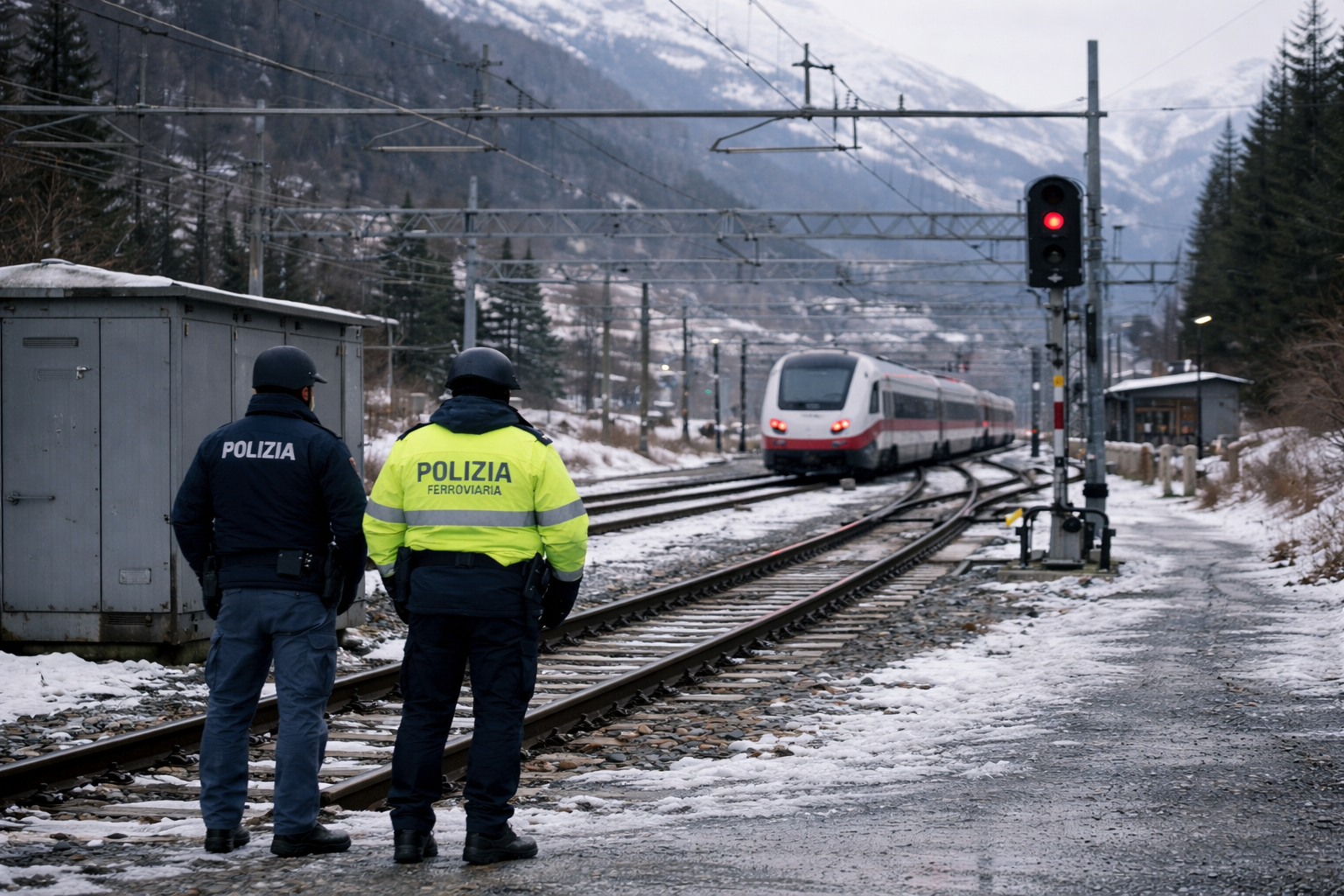
Since this article was first published, significant developments have clarified the scale and investigative trajectory of the Milano Cortina rail sabotage. Three coordinated incidents struck on February 7, 2026 — the opening day of the Winter Olympics — within a four-hour window: electrical cables were severed on the Bologna high-speed corridor, an improvised incendiary device was detonated at Castel Maggiore (a second device failed to initiate and was recovered for forensic analysis), and an electrical cabin was set ablaze near Pesaro on the Ancona–Rimini line. Approximately 40,000 passengers were affected, with delays reaching 150 minutes.
Bologna and Ancona prosecutors opened terrorism probes on February 9, charging conspiracy to commit terrorism and attacking transport safety. Italy’s DIGOS anti-terrorism unit leads the investigation. The Italian Ministry of the Interior classified the events as “serious sabotage” and “acts of terrorism.” On February 9, an anarchist claim was published on the portal La Nemesi, with a separate statement on sottobosko.noblogs calling for escalation from legal protest to clandestine action. A second wave of disruption struck on February 14, affecting Rome–Naples and Rome–Florence high-speed lines.
Separately, Italian Foreign Minister Antonio Tajani confirmed that cyberattacks of Russian origin targeting Olympic facilities and hotels had been repelled. No arrests have been reported as of March 2026, and the physical rail sabotage has not been formally attributed to a foreign intelligence service.
Sources: ANSA, Reuters, CNN, Al Jazeera, Wikipedia (2026 Italian rail sabotage), Decode39, Terrogence.
What Is Confirmed, What Is Suspected, and What It Signals for Europe
The 2026 Winter Games in northern Italy were always going to test infrastructure resilience. Mega-events concentrate visibility, compress timelines, and amplify disruption. In early February 2026, rail disruptions linked to suspected sabotage placed transport security at the center of the conversation.
Some incidents are confirmed acts of sabotage. Others remain under investigation. A small number involve claimed responsibility without official attribution. Beyond Italy, Europe has experienced a measurable rise in sabotage and hybrid disruption cases over the past two years, including several where authorities explicitly cited Russian-linked direction.
This article separates confirmed facts from allegations, compares Milano Cortina with the rail attacks during the Paris 2024 Summer Olympics, and situates both within the broader European trend of hybrid threats.
Publicly Acknowledged Incidents
Italian authorities publicly acknowledged that the incident involved deliberate physical interference with railway infrastructure. The damage disrupted passenger service along affected corridors and prompted an immediate operational response. Prosecutors opened a criminal investigation under public safety statutes, treating the event as sabotage rather than accidental failure.
Transport officials stated that contingency planning had been activated and that rail service was restored quickly, limiting longer-term disruption. At the time of initial reporting, authorities emphasized that there was no publicly identified link to a foreign actor.
What is confirmed is limited but clear: there was physical damage to rail infrastructure, service was disrupted, and a formal investigation remains ongoing. What remains unconfirmed includes the identity of the perpetrators, their motivation, and whether any external direction or coordination was involved.
Milano Cortina 2026: The Rail Incidents
What Is Confirmed
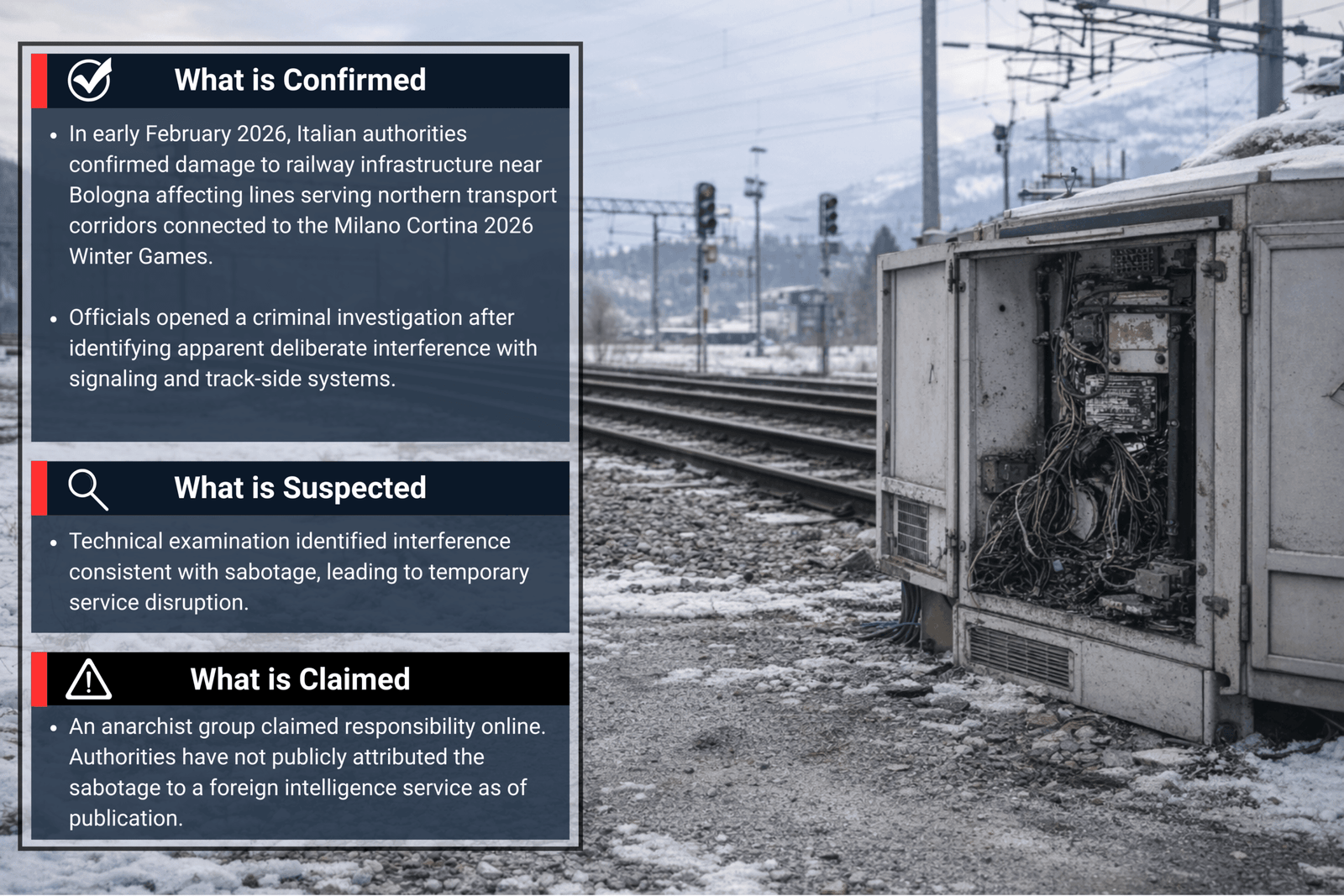
In early February 2026, Italian authorities confirmed damage to railway infrastructure near Bologna affecting lines serving the broader northern transport network connected to Milano Cortina 2026 Winter Olympics corridors.
According to reporting by Reuters, investigators described the incident as suspected sabotage after technical examination identified deliberate interference with signaling and track-side systems. Service disruptions followed, including delays and partial line suspensions.
What Is Claimed or Suspected
Subsequent reporting noted that an anarchist group claimed responsibility online. Authorities confirmed they were reviewing the claim. At the time of publication, no formal prosecutorial attribution had been made to a foreign intelligence service.
This distinction matters. A claim of responsibility does not equal verified responsibility. Italian officials have refrained from publicly naming a foreign actor in connection with this specific rail incident.
Parallel reporting indicated attempted cyber disruptions targeting Italian networks during the Games period. Some outlets referenced pro-Russian hacktivist activity in the broader Olympic context. However, the rail sabotage investigation and cyber incidents have not been formally linked by authorities.
At present, the Milano Cortina rail incident is confirmed as an act of sabotage and remains under active investigation. Authorities have not publicly declared foreign attribution, and no official statement has linked the event to an external intelligence service. The case therefore stands as a verified instance of infrastructure interference, with responsibility and motive still unresolved.
Olympic-Adjacent Threat Activity
Mega-events often attract multi-domain probing. Rail systems are attractive targets due to high visibility and low cost of disruption. Cyber operations, disinformation, and small-scale physical sabotage frequently cluster around such events.
Italian officials acknowledged heightened cyber activity during the Games period. Some reporting suggested possible Russian-linked hacktivist involvement in network disruption attempts. No official statement has tied the physical rail sabotage directly to state-sponsored direction.
This pattern is consistent with broader European security service warnings about 2026 being an elevated risk year for infrastructure interference. The key point is structural, not conspiratorial: Olympic hosting increases exposure to both domestic protest-driven disruption and foreign hybrid activity.
Paris 2024: A Clear Precedent
What Happened
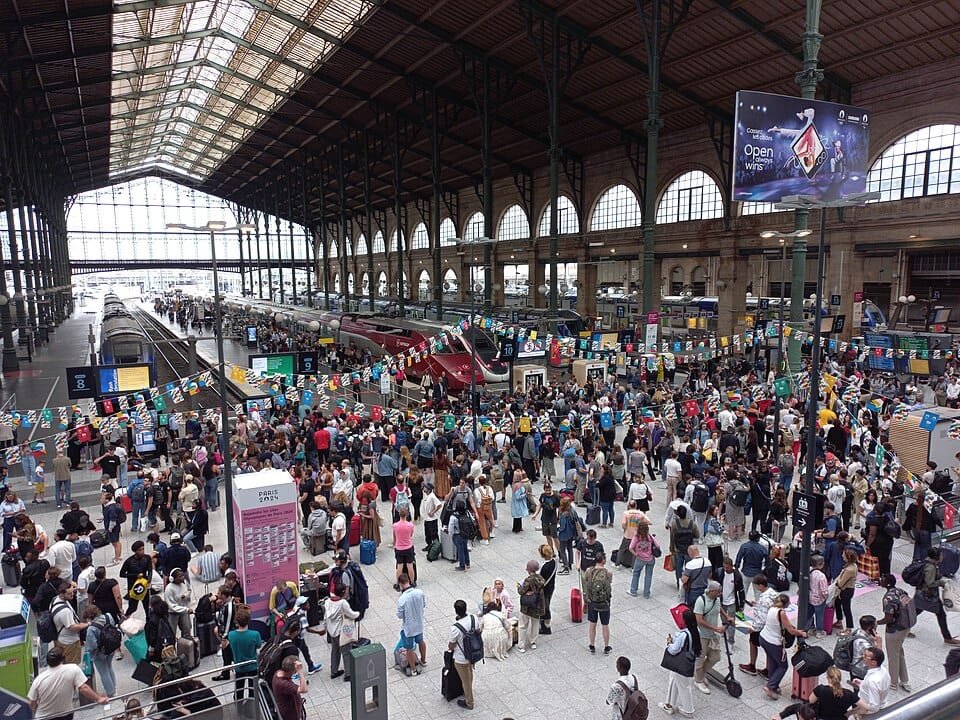
On July 26, 2024 — only hours before the opening ceremony of the Paris Games — coordinated arson attacks struck France’s high-speed rail network. Signal cables were deliberately set on fire at multiple locations, disrupting major TGV corridors and affecting hundreds of thousands of passengers at the outset of a global event.
Reporting by AP News and Reuters confirmed that the attacks were synchronized and deliberately targeted rail signal infrastructure using incendiary methods. The operational impact was immediate and significant, with widespread service disruption across key lines.
French authorities characterized the incidents as coordinated sabotage and opened criminal investigations into what they described as deliberate attacks on critical infrastructure during a high-visibility international event.
Attribution Posture
In the immediate aftermath of the July 2024 attacks, French authorities did not publicly attribute the sabotage to a foreign intelligence service. Investigations initially examined extremist networks and activist circles, with officials emphasizing that conclusions would be evidence-driven rather than speculative.
Analytical commentary in outlets such as The Economist explored possible geopolitical motivations and broader hybrid threat dynamics. However, French officials maintained a cautious public posture, limiting statements to verified facts and investigative findings.
The Paris incident exposed a structural vulnerability that extends beyond any single perpetrator. Rail infrastructure can be disrupted with relatively limited resources, particularly when signaling systems are targeted. Coordination across multiple sites multiplies operational impact, and timing attacks alongside mega-events significantly amplifies strategic visibility. It was against this backdrop that the Milano Cortina rail incident occurred, inevitably inviting comparison to the events in France two years earlier.
The Broader European Trend
The Olympic rail incidents did not occur in isolation. Since 2022, security services across Europe have reported a noticeable increase in sabotage and disruption cases affecting transport, logistics, and defense-related infrastructure.
AP News conducted a multi-country review examining suspected Russian-linked sabotage and interference cases across Europe, documenting a pattern of incidents ranging from arson to infrastructure tampering. Separately, ACLED has tracked a rise in events categorized as consistent with hybrid activity patterns, particularly in states supporting Ukraine.
The incidents vary in scale and method. They include arson attacks targeting logistics facilities, interference with rail infrastructure, attempted sabotage of defense-industry supply chains, and the placement of explosive devices near transport assets. In some cases, damage was limited and quickly contained. In others, investigations revealed more structured coordination.
Not all incidents have been conclusively attributed. Many remain under investigation or unresolved. At the same time, several European governments have publicly named Russian direction in specific cases, citing prosecutorial findings or security service assessments. This mixed landscape of confirmed attribution, ongoing investigation, and unresolved cases defines the current European security environment surrounding infrastructure protection.
The timeline above maps selected incidents where European authorities publicly acknowledged sabotage, suspected hybrid activity, or attributed direction to foreign services. The pattern underscores a structural shift: critical infrastructure — from undersea cables to rail signaling — has become a persistent target in Europe’s evolving threat environment.
Hybrid Threat Doctrine and Infrastructure Pressure
Research institutions such as RUSI and the Center for European Policy Analysis have characterized recent Russian activity in Europe as a form of shadow warfare or hybrid coercion. In this framework, pressure is applied below the threshold of conventional armed conflict through deniable, limited, and strategically calibrated actions.
Analysts describe several recurring characteristics. Operations often rely on the recruitment of local proxies or loosely affiliated actors rather than uniformed personnel. Financial inducements or criminal intermediaries may be used to create distance between planners and executors. Target selection is typically calibrated to avoid mass-casualty escalation while still generating disruption, economic cost, or psychological impact.
Rail infrastructure aligns closely with this model. It carries high symbolic and practical value, particularly in countries that rely heavily on passenger rail. At the same time, long stretches of track and signaling systems remain physically exposed and difficult to harden comprehensively. Interference can produce meaningful disruption without necessarily causing large-scale casualties. Media amplification further increases the strategic effect, especially when incidents occur during globally visible events such as the Olympic Games.
Mega-events magnify these dynamics. Concentrated international attention ensures that even limited physical damage can produce disproportionate strategic visibility.
Comparing Paris 2024 and Milano Cortina 2026
The incidents surrounding the Paris 2024 Games and the Milano Cortina 2026 Winter Olympics share several structural similarities. In both cases, rail infrastructure was targeted in proximity to Olympic timelines, and each incident produced highly visible transport disruption at moments of concentrated international attention.
At the same time, the scale and investigative posture differ. The Paris attacks involved confirmed, coordinated arson across multiple sites on France’s high-speed rail network, with synchronized interference designed to maximize operational impact. In contrast, the Milano Cortina incident involved confirmed sabotage at a smaller scale, and the investigation remains ongoing. As of publication, Italian authorities have not publicly attributed the rail sabotage to a foreign intelligence service. Similarly, French authorities did not immediately attribute the 2024 attacks to a foreign state in the immediate aftermath.
The most important commonality lies not in attribution but in vulnerability exposure. Rail networks remain structurally difficult to harden comprehensively. They extend across thousands of kilometers, depend on distributed signaling systems, and include numerous access points that are challenging to secure continuously. When disruption occurs during a globally visible event, the strategic effect is amplified regardless of the perpetrator’s identity.
Attribution Discipline and Analytical Boundaries
In the current security climate, it can be tempting to interpret every act of sabotage through a Russia-centered lens. Doing so, however, risks eroding analytical credibility and collapsing distinct cases into a single explanatory frame. Infrastructure interference in Europe includes domestic extremism, criminal opportunism, protest activity, and foreign-directed operations. Treating all incidents as externally orchestrated obscures important differences.
A responsible analytical posture begins with confirmed facts. Verified sabotage should be reported as such. Claims of responsibility should be clearly distinguished from established investigative findings. Where prosecutors or security services explicitly name actors or attribute direction to foreign intelligence services, those statements should be presented accurately and with sourcing. Beyond that boundary, inference should be restrained.
At the same time, omitting the documented rise in cases where European authorities have publicly linked sabotage or interference to Russian direction would remove essential context. Hybrid threat analysis requires holding both realities simultaneously. Not every incident is foreign-directed. Yet several documented cases have been. Maintaining that balance is central to credible assessment.
Implications for Rail Security and Mega-Events
Rail systems face structural challenges that make comprehensive hardening difficult. Physical exposure is distributed across vast networks that stretch for thousands of kilometers. Many signaling systems rely on legacy components that were not originally designed with modern sabotage or hybrid threat considerations in mind. At the same time, rail infrastructure remains inherently public, with numerous access points that cannot be sealed without undermining its function.
In response, European security and transport authorities have increasingly emphasized resilience over total prevention. This approach prioritizes redundancy in routing and control systems, rapid restoration capability following disruption, enhanced monitoring of critical nodes, and closer cross-border intelligence sharing. Legal frameworks have also evolved to enable more coordinated investigations across jurisdictions when sabotage is suspected.
Italy’s rapid restoration of service following the February 2026 rail incident illustrates this resilience-centered posture. While disruption occurred, contingency planning limited longer-term operational impact. More broadly, warnings issued by multiple European security services suggest that 2026 is viewed as a year of elevated hybrid risk, particularly for critical infrastructure associated with high-visibility events.
Infrastructure as Strategic Signaling
The rail sabotage associated with the Milano Cortina 2026 Winter Olympics is confirmed. Responsibility, however, remains under investigation, and claimed responsibility has not resulted in formal attribution to a foreign intelligence service. The distinction matters. Verified disruption does not automatically establish verified direction.
The events in France during the Paris 2024 Games demonstrated how coordinated rail sabotage aligned with an Olympic timeline can generate disproportionate disruption. Even limited physical damage, when timed to coincide with a globally visible event, can produce strategic visibility that exceeds the scale of the act itself.
Across Europe, documented sabotage and hybrid interference cases have increased since 2022, including several instances in which authorities have explicitly attributed direction to Russian services. These cases do not define every incident, but they shape the broader security context in which new disruptions are assessed.
Taken together, the pattern suggests that critical infrastructure remains an attractive vector for gray-zone pressure. Mega-events amplify the strategic effect of disruption, while the ambiguity inherent in hybrid operations complicates response and attribution. In that environment, analytical discipline is essential to maintaining credibility, and rail resilience has become a strategic security priority rather than a purely technical concern.
Milano Cortina 2026 is unlikely to be the final mega-event confronting this risk profile. The central question for Europe is whether deterrence, resilience planning, and intelligence coordination can raise the cost of disruption high enough to diminish its strategic utility.
A rigorous examination of how both Russia and the West define and weaponize the concept of hybrid warfare — essential context for understanding the attribution debates surrounding European infrastructure sabotage.
View on Amazon →A historical survey of hybrid conflict from antiquity to the present, demonstrating how states and non-state actors have long combined conventional and irregular methods — the framework underpinning the rail sabotage pattern analyzed in this article.
View on Amazon →A practitioner-focused collection covering NATO, EU, Russian, and Chinese perspectives on hybrid threats, with case studies from the Baltics, Ukraine, and Taiwan — directly relevant to the European infrastructure security landscape.
View on Amazon →