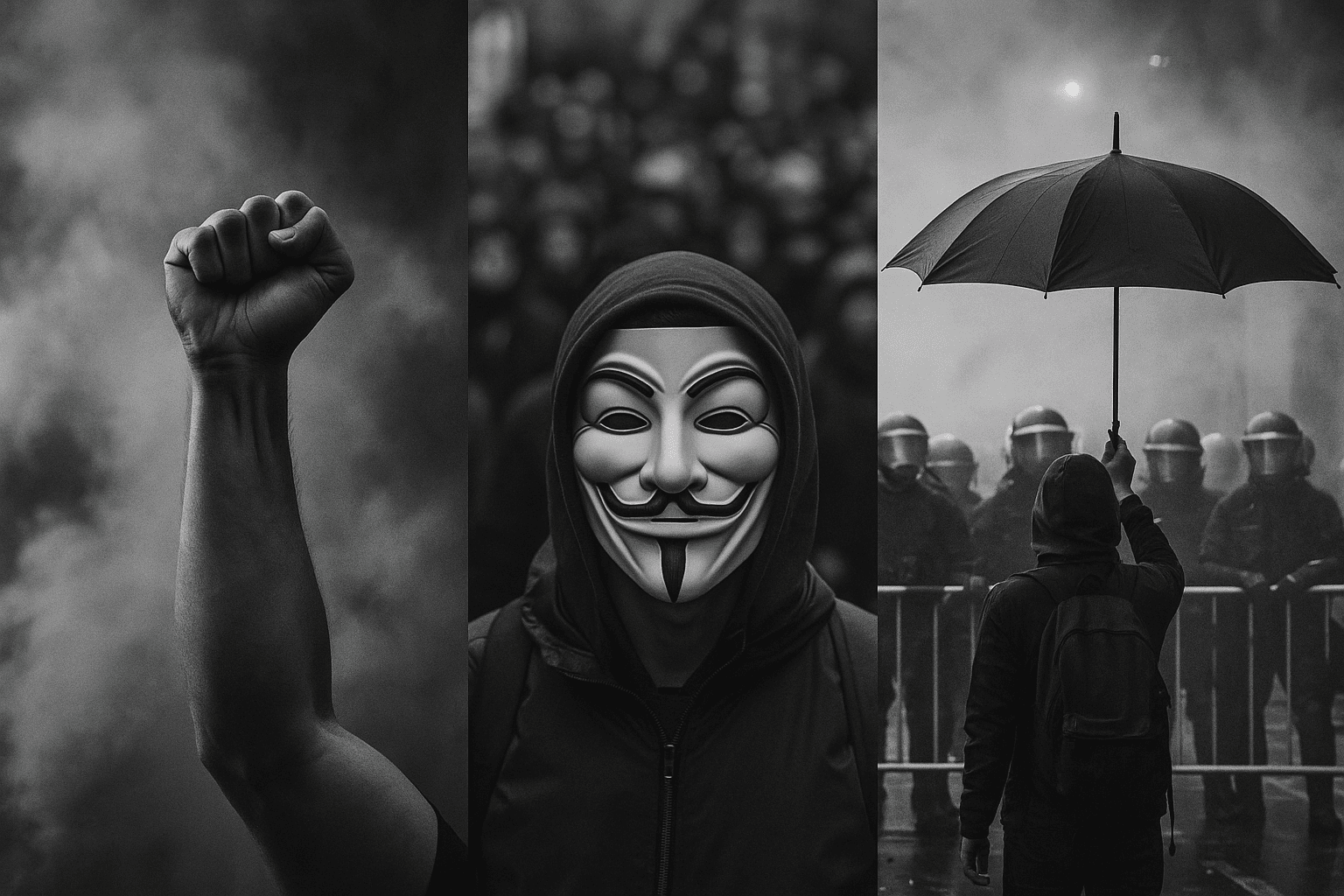
In every uprising, protest, or revolution, some moments transcend words. A lone figure with a raised fist. A sea of masked faces under glowing streetlights. A canopy of umbrellas repelling tear gas. These images don’t document. They define. They are the language of resistance, and like any language, they are strategic, deliberate, and powerful.
For resistance movements around the world, iconography is doctrine. It conveys messages under censorship, unites fragmented voices, and challenges authoritarian narratives. As Gene Sharp, the father of modern nonviolent resistance, observed, symbols are among the most powerful psychological weapons available to oppressed populations. The use of symbols, according to Sharp’s 198 Methods of Nonviolent Action, can form a foundation of resistance when all other tools are stripped away.
This article explores three of the most widely adopted symbols in contemporary resistance: the raised fist, the Guy Fawkes mask, and the umbrella. Each embodies purpose, anchored in psychology, history, and strategy.
The Raised Fist: A Universal Salute of Defiance
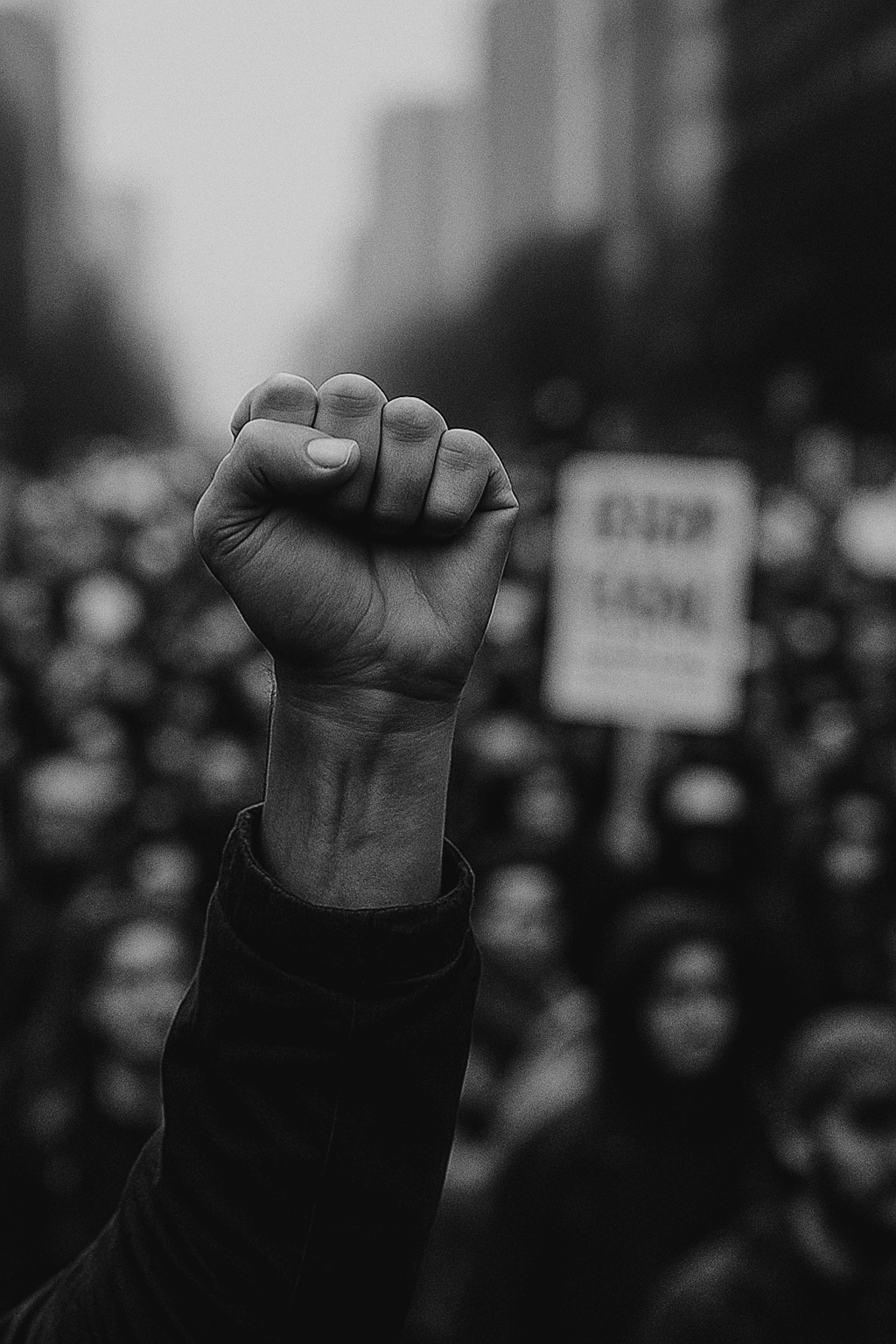
Few gestures are as instantly recognizable, or as politically loaded, as the raised fist. It’s a symbol that speaks across borders and decades, from anti-fascists in 1930s Spain to climate strikers in 2020s Europe. Its meaning is deceptively simple: defiance, solidarity, resistance.
A Symbol Forged in Struggle
The raised fist gained global prominence during the 1968 Mexico City Olympics, when American athletes Tommie Smith and John Carlos stood atop the podium with black-gloved fists in the air. It was a stunning moment of silent protest against racial injustice in the United States. But the fist predates even that. Labor unions in the early 20th century used it to symbolize worker unity. Anti-colonial and anti-fascist movements across Africa, Europe, and Latin America adopted it as a gesture of refusal.
Gene Sharp’s Alignment
Sharp placed the raised fist among the symbolic public acts, the block of his taxonomy that runs from wearing of symbols (Method #19) to rude gestures (Method #30), and treated them as a cornerstone of low-risk, high-impact resistance. The raised fist satisfies several of Sharp’s imperatives: it projects unity because the gesture is uniform, repeatable, and instantly aligns participants without coordination; it projects courage because it signals boldness without requiring weapons or confrontation; and it projects legitimacy because it conveys shared moral authority against oppression.
The Modern Fist
Today, the raised fist is omnipresent. During the Belarusian uprising of 2020, women in white raised their fists in silent chains of protest. In Chile’s 2019 protests, mural art and protest signs resurrected the gesture to denounce inequality. Iranian women, in defiance of the morality police, have used it in social media videos and demonstrations where even the act of raising a hand can be criminalized, a defiance documented in the Woman, Life, Freedom movement.
But the symbol has also faced appropriation and dilution. Corporate advertising has co-opted the gesture in vague nods to “empowerment,” often devoid of context. For resistance movements, preserving the clarity of meaning is part of the struggle. Serbia’s Otpor movement understood this. Its clenched fist logo became one of the most effective resistance brands in modern history, precisely because it was deployed with strategic discipline.
The Guy Fawkes Mask: The Face of Faceless Resistance
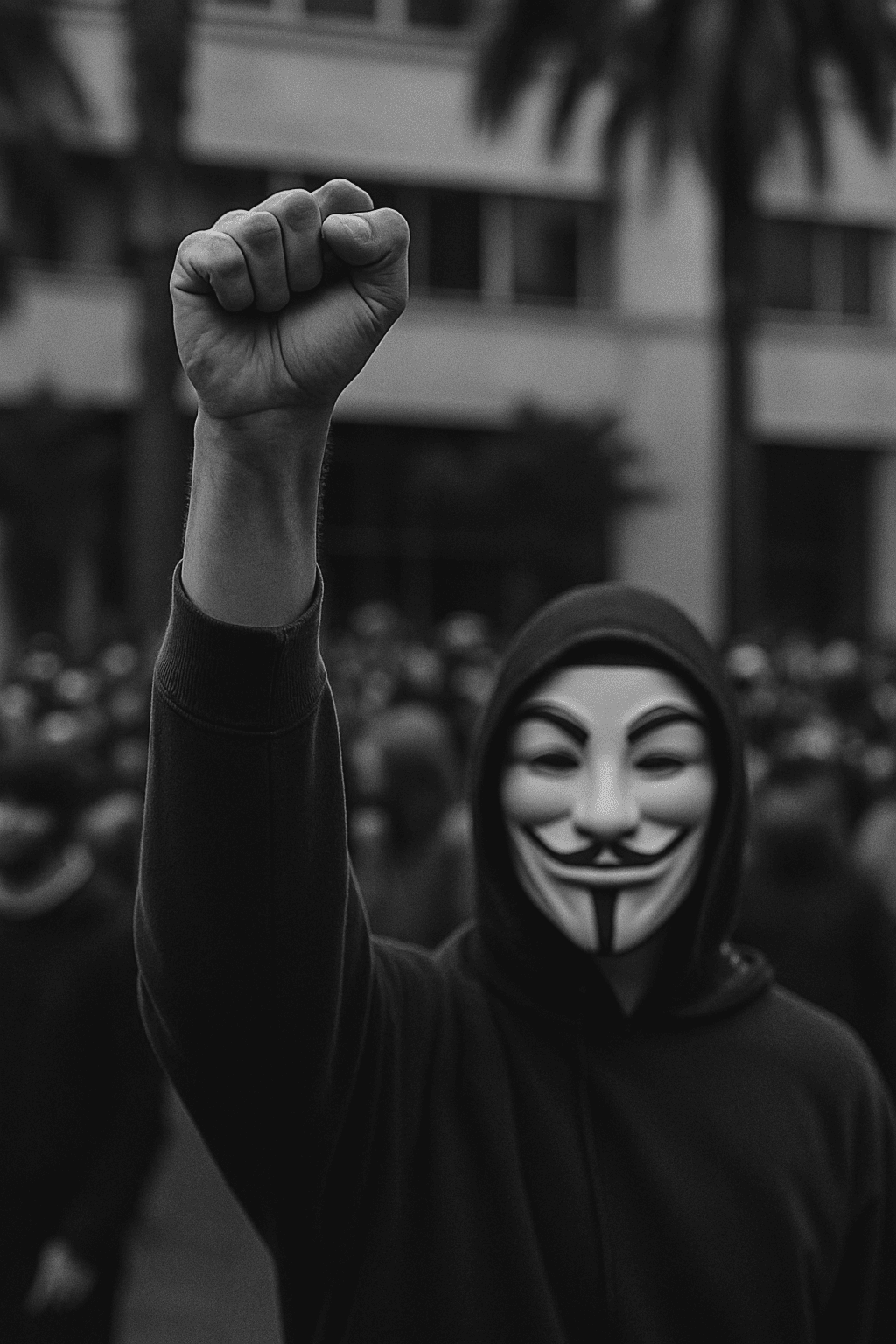
The Guy Fawkes mask, popularized by the V for Vendetta graphic novel and film, has become the digital-age balaclava. It blends anonymity, menace, and satire in one iconic visage. Originally a reference to the 1605 Gunpowder Plot in England, the mask became a symbol of Anonymous, then of the global Occupy movement, and eventually of networked resistance everywhere from Hong Kong to Nigeria.
Weaponizing Anonymity
In Sharp’s framework, the mask fits multiple roles. It protects individual identity, critical in authoritarian regimes, while also creating a shared face for leaderless movements. It is both a mask and a mirror.
Sharp’s Method #7, slogans, caricatures, and symbols, emphasizes that psychological disruption matters as much as physical resistance. A sea of Guy Fawkes masks disrupts surveillance and unnerves regimes. Who is the leader? Who can be punished? Where does one end and another begin? This is the power of leaderless network structures made visible.
On the Ground and Online
Occupy Wall Street (2011) cemented the mask’s global relevance, visually uniting disparate movements. In Hong Kong’s 2014 Umbrella Movement and again in 2019, masks were worn in defiance of anti-mask laws designed to aid facial recognition. In Nigeria’s #EndSARS movement, the mask became a digital avatar for protest, as many activists faced arrest or disappearance.
The symbol’s commercial origin, licensed by Time Warner, has drawn criticism. Can a resistance symbol owned by a media conglomerate truly remain subversive? Perhaps paradoxically, the answer is yes. Its mass production ensures accessibility, and its meaning has evolved far beyond its creator’s intent.
The Umbrella: A Shield and a Banner
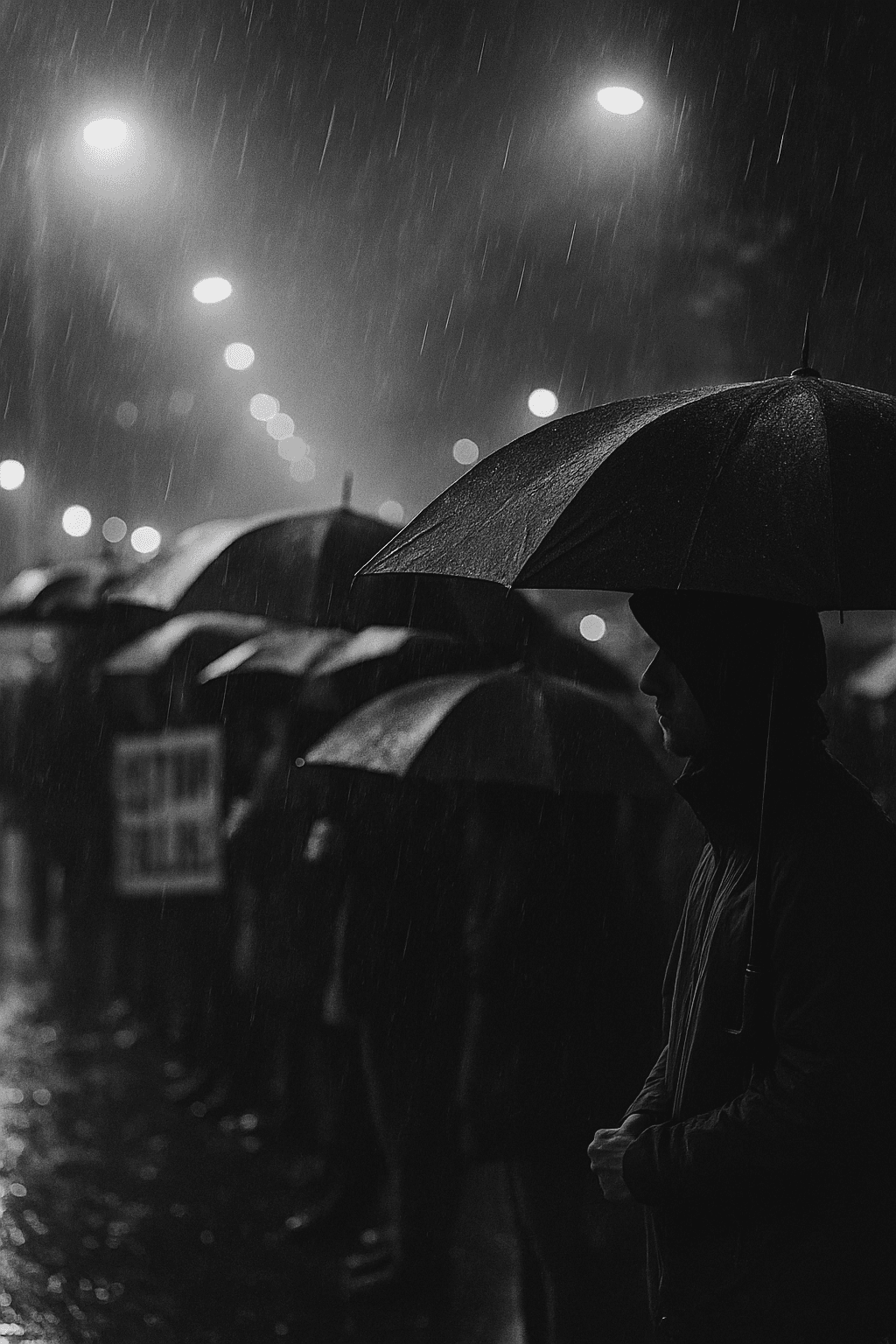
Of all the modern resistance symbols, the umbrella may be the most poetic. It is ordinary. Civilian. Almost laughably benign. Yet in 2014, when Hong Kong protesters opened umbrellas against police tear gas, they transformed an everyday object into a shield of democracy.
The term “Umbrella Movement” was coined not by protest leaders, but by the public and press, proving Sharp’s insight that delivering symbolic objects (Method #21) gain traction not by design, but by resonance.
Tactics in the Rain
The umbrella served practical, strategic, and symbolic roles. As protection, protesters used umbrellas to block pepper spray and obscure their identities from surveillance drones. As cohesion, a sea of umbrellas turned crowds into visual blocs, offering strength in apparent unity. As improvisation, a quality Sharp emphasized, umbrellas adorned with protest art or slogans became mobile billboards for the movement’s message.
Evolution of a Symbol
In Hong Kong’s 2019 protests, umbrellas re-emerged, this time color-coded for units or message clusters. In Myanmar, small folded paper umbrellas appeared on altars and roadside shrines during the civil disobedience movement, representing prayer and peaceful resistance. In Iran, symbolic umbrella art has surfaced in online protests where real-world action is often lethal. What makes the umbrella potent is its duality: it doesn’t provoke, it protects. It is an assertion of the people’s right to exist in public space, and it challenges the state’s monopoly on force without inviting escalation.
Why Symbols Work: The Gene Sharp Framework
Gene Sharp, in his lifetime of study on nonviolent action, understood the strategic potency of symbols. His frameworks are not just about marches or strikes, but about controlling the psychological terrain of conflict.
Symbols are low-cost, high-impact tools that scale rapidly because anyone can print a mask or raise a fist; defy censorship because images can go viral even when speech is silenced; unify disparate groups by creating cohesion without central leadership; and outlive movements because even if leaders are jailed or killed, the symbol survives. Each of the three icons explored in this article fulfills one or more of Sharp’s imperatives. They are psychological weapons because they rally, reassure, and reframe the battle.
| Symbol | Sharp Method | Primary Function | Key Deployments |
|---|---|---|---|
| Raised Fist | #19 / #30: Symbolic public acts | Unity, defiance, moral authority | 1968 Olympics; Otpor (Serbia); Belarus 2020; Chile 2019; Iran (Woman, Life, Freedom) |
| Guy Fawkes Mask | #7: Slogans, caricatures, symbols | Anonymity, disruption of surveillance, leaderless identity | Anonymous; Occupy Wall Street 2011; Hong Kong 2014 & 2019; Nigeria #EndSARS |
| Umbrella | #21: Delivering symbolic objects | Protection, improvisation, non-escalatory defiance | Hong Kong 2014 & 2019; Myanmar civil disobedience; Iran online activism |
Sources: Gene Sharp, 198 Methods of Nonviolent Action · TRH IW Glossary
Holding the Line in the Visual Arena
In asymmetric struggles, resistance movements often lose the battle of resources, but can win the battle of meaning. Symbols help them do that. They become the shorthand for sacrifice, unity, and aspiration. They transform ordinary objects, fists, masks, umbrellas, into emblems of extraordinary defiance.
But iconography is not passive. It requires stewardship. A good symbol must be usable, safe, and unforgettable. It must communicate to both the oppressed and the oppressor. And it must invite replication, as Sharp argued, to become a weapon of psychological warfare against repression.
As regimes adapt with propaganda, digital surveillance, and counter-messaging, resistance movements must treat their iconography not just as art, but as strategy. In the end, a symbol is more than an image. It is a rallying cry, a shield, and sometimes, a line in the sand.
// Further Reading
Gene Sharp, From Dictatorship to Democracy. The foundational manual on nonviolent resistance strategy, referenced by movements from Serbia to Egypt. Sharp’s framework for symbolic action underpins every case study in this article. Available on Amazon →
Srdja Popović, Blueprint for Revolution. How Serbia’s Otpor movement weaponized the clenched fist and other symbols to topple Milošević, then exported that model worldwide. Essential reading on the strategic use of iconography. Available on Amazon →
Albert Einstein Institution, 198 Methods of Nonviolent Action. Sharp’s foundational taxonomy of resistance techniques, from symbolic gestures to full noncooperation. Read →
National Geographic, The History of the Raised Fist. How a simple gesture became a global symbol of fighting oppression across cultures and centuries. Read →
// TRH Shop RESIST Sticker: Die-Cut Raised Fist Decal
The raised fist discussed in this article, available as a die-cut decal from The Resistance Hub. Wear the symbol.
View in Shop →