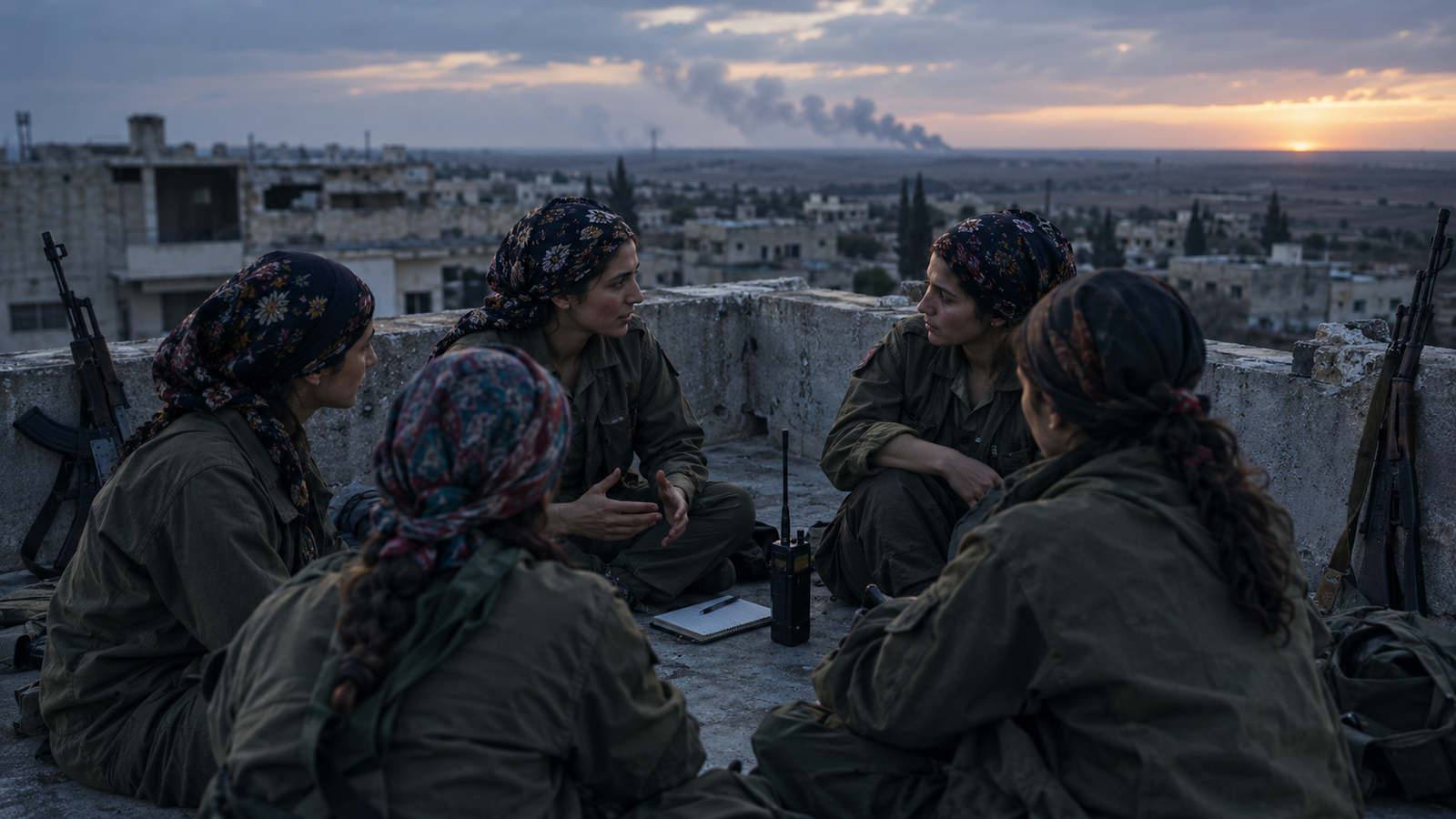
Revolutionary warfare is commonly understood as a struggle in which an organized political movement uses armed force to defeat an existing political order and establish a new one. This conventional view implies a relatively linear relationship between political organization, military action, and social transformation: the revolutionary movement provides political direction, military forces implement its objectives, and broader social transformation follows political or military victory. The experience of the Kurdish revolutionary movement, particularly the emergence of the Women’s Protection Units or YPJ (Yekîneyên Parastina Jin) in northern Syria, suggests a different relationship. Here, military struggle can be understood not simply as an instrument of revolution but as a condition within which the revolutionary movement, its organizations, political subjects, and social relations are continuously transformed.
Moe Gyo is a writer and consultant working with ethnic organizations in Myanmar. Writing from the Thai–Myanmar borderlands, he draws on years of direct engagement with communities shaped by conflict and disrupted health systems. His work captures firsthand how resilience and informal support networks develop under prolonged irregular warfare. His writing has appeared in the Small Wars Journal and the Journal of Special Operations Medicine, among others.
This perspective requires examining the transformation of the broader Kurdish revolutionary movement associated with the Kurdistan Workers’ Party (PKK). Its movement away from a predominantly state-centered conception of national liberation toward democratic confederalism, radical democracy, women’s liberation, and ecological politics changed the meaning of revolutionary transformation. Political liberation was increasingly conceived not primarily as the capture or creation of a nation-state, but as the construction of alternative forms of political and social organization. This provided the ideological and organizational conditions for autonomous women’s organization to become a central component of revolutionary practice rather than an auxiliary role within a predominantly male movement.
The development of the YPJ, however, was not simply the implementation of an ideology produced elsewhere. Women’s autonomous organization, political participation, military experience, and intellectual practices associated with Jineolojî also contributed to the continuing transformation of the movement. The relationship between the Kurdish revolutionary movement and the YPJ was therefore reciprocal: movement transformation enabled new forms of women’s organization, while women’s organization and practice further transformed the movement. The YPJ thus provides a particularly important site for examining how organizational transformation and political subject formation can occur together. It had to develop the command structures, discipline, training, leadership, logistics, intelligence, and tactical adaptability required of an effective military organization while simultaneously attempting to challenge the patriarchal relations that conventional military institutions can reproduce.
These processes can be understood through four interconnected transformations: the transformation of the revolutionary movement, the transformation of organization, the transformation of the political subject, and the transformation of social relations. Democratic confederalism provided a broader political framework for rethinking authority and collective organization, while Jineolojî provided an important framework for questioning patriarchal knowledge, gender relations, and women’s position within political and social life. Together, they linked organizational practice to the formation of new political subjects and to broader attempts at social transformation.
A 2016 documentary produced by the YPJ Media Center, tracing the formation of the Women’s Protection Units in December 2012 and their role in the defense of Rojava, from the founding conference in Dêrik through the resistance at Kobanê.
Loading video…
Military struggle should therefore be understood as the continuous material dimension through which these transformations were tested, constrained, and reproduced. The movement had to transform while fighting; the YPJ had to become militarily effective while attempting to transform military organization; and political subjects had to develop through participation under conditions of danger, uncertainty, and collective responsibility. The Battle of Kobane illustrates this simultaneity. The Peoples’ Protection Units or YPG (Yekîneyên Parastina Geland) and YPJ confronted a major Islamic State offensive under severe material constraints, while their survival also depended on external military assistance, including U.S.-led coalition airpower and Iraqi Kurdish reinforcement. Kobane therefore does not demonstrate that ideological transformation caused military victory. Rather, it illustrates how revolutionary transformation and military effectiveness could develop simultaneously under conditions of intense military pressure.
Loading podcast player…
The Kurdish case consequently suggests that revolutionary warfare is better understood as a simultaneous, recursive, and reflexive process rather than as a linear sequence from political organization to military victory and then social transformation. The transformation of the PKK-associated movement and the development of the YPJ were interconnected processes through which revolutionary organization, political agency, women’s liberation, self-defense, and social transformation were continually redefined in practice.
Where these organizations stand in September 2026: The PKK announced its dissolution in May 2025 and began disarming that July. In January 2026 Syrian government forces moved into the northeast, and an integration agreement concluded on 30 January set terms for absorbing the Syrian Democratic Forces into the state. The SDF announced its own dissolution in late August 2026. Damascus has declined to take the YPJ into the army as a distinct formation and has proposed an Interior Ministry role for its members, an outcome YPJ commanders have rejected. The essay below examines how organization, political subjects and military struggle shaped one another from Kobane onward. For the current Syrian picture, see Syria’s Transitional Government.
From National Liberation to Democratic Confederalism
The transformation of the YPJ begins before the YPJ itself existed. It begins with the transformation of the political movement from which it emerged. Founded in 1978, the PKK initially developed within a national-liberation framework in which the Kurdish question was closely connected to the establishment of an independent Kurdish state and the transformation of society through revolutionary political struggle. During the following decades, however, the movement’s political orientation changed substantially. Particularly after the PKK leader Abdullah Öcalan’s imprisonment in 1999, the movement increasingly developed a critique of the centralized nation-state and articulated an alternative political paradigm based on democratic autonomy, women’s liberation, and ecological politics. This development was a major transformation in the political thought of the Kurdish revolutionary movement rather than merely a tactical modification of its earlier national-liberation strategy.
The importance of this transformation lies in its redefinition of the revolutionary objective. If liberation is understood primarily as the establishment of an independent state, then the revolutionary organization is fundamentally oriented toward obtaining and exercising political sovereignty. The organization becomes an instrument through which power is accumulated and ultimately transferred into a new state structure. The PKK concept of democratic confederalism challenges this logic by shifting the focus from control over the state toward the construction of democratic political relations within society. The objective becomes the development of decentralized and participatory forms of political organization through which communities can govern themselves without reproducing the centralized structures of power characteristic of the nation-state.
This transformation changes the meaning of revolutionary time. Under a state-centered revolutionary model, the new society can be imagined as something to be constructed after victory. Under democratic confederalism, by contrast, the political practices of the movement become part of the transformation itself. If the desired society is to be democratic, participatory, decentralized, and emancipatory, then the revolutionary movement must attempt to develop forms of organization that embody these principles before any final political victory has been achieved. Revolution consequently becomes less a singular event and more an ongoing process of institutional construction and social transformation.
The significance of democratic confederalism therefore extends beyond political administration. It represents an attempt to transform the relationship between power and political organization. Rather than concentrating political authority within a state, democratic confederalism emphasizes communal and decentralized forms of organization through which political participation can be distributed throughout society. Research on the development of this paradigm identifies radical democracy, women’s liberation, and ecology as central dimensions of the transformed political framework.
This transformation also creates a new problem for the revolutionary movement itself. If the movement seeks to construct a society based on democratic and emancipatory relations, then the movement cannot simply reproduce authoritarian, patriarchal, or highly centralized relations within its own structures and expect those relations to disappear after victory. The revolutionary organization itself becomes an object of transformation. Its leadership, authority, gender relations, political education, and relationship to its members become part of the revolutionary question.
The transformation of the PKK should therefore be understood as involving not only a change in what the movement wanted to establish but also a change in what kind of movement it needed to become. The revolutionary actor itself had to be transformed because the organization was no longer conceived simply as a vehicle for capturing state power. It increasingly became a political institution through which alternative forms of collective life were to be developed and practiced. This transformation created the conditions for autonomous women’s organization to become central to the revolutionary process.
The Masters of Resistance collection distills the strategic thinking of Mao Zedong, T.E. Lawrence and Che Guevara on how insurgencies are organized, fought and sustained, the classical revolutionary models against which the Kurdish case can be read.
Get the Collection →Women’s Autonomous Organization and the Transformation of the Revolutionary Movement
The question of gender exposes one of the fundamental contradictions of revolutionary organization. A movement can oppose national oppression, capitalism, colonialism, or state domination while simultaneously reproducing patriarchal relations within its own institutions. Women may be mobilized for the revolution without possessing equal authority within the revolutionary organization. They may participate in military struggle without controlling the institutions in which military decisions are made. They may be celebrated as revolutionary symbols while remaining subordinate in everyday organizational relationships.
The Kurdish women’s movement developed in direct engagement with these contradictions. Women increasingly created autonomous structures through which they could organize independently, develop political education, exercise leadership, and challenge male dominance. The transformation of women’s political position was therefore not simply the result of an ideological declaration from the movement’s leadership. Women themselves fought for organizational and political autonomy over many years and that their achievements cannot be reduced to a top-down shift in ideology.
This point is essential for understanding the transformation of the PKK. If women’s autonomy were simply imposed by the male leadership of the revolutionary movement, then the process would remain fundamentally hierarchical. Women would be granted a new institutional status without necessarily becoming agents of transformation. The development of autonomous women’s structures instead created an institutional mechanism through which women could participate in transforming the movement itself.
Jineolojî (“science of women”) is a theoretical and methodological framework developed within the Kurdish revolutionary movement, principally through the writings of Abdullah Öcalan and the work of the Kurdish women’s movement. Rather than constituting a conventional academic discipline, Jineolojî seeks to reconstruct knowledge by challenging patriarchal assumptions embedded in history, the social sciences, and political thought. It argues that women’s liberation requires not only institutional or legal reforms but also a transformation of the ways knowledge, history, and social relations are understood. Within the broader framework of democratic confederalism, Jineolojî provides the epistemological foundation for autonomous women’s organization by linking personal experience, political education, and collective struggle to the creation of new forms of political subjectivity and social life. This perspective therefore functions not merely as feminist theory but as an integral component of the Kurdish revolutionary framework.
Jineolojî became an important expression of this process. Rather than treating women as a category that simply needed to be included in existing political structures, Jineolojî questioned the ways in which knowledge, history, social relations, and political authority had been organized around patriarchal assumptions. It provided an intellectual framework through which women’s liberation could be connected to broader questions of political and social transformation. Jineolojî can be characterized as an ideological underpinning and epistemology of Kurdish women’s political struggle while also situating it within broader transnational feminist debates.
Jineolojî and democratic confederalism consequently address different but interconnected dimensions of the same revolutionary transformation. Democratic confederalism concerns the organization of political and social power, while Jineolojî concerns the transformation of knowledge, gender relations, and women’s political subjectivity. Democratic confederalism asks how society might organize authority differently, while Jineolojî asks how people, particularly women, must transform their relationship to knowledge, power, and social identity for such a political order to become possible.
The relationship is therefore mutually reinforcing. Democratic confederalism creates political space for autonomous organization, while autonomous women’s organization gives concrete institutional form to the principle that liberation requires the transformation of gender relations. Jineolojî provides an intellectual framework for that transformation, while organizational practice provides the experience through which the framework can be tested and modified. The YPJ emerged from this historical process.
The Transformation of the YPJ
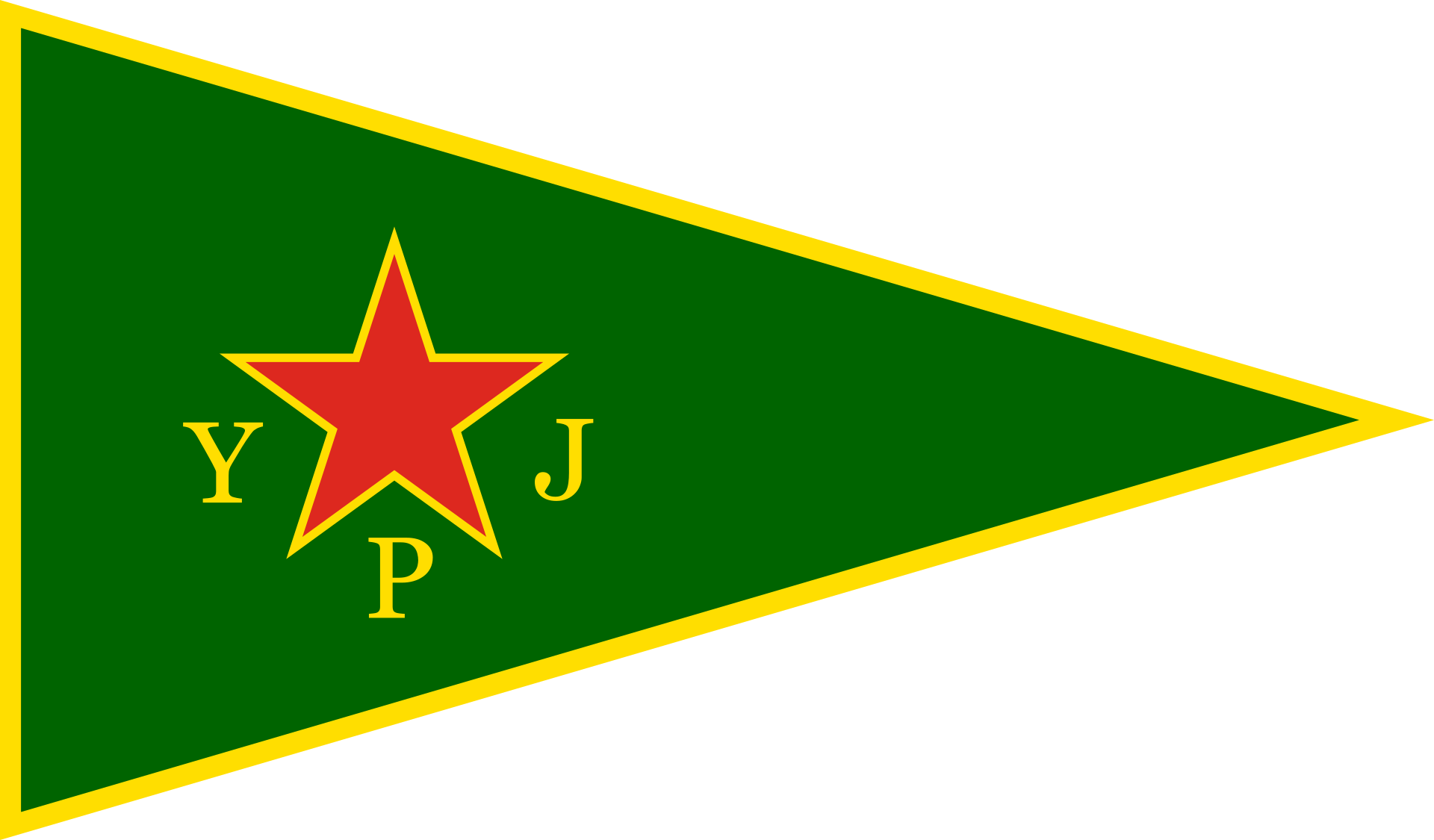
The YPJ was established in 2013 in northern Syria as an autonomous women’s military organization within the broader political and military structures developing during the Syrian conflict. Its creation represented an important transformation in the institutional position of women within a revolutionary military organization. Women were no longer simply participating as individuals within a predominantly male military structure. They possessed an autonomous organization through which they could develop military leadership, political education, organizational responsibility, and collective identity.
This transformation should not be considered simply that the YPJ was composed of women. Its significance lies in the relationship between autonomy and political agency. An autonomous women’s organization creates the possibility for women to exercise authority collectively rather than merely receiving access to an institution whose basic structure remains defined by men. The organization becomes a space in which women can produce their own leaders, develop their own organizational knowledge, establish their own political priorities, and define their own relationship to military power.
The transformation of the YPJ was consequently simultaneously military and political. It had to create a military organization capable of operating under extremely difficult conditions, but it also sought to create a different relationship between military organization and political subjectivity. The organization had to maintain discipline while cultivating agency, establish leadership while challenging domination, and develop command structures while emphasizing collective responsibility.
This produced an important contradiction. Military effectiveness generally requires clear command relationships, differentiated responsibilities, discipline, specialization, and the capacity for rapid decision-making. Revolutionary democracy, by contrast, can emphasize participation, autonomy, equality, and distributed authority. The transformation of the YPJ therefore could not consist of simply abolishing hierarchy. Such an approach would risk undermining the very military capacity necessary for the organization to survive.
The more significant transformation concerns the meaning and organization of authority. Leadership can be understood as more than command; it can involve education, responsibility, mentoring, development of new leaders, organizational learning, and accountability. Discipline can be understood as more than obedience; it can become a form of collective responsibility toward the organization and the political principles. Authority can remain necessary without being understood as inherently legitimate simply because it is hierarchical.
This does not mean that the YPJ eliminated hierarchy or resolved the contradiction between military command and political equality. Instead, the contradiction itself became a central organizational problem that had to be continually managed. Organizational transformation therefore consisted not in abolishing authority but in changing its character by redefining the relationship between authority and the individual, emphasizing accountability, political education, and collective responsibility over domination.
This distinction is central to the wider transformation of the PKK-associated revolutionary movement. If democratic confederalism requires autonomous and participatory political subjects, then the movement requires organizations capable of producing such subjects. The YPJ therefore becomes not simply an institution that carries out military tasks but a formative institution in which political subjects are developed.
The Transformation of the Political Subject
The transformation of the political subject is inseparable from the transformation of the organization. A revolutionary organization cannot construct a democratic political order solely through institutional design if the people within it remain passive objects of political authority. The transformation of society therefore requires the transformation of individuals into political actors capable of collective responsibility, participation, judgment, and self-organization.
The YPJ represents one institutional mechanism through which this transformation could occur. A woman entering the YPJ was not simply becoming a combatant. She entered an organization in which military training, political education, collective responsibility, leadership, and autonomous women’s organization could become interconnected. The transformation was therefore from individual to political participant and from protected subject to agent of collective self-defense.

The gendered dimension of this process is particularly important. Patriarchal social systems have historically associated women with dependency and men with authority, political decision-making, and legitimate violence. Women’s participation in armed self-defense disrupts this division because women become visible as political actors capable of exercising authority and assuming responsibility for collective survival. The importance of the YPJ therefore lies not simply in demonstrating that women can fight but in challenging the social assumption that political and military agency belongs primarily to men.
Participation in armed struggle does not automatically create an emancipated political subject. Military organizations can reproduce authoritarianism, obedience, violence, and domination regardless of the gender of their members. The transformative potential of the YPJ therefore depends on the broader political and organizational practices through which military participation is connected to political education, autonomous organization, collective responsibility, and gender transformation.
This is why Jineolojî matters to the formation of the political subject. It provides a framework through which women can interpret their personal experiences not simply as individual problems but as expressions of broader social structures. The personal experiences of patriarchy by the members of the YPJ could become connected to broader ideological understandings of liberation and democracy. The individual experience is thus transformed into political consciousness, and political consciousness becomes a basis for collective action.
The process is recursive because political subjects do not merely emerge from organizations and then remain unchanged. They also transform the organizations in which they participate. A politically educated and organizationally capable member can exercise initiative, question established practices, assume leadership, identify contradictions, and contribute to institutional adaptation. The organization produces the political subject, but the political subject reproduces and transforms the organization.
From the Transformation of the YPJ Back to the Transformation of the Movement
The relationship between the YPJ and the Kurdish revolutionary movement can therefore be understood as a continuous feedback process. The transformation of the PKK-associated movement toward democratic confederalism and women’s liberation created the ideological conditions for autonomous women’s organization. Yet the YPJ and the wider Kurdish women’s movement then became institutional spaces through which these principles were tested and developed.
This means that the YPJ should not be understood simply as an organizational product of the PKK’s ideological transformation. Such a formulation implies that the movement first developed its political theory and subsequently created an organization to implement it. The actual relationship is more dynamic. The movement transforms the organization, but the organization generates practices and experiences that can transform the movement.
This recursive relationship is particularly visible in the development of women’s autonomous political and military structures. Women entered the revolutionary movement, experienced its contradictions, created autonomous institutions, developed their own political education and leadership, and subsequently contributed to changing the movement’s understanding of women’s liberation and revolutionary organization. The transformation of the movement therefore occurred partly through the transformation of its own internal relations.
Although the YPJ emerged from the broader Kurdish revolutionary movement associated with the PKK, it was constituted as an autonomous women’s military organization in northern Syria. The relationship between the two is therefore not one of organizational equivalence but of reciprocal political and organizational development. The movement’s ideological transformation created the conditions for the YPJ’s formation, while the YPJ became an institutional arena in which the movement’s principles of democratic confederalism, women’s liberation, and autonomous organization were implemented, tested, and further refined.
The relationship can consequently be understood as a movement from movement to organization and then back from organization to movement. The transformed movement produces new organizational possibilities; the organization produces new political subjects; political subjects develop new practices; and those practices can modify the broader movement. The revolution therefore transforms itself through the organizations and subjects that it creates.
This is one of the most significant differences between a conventional revolutionary model and the political framework represented by democratic confederalism. In a conventional model, the revolutionary organization may understand itself as an instrument that will eventually become unnecessary after victory. In the transformed paradigm, organization becomes part of the revolution’s ongoing practice. The movement must continuously ask whether its own institutions reproduce the forms of domination that it claims to overcome.
The YPJ therefore represents not simply the implementation of democratic confederalism but one of the arenas in which democratic confederalism becomes materially contested. The organization has to negotiate between autonomy and coordination, equality and command, participation and specialization, political education and operational efficiency, and revolutionary principles and military necessity.
Military Struggle as the Material Test of Transformation
The military dimension is essential because revolutionary transformation cannot be examined only at the level of political theory. The YPJ operated in conditions in which failure had immediate material consequences. The organization had to survive military attack, defend territory and communities, and maintain operational capacity under conditions of extreme uncertainty. Military struggle is the environment through which all the other transformations are continuously tested.
Combat can reveal organizational weaknesses. Failures in command, logistics, communication, leadership, training, intelligence, or coordination create pressures for organizational change. Military experience therefore becomes a source of organizational learning.
Combat can also transform political subjects. Individuals confronted with uncertainty and danger must exercise judgment, responsibility, courage, cooperation, and initiative. Military experience can therefore become one of the contexts through which political agency is developed, although this outcome is not automatic.
Military struggle can also transform the broader movement. Strategic failures and successes can influence political priorities, organizational structures, alliances, and conceptions of self-defense. The movement therefore learns through warfare.
Finally, military struggle can determine whether the social and political institutions being constructed can survive. An emerging political order cannot easily reproduce alternative institutions if those institutions are destroyed militarily. Self-defense therefore becomes a condition for the continuity of political transformation.
The relationship is consequently reciprocal. Political organization shapes military capacity, while military experience reshapes political organization. Political subjects contribute to military effectiveness, while military participation can transform political subjects. The broader movement provides strategic direction, while military experience can force the movement to reconsider strategy. Emerging social institutions provide the political environment for collective defense, while collective defense protects the space in which those institutions can develop. Military effectiveness is a condition that the revolutionary movement must continuously negotiate.
War acts on every level of the revolutionary process simultaneously. Each arena feeds back into the others, which is why the relationship runs in both directions.
Kobane and the Possibility of Simultaneous Transformation
The Battle of Kobane provides the most important empirical case for examining this relationship. Beginning in 2014, the Islamic State launched a major offensive against Kobane, placing the YPG and YPJ under intense military pressure. The defenders faced significant disadvantages in heavy weapons and military resources, while the Islamic State possessed substantial offensive capabilities. However, the situation emphasized the defenders’ local knowledge, tactical adaptation, cohesion, and determination.
The significance of Kobane lies instead in the coexistence of military struggle and political transformation. The YPJ was simultaneously engaged in combat and operating as an autonomous women’s organization. Women were simultaneously participating in military defense and challenging established gender assumptions concerning political authority and violence. Political subjects were being formed through organizational participation under conditions of extreme danger. The broader revolutionary movement was simultaneously attempting to defend and develop a political order based on democratic autonomy and confederal organization. Kobane therefore provides evidence for the possibility of simultaneity.
These transformations did not occur sequentially, with military victory first and political transformation later. The transformation of the revolutionary movement, the transformation of the YPJ, the transformation of political subjects, and the defense of emerging social institutions were occurring within the same historical process.
This does not mean that these transformations were completed at Kobane. Nor does it mean that the battle proves democratic confederalism to be militarily superior. However, Kobane demonstrates that political transformation and military effectiveness can coexist under conditions in which both are simultaneously necessary.
The battle therefore challenges the assumption that revolutionary movements must choose between political transformation and military effectiveness. The YPJ could not afford to become militarily ineffective, because military failure would threaten the communities and political institutions that it sought to defend. At the same time, the military struggle did not require the organization to abandon its autonomous women’s identity or the broader political framework within which that identity was situated.
The importance of Kobane is consequently not simply military. It is organizational and political. The battle became a demonstration that a transformed revolutionary organization could attempt to maintain military effectiveness while continuing to reproduce a transformed conception of women’s political agency and collective self-defense.
The Contradiction Between Military Necessity and Democratic Transformation
The simultaneous character of these processes should not obscure their contradictions. Military organizations are structurally exposed to pressures toward hierarchy, secrecy, centralization, specialization, and obedience. Democratic political organizations generally seek participation, transparency, autonomy, and distributed authority. The revolutionary military organization therefore occupies a contradictory institutional position.
Combat requires differentiated responsibilities and command. This raises a more important question of whether hierarchy becomes a permanent form of domination or remains embedded within a broader political relationship characterized by accountability, education, collective responsibility, and autonomous political agency.
This suggests that revolutionary organizational transformation should be understood not as the abolition of all hierarchy but as the transformation of the relationship between authority and those who exercise and receive it. Leadership can become a responsibility rather than a privilege. Command can be connected to accountability. Discipline can be linked to collective political purpose. Organizational authority can be exercised within a political culture that attempts to prevent authority from becoming detached from the collective.
Such an arrangement remains inherently difficult, particularly under conditions of war. Military necessity can push organizations toward centralization precisely when revolutionary principles demand decentralization. The significance of the Kurdish case is therefore not that it has permanently solved this contradiction but that it has made the contradiction itself part of the revolutionary problem.
This is also why the transformation of the YPJ cannot be separated from the transformation of the PKK-associated movement. The broader movement’s shift toward democratic confederalism created an expectation that political authority should be decentralized and that social relations should be transformed. The YPJ then had to determine how such principles could be reconciled with the requirements of military organization. The result is not a simple synthesis. It is a continuous process of negotiation.
The Transformation of Society
The transformation of both the Kurdish revolutionary movement and the YPJ ultimately points toward a broader transformation of society. Democratic confederalism is significant because it seeks to locate political transformation within society rather than treating the state as the exclusive site of political power. The development of communes, councils, autonomous institutions, and participatory structures in northern Syria reflected an attempt to construct forms of political organization consistent with this broader paradigm.
The social transformation, therefore, differs from conventional revolutionary models in which political power is first captured and social transformation subsequently implemented. Democratic confederalism instead emphasizes the construction of alternative institutions within existing conditions. The revolution is consequently not simply a future event but an ongoing process of institutional experimentation.
Women’s autonomous organization is central to this process because gender transformation cannot be separated from political transformation. If political authority is decentralized but remains overwhelmingly male, then decentralization alone does not produce gender emancipation. The political transformation of society therefore requires changes in who participates, who exercises authority, and how gender relations are reproduced.
The YPJ connects this social transformation to self-defense. Its military role protects the political and social environment in which alternative institutions can survive. But the relationship is not one-directional. Society also provides the human and political basis for collective defense. Military organization depends upon social organization, while social organization depends upon a degree of security.
This relationship means that military struggle and social transformation are mutually conditioning. The military organization is not simply defending territory in an abstract sense. It is defending the possibility of a particular political and social order. At the same time, the political and social order provides the legitimacy and organizational environment within which collective defense can be sustained.
The Revolutionary Movement as a Self-Transforming Actor
The relationship among the PKK, democratic confederalism, the YPJ, Jineolojî, and political subject formation ultimately suggests that the revolutionary movement must be understood as a self-transforming actor.
The movement is not simply attempting to transform an external enemy or social structure. It is also attempting to transform its own organizational and political relations. This makes revolutionary transformation reflexive. The movement must continually examine whether its practices correspond to its stated political objectives.
The transformation of the PKK-associated movement illustrates this reflexivity at the ideological level. The movement reconsidered the state-centered assumptions of its earlier national-liberation paradigm and developed a political framework centered increasingly on democratic autonomy, radical democracy, women’s liberation, and ecology.
The transformation of autonomous women’s organization represents reflexivity at the organizational level. Women challenged patriarchal relations within the revolutionary movement and developed autonomous institutions through which alternative relationships of authority could be constructed.
The YPJ represents reflexivity at the military-organizational level. The organization had to confront the contradiction between revolutionary equality and military hierarchy while maintaining the practical capabilities necessary for survival.
The transformation of the political subject represents reflexivity at the individual and collective level. Individuals were encouraged to examine their own assumptions, social conditioning, relationship to authority, and understanding of gender and political responsibility.
The transformation of society represents reflexivity at the institutional level. Political institutions were expected not simply to reproduce established state structures but to experiment with alternative forms of participation and collective governance.
These levels are interconnected. Each transformation creates contradictions that can generate further transformation.
From Transformation to Recursion
The most appropriate conceptual model for the Kurdish case is therefore not a linear sequence but a recursive system. The transformation of the PKK-associated revolutionary movement toward democratic confederalism created the political conditions for autonomous women’s organization. Autonomous women’s organization contributed to the development of new forms of political agency and gender relations. These practices became institutionalized within organizations such as the YPJ. The YPJ produced political subjects who could exercise military and organizational agency. Those political subjects reproduced and modified the organization. The organization, through its experiences and practices, contributed to the continuing transformation of the broader movement.
At the same time, military struggle passed through all of these relationships. Military necessity influenced organizational structure. Organizational structure influenced military effectiveness. Combat experience influenced political subject formation. Political subjects influenced military initiative and adaptation. Military experience influenced movement strategy. Military defense protected the political and social space in which democratic institutions could develop. Social institutions provided the political environment necessary for collective defense.
This means that the revolutionary movement cannot be understood as a fixed entity that creates a military organization and then directs it from above. Nor can the YPJ be understood as an autonomous organization completely detached from the broader movement. Their relationship is better understood as mutually constitutive.
The PKK-associated movement transformed the conditions under which the YPJ became possible.
The YPJ then became one of the institutional forms through which that transformation was practiced.
The experience of the YPJ contributed to the production of political subjects and organizational practices.
Those practices fed back into the broader revolutionary process.
The process therefore contains no definitive starting point or final endpoint.
Each stage produces the conditions for the next, and the last feeds back into the first. Military struggle passes through every stage of the loop.
Theoretical Implications for Revolutionary Warfare
This understanding of revolutionary warfare has implications beyond the Kurdish case. It suggests that revolutionary warfare should not be conceptualized simply as the military expression of a political program established independently of warfare. Military struggle can itself become a site of political and organizational transformation.
The crucial distinction is between understanding military struggle as an instrument of politics and understanding it as a constitutive dimension of revolutionary transformation. In the first sense, military force is simply a means of achieving political objectives. In the second, warfare is not merely a means but a social and political process that continually reshapes organizations, political subjects, strategies, and institutions through the pressures of conflict and adaptation.
This does not imply that warfare is inherently emancipatory. War can reinforce authoritarianism, militarization, hierarchy, violence, and social destruction. Military organization can reproduce precisely the forms of domination that revolutionary movements claim to overcome. The transformative potential of military struggle therefore depends on how political organizations respond to these pressures.
The Kurdish case is significant because it represents an attempt to confront this problem explicitly. Military self-defense was treated as necessary, but military organization was also embedded within a broader political framework concerning democracy, women’s liberation, and social transformation.
The resulting model is therefore characterized by tension rather than harmony. Military effectiveness requires command; democratic transformation requires participation. Military survival may require secrecy; democratic politics requires accountability. Military organization requires specialization; revolutionary equality challenges rigid status distinctions. The revolutionary process cannot simply eliminate these contradictions. It must continuously manage them.
The concept of simultaneity is therefore more useful than the concept of synthesis. The goal is not necessarily to eliminate the contradiction between military hierarchy and democratic participation but to construct organizational practices capable of operating within that contradiction.
Kobane provides an important historical illustration because the defenders had to perform effectively within a real military environment while the broader revolutionary process remained committed to organizational and social transformation. The battle demonstrates that these processes could coexist, although their coexistence depended on concrete military capabilities and external support.
Conclusion
The transformation of the PKK-associated Kurdish revolutionary movement through democratic confederalism and the transformation of the YPJ should be understood as interconnected dimensions of a broader revolutionary process. The movement’s shift from a predominantly state-centered national-liberation paradigm toward democratic confederalism redefined liberation as the construction of democratic, decentralized, gender-transformed, and socially embedded forms of political organization. This also made the revolutionary movement itself an object of transformation: a different social order could not be constructed through organizations that continued to reproduce the relations of domination they sought to overcome.
The YPJ emerged within this transformed political environment, but it was not simply the implementation of an ideology developed elsewhere. Its autonomous organization and experience of military struggle also contributed to the continuing transformation of the broader movement. The YPJ thus became both a product and a producer of revolutionary transformation, providing an institutional setting in which women’s liberation, political agency, democratic organization, and collective self-defense could be developed under conditions of war. The Battle of Kobane illustrates this relationship. The YPJ’s prolonged resistance demonstrates that military struggle and revolutionary transformation could occur simultaneously. Organizational autonomy, political subject formation, and institutional development continued while the organization was engaged in intense warfare.
Military struggle should therefore be understood neither simply as an instrument of revolutionary politics nor as a separate transformation. It is the material environment in which organizational, political, and social transformations are tested, constrained, and reproduced. Warfare places organizations under conditions requiring adaptation, discipline, coordination, and strategic decision-making, while participation in collective struggle can reshape political agency and organizational relations. Transformation consequently occurs through interaction rather than in sequential stages: movements transform organizations, organizations shape political subjects, political subjects reshape organizations, and military struggle places pressure across the entire process.
Thus, warfare is neither simply an instrument employed by a revolutionary movement nor politics conducted through military means. It is a continuous arena in which military struggle, political organization, subject formation, movement transformation, and social reconstruction interact. The defining feature of this process is not the elimination of contradiction, but the capacity to transform through contradiction: to fight while changing, to organize while transforming organization, to produce political subjects who can reshape the movement, and to defend social space while attempting to construct a different form of social life. The experience of the YPJ makes this simultaneous and recursive character of revolutionary transformation especially visible.
