Moe Gyo is a writer and consultant working with ethnic organizations in Myanmar. Writing from the Thai–Myanmar borderlands, he draws on years of direct engagement with communities shaped by conflict and informal governance under prolonged irregular warfare. His writing has appeared in the Small Wars Journal and the Journal of Special Operations Medicine, among others.
Revolutionary warfare in the twentieth century was not merely a method of fighting but a complex political phenomenon that functioned simultaneously as theory, organization, and myth. It emerged in response to a fundamental strategic asymmetry of modern conflict: how could militarily weaker movements confront and ultimately overcome states with superior resources, industrial capacity, and conventional armies? Across different revolutionary contexts, answers to this question took distinct but related forms, ranging from disciplined political-military doctrine to adaptable systems of insurgent organization and, ultimately, to globally circulated symbols of resistance that often outlived the conditions that produced them.
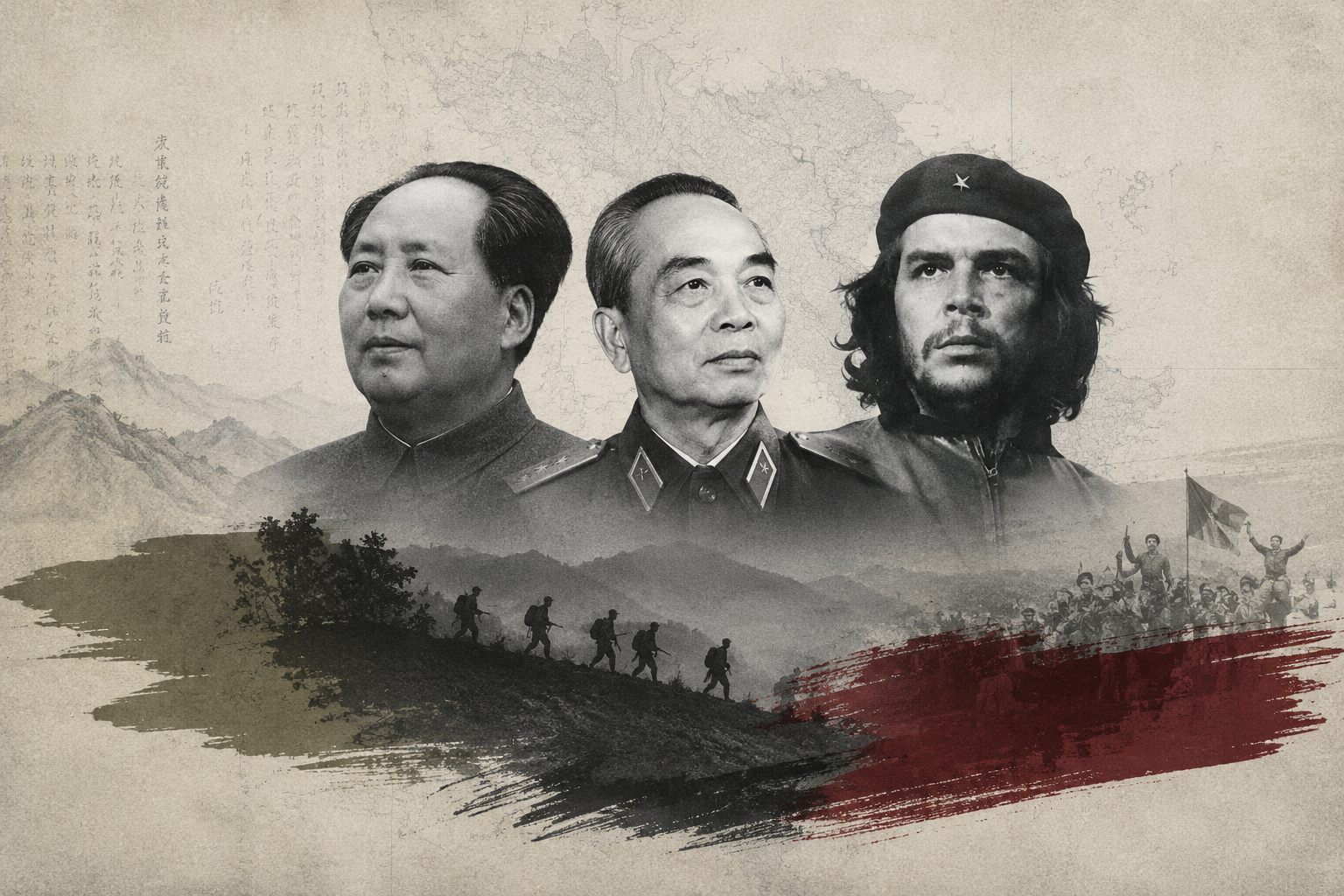
Its evolution can be understood through three distinct yet interconnected visions: the intellectual framework developed by Mao Zedong, the operational system refined by Võ Nguyên Giáp, and the global symbolic legacy associated with Che Guevara. Each represents a different dimension of insurgent warfare: the conceptual logic explaining how the weak might defeat the strong, the organizational structure that allowed such strategies to function in practice, and the process by which revolutionary warfare was abstracted, simplified, and transformed into a portable model of insurgency that gained its greatest influence as political myth rather than as a reproducible system.
Although these figures are often grouped together in discussions of guerrilla warfare, their contributions are not equivalent in form or function. Mao’s work provides a systematic theory of protracted revolutionary struggle grounded in political mobilization and the integration of armed struggle with social transformation. Giáp’s practice demonstrates how such a theory could be operationalized through a layered military structure capable of sustaining both guerrilla and conventional warfare over time. Che Guevara, by contrast, represents a more contested and compressed interpretation of revolutionary experience, in which the Cuban model was generalized into foco theory: the idea that a small guerrilla nucleus could catalyze revolution through action even in the absence of fully developed political conditions. The uneven outcomes of this approach outside Cuba highlight the limits of detaching insurgency from the social and organizational depth emphasized in both Maoist doctrine and Vietnamese practice.
Taken together, these three perspectives do not describe a linear progression so much as a spectrum of revolutionary warfare’s possibilities and constraints. They reveal insurgency as something that could be deeply embedded in social structures, carefully organized into durable systems, or abstracted into symbolic form and ideological inspiration. Examining the relationship between these dimensions allows for a broader understanding not only of how revolutionary movements fought, but also of how they imagined the conditions under which the weak might overcome the strong.
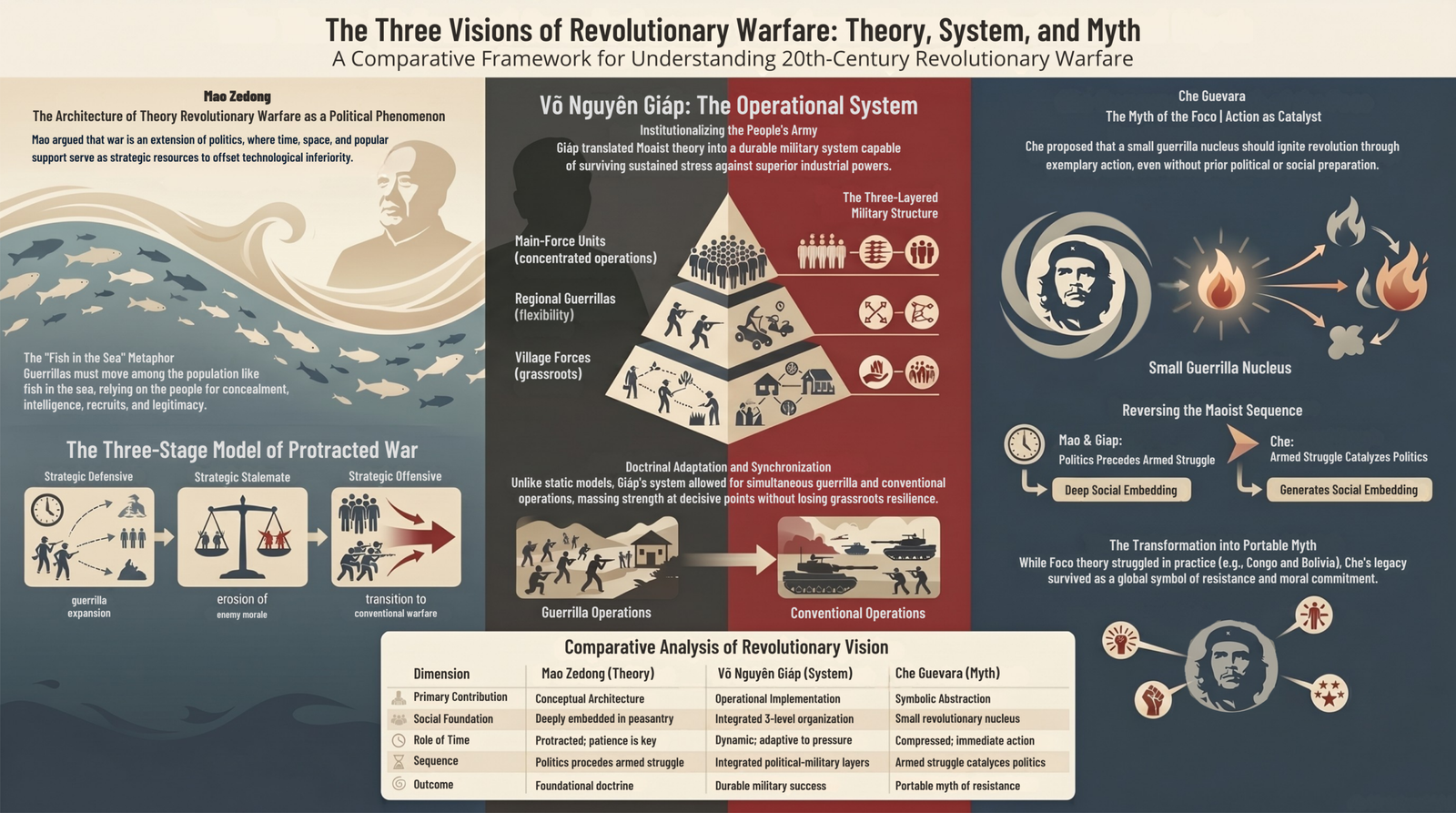
Tap to enlarge · Illustration generated by The Resistance Hub. Sources for the models shown: Mao Zedong on protracted war, Vo Nguyen Giap on the three force tiers, and Che Guevara on foco theory. Terms are defined in the IW and Resistance Glossary.
The Theory of Mao Zedong: The Architecture of Protracted Revolutionary Warfare
Mao’s key achievement was conceptual. Writing during the Chinese Civil War and the anti-Japanese struggle, he confronted a problem shared by many revolutionary movements: how could a materially weak force defeat a stronger, better-equipped adversary? Instead of seeking decisive confrontation, Mao insisted that revolutionary warfare was fundamentally political, and therefore temporal. Time, space, and popular support were resources that could offset technological inferiority.
In works such as On Guerrilla Warfare and On Protracted War, Mao systematized a theory that fused military action with political mobilization. War was an extension of politics; armed struggle could not be detached from ideology, organization, and social transformation. The Red Army was not a separate professional caste but a political army embedded in the peasantry. Mao’s famous metaphor that guerrillas must move among the people as fish swim in the sea captured this fusion. The “sea” of the population provided concealment, intelligence, recruits, and legitimacy.
From this foundation Mao articulated a three-stage model of protracted conflict. The first stage, the strategic defensive, emphasized survival and expansion through dispersed guerrilla operations, land reform, and base-area construction. The second stage, the strategic stalemate, saw the gradual strengthening of revolutionary forces alongside the erosion of the enemy’s morale and resources. The final stage, the strategic offensive, envisioned the transition to conventional warfare once the balance had shifted. Importantly, these stages were not merely military escalations; they were political transformations. Each stage consolidated alternative authority in liberated zones, demonstrating that the revolution could govern as well as fight.
Mao elevated patience to a principle. Victory would not come from dramatic confrontation but from cumulative pressure exerted over time. By redefining weakness as potential strength, Mao provided a framework through which materially inferior movements could imagine eventual victory. His model offered more than tactical guidance; it supplied a strategic logic that resonated across the decolonizing world.
Yet the durability of Mao’s theory ultimately depended on whether it could survive the pressures of modern warfare. The most compelling demonstration of that possibility would emerge not in China, but in Vietnam under the leadership of Võ Nguyên Giáp.
The System of Võ Nguyên Giáp: Revolutionary Warfare in Practice
If Mao built the architecture, Võ Nguyên Giáp proved it could endure the stress of modern war. Yet Giáp did more than replicate Maoist prescriptions. His achievement lay in doctrinal adaptation, preserving core principles while reshaping their application to Vietnamese realities. In works such as People’s War, People’s Army, Giáp articulated how revolutionary warfare could function not merely as theory but as an integrated military system rooted in society. What Mao had described conceptually, Giáp translated into a structure capable of surviving sustained conflict against materially superior forces.
At the base were village forces who were part-time fighters embedded within their own communities. These peasants farmed by day and defended their hamlets by night. Their responsibilities extended beyond combat: intelligence gathering, logistical support, political education, and maintenance of revolutionary authority. By institutionalizing armed resistance at the grassroots, Giáp ensured that insurgency was woven into everyday life. The revolution could not be uprooted without uprooting entire communities.
Above them operated mobile guerrilla forces. These regional units could strike beyond a single village but retained flexibility and mobility. They specialized in ambushes, raids, and interdiction of supply lines. When confronted with superior firepower, they dispersed; when opportunity arose, they concentrated. Crucially, Giáp synchronized these guerrillas with local militias. Intelligence flowed upward from villages, while protection and operational coordination flowed downward. The result was a networked insurgency capable of adapting to shifting pressures.
At the apex stood conventional main-force units: regular formations organized, trained, and equipped for sustained combat against enemy formations. In classical Maoist theory, such forces were typically associated with the final phase of revolutionary warfare, when the balance of power had shifted decisively. Võ Nguyên Giáp, however, treated these units not merely as the end point of the struggle but as a flexible instrument within it. He committed them to concentrated operations when favorable conditions emerged, while allowing guerrilla and local forces to continue operating elsewhere. In this way, large-unit warfare and dispersed insurgency could occur simultaneously, enabling revolutionary forces to mass strength at decisive points without sacrificing the resilience of the broader guerrilla network.
Giáp’s adaptation did not betray Maoist doctrine; it revitalized it. By allowing simultaneous development across levels of warfare, he ensured that revolutionary struggle could contract when weak and concentrate when strong. Doctrine became dynamic: a living framework responsive to terrain, enemy capabilities, and international context.
Yet even as revolutionary warfare demonstrated its capacity to defeat powerful states, its meaning was beginning to shift. Beyond the battlefields of Asia, the idea of guerrilla struggle was increasingly transformed into a broader symbol of revolutionary possibility, a transformation closely associated with the figure of Che Guevara.
The Myth of Che Guevara: From Strategy to Symbol
If Mao Zedong supplied the theoretical architecture of revolutionary warfare and Võ Nguyên Giáp demonstrated how it could be organized and sustained in practice, Che Guevara gave the idea its most portable and mythic expression. While his writings drew on the Cuban revolutionary experience, they also sought to generalize it into a more universal model of insurgency. In Guerrilla Warfare, Che articulated what later became known as “foco theory“: the idea that a small, committed guerrilla nucleus could ignite revolutionary conditions through armed action, even in the absence of fully developed political or social structures.
This formulation marked a significant departure from Mao’s insistence on prolonged political preparation and mass mobilization, and from Giáp’s carefully layered integration of village militias, guerrilla units, and conventional forces. Whereas Mao and Giáp treated revolutionary warfare as something that must be built through deep social embedding, foco theory implied that insurgency itself could precede and help generate that embedding. In this sense, it inverted the sequence at the heart of Maoist strategy: rather than political consolidation producing armed struggle, armed struggle was expected to catalyze political consolidation.
The limitations of this reversal became clear in Che’s later revolutionary campaigns. In both the Congo and Bolivia, the foco model struggled to take root in environments where the necessary conditions, coherent peasant support networks, effective local political organization, and sympathetic social structures, were either weak or absent. Without the dense “sea” of popular support central to Mao’s conception, or the institutional depth developed by Giáp in Vietnam, the guerrilla foco remained isolated and militarily exposed. These failures did not simply reflect tactical errors but revealed a structural weakness in assuming that revolutionary will could substitute for political and social preparation.
Che’s execution in Bolivia transformed this strategic limitation into an ideological legacy. Stripped of its operational shortcomings, the foco theory survived less as a reliable model of insurgency than as a symbol of revolutionary possibility. His writings and image circulated globally as shorthand for defiance, even as the practical conditions that had enabled the Cuban Revolution proved difficult to reproduce elsewhere. In this sense, Che’s contribution was to detach revolutionary warfare from its embedded social and organizational foundations and reframe it as an act of will, sacrifice, and moral commitment.
Through this transformation, Che Guevara ensured that revolutionary warfare would endure not only as a strategy for movements rooted in specific historical conditions but also as a portable myth of resistance: one that often outlived the material circumstances required to make it effective.
Conclusion: From Theory to System to Myth
Examining these three visions together reveals not only the contributions of individual revolutionaries but also the different ways revolutionary warfare was conceptualized, organized, and ultimately transformed during the twentieth century. Rather than representing a linear progression or a shared doctrine applied in varying contexts, these perspectives illuminate a broader spectrum of insurgent possibility. Revolutionary warfare can be understood as existing simultaneously across three interconnected but uneven registers: as strategic theory, as institutionalized military practice, and as symbolic narrative detached from its original material conditions.
Mao Zedong provided the foundational theoretical architecture of protracted revolutionary warfare, grounding armed struggle in political mobilization, temporal endurance, and the transformation of social relations. In his formulation, military success was inseparable from the construction of revolutionary legitimacy within society, and time itself became a strategic resource through which material inferiority could be offset. War, in this sense, was not an autonomous domain but an extension of political struggle embedded within a broader process of social change.
Võ Nguyên Giáp translated this conceptual framework into an operational system capable of surviving sustained engagement with technologically superior forces. His achievement lay in integrating dispersed village militias, mobile guerrilla units, and conventional main-force formations into a coherent and flexible structure of warfare. This layered model ensured that revolutionary forces could adapt dynamically to changing conditions, concentrating power when necessary while preserving resilience at the grassroots level. In doing so, Giáp demonstrated that Maoist principles could be institutionalized into a durable military system capable of long-term execution.
Che Guevara, by contrast, represents a different trajectory: the abstraction and compression of revolutionary warfare into a more universal and transferable idea. Through foco theory, he proposed that a small guerrilla nucleus could initiate revolutionary conditions through exemplary action, even in the absence of the extensive political and organizational preparation emphasized by Mao and embodied in Giáp’s practice. However, his later campaigns in the Congo and Bolivia exposed the fragility of this model when detached from the social, political, and logistical foundations that had underpinned earlier revolutionary successes. In these contexts, the foco did not generate the expected mass mobilization, but instead revealed the limits of substituting revolutionary initiative for embedded structural support. Its subsequent transformation into a global symbol of resistance, amplified after Che’s death, marked the point at which revolutionary warfare became increasingly separable from its original strategic conditions.
Seen in this light, revolutionary warfare did not simply evolve from theory to practice to symbol in a straightforward sequence. Rather, these three dimensions coexist in tension, each highlighting different requirements for insurgent success and different ways of imagining political change. The durability of Maoist theory lies in its integration of politics and war; the effectiveness of Giáp’s system lies in its institutional depth and adaptability; and the enduring influence of Che’s legacy lies in its ability to circulate beyond the material constraints that made earlier revolutionary victories possible.
Ultimately, revolutionary warfare endured in the twentieth century not only because it offered a method by which materially weaker forces could contest stronger states, but also because it articulated a compelling vision of historical transformation. It promised that political order was not fixed, that asymmetry did not guarantee permanence, and that organized collective action could reshape the balance of power. Yet the comparison of Mao, Giáp, and Che also reveals that this promise was realized only when strategy, organization, and social conditions were aligned. Where that alignment failed as in the attempted generalization of foco theory, the result was not revolution but myth.
Revolutionary warfare, therefore, survives in two distinct forms: as a historically grounded set of practices embedded in specific social and political contexts and as a symbolic language of resistance that continues to circulate independently of those contexts. It is in the tension between these forms that its twentieth-century legacy is best understood.
On Guerrilla Warfare · Mao Tse-tung, trans. Samuel B. Griffith. The 1937 treatise that systematized protracted revolutionary struggle.
People’s War, People’s Army · Võ Nguyên Giáp. The Vietnamese commander’s account of layered insurgent organization.
Guerrilla Warfare · Ernesto Che Guevara, ed. Marc Becker. Three essays that set out and later revised foco theory.
Masters of Resistance: Series One · The Distillery Press. A remastered reader on the foundational strategists of irregular warfare.
The Guerrilla Tactical Triad: Series Two · The Distillery Press. The raid, the ambush, and reconnaissance as the operational core of guerrilla practice.
