
Significant developments since publication: Al-Sharaa was formally appointed president in January 2025 and announced a transitional government of 23 ministers in March. A constitutional declaration established a five-year transition period. Al-Sharaa met with Macron in Paris (May 2025) and Trump in both Saudi Arabia (May 2025) and Washington (November 2025) — the first US-Syria presidential meetings since 2000. The UN Security Council removed al-Sharaa from its sanctions list in November 2025. In January 2026, SDF-government talks collapsed and the transitional government launched a military campaign in eastern Syria. ISIS has conducted coordinated attacks in Raqqa and Deir ez-Zor. As of February 2026, the US is reportedly preparing to withdraw its remaining ~1,000 troops within months. The analysis below has been updated to reflect these developments.
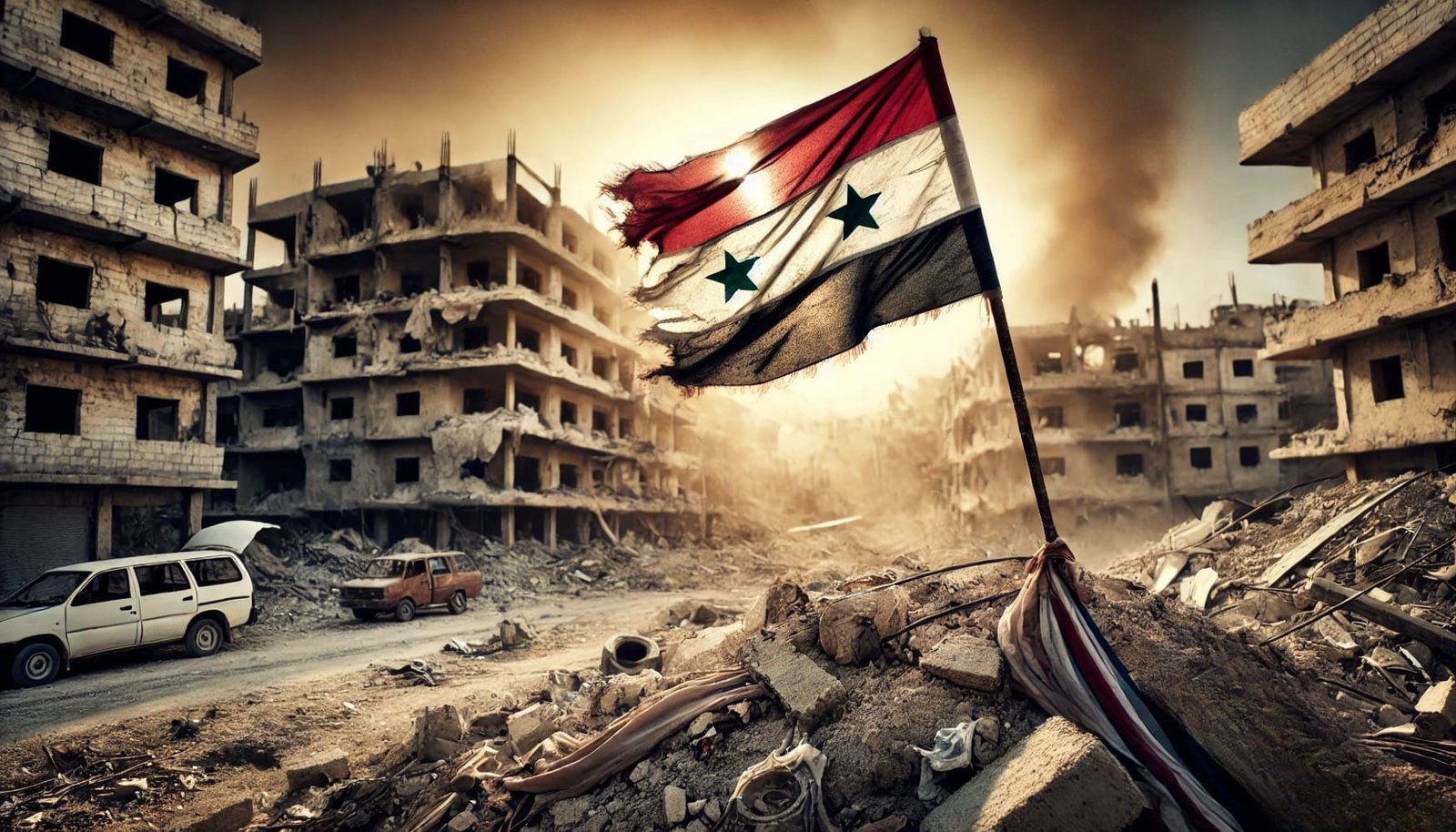
The Syrian Civil War, which began in 2011 as a protest movement against the regime of Bashar al-Assad, saw numerous factions vying for control over the country. After more than a decade of brutal conflict, an opposition-led coalition finally ousted Assad’s government in December 2024. The new administration, led by President Ahmed al-Sharaa, quickly moved to consolidate power, establish governance, and stabilize a shattered nation. However, the downfall of Assad did not mark the end of Syria’s struggles. Instead, the country has entered a new phase of conflict as remnants of the Assad regime, sectarian groups, and jihadist factions launch insurgencies against the transitional government.
This article examines the rise of Syria’s opposition government, the insurgencies threatening its authority, and the broader implications for regional and international stability. By analyzing key players, emerging security threats, and governance challenges, we assess whether the new leadership can hold Syria together — or whether the country risks fracturing further.
The Fall of the Assad Regime
The Opposition’s Final Offensive
The decisive blow to Assad’s rule came in late November 2024, when Hay’at Tahrir al-Sham (HTS), backed by Turkish-supported factions in the Syrian National Army, launched Operation “Deterrence of Aggression.” The offensive moved with unexpected speed, capturing Aleppo, Hama, and then Damascus in rapid succession. Assad fled the country, ending five decades of the Assad family’s grip on power — a dynasty that began when Hafez al-Assad seized control in 1970.
The Aftermath of Assad’s Departure
The fall of the regime created a power vacuum that multiple factions rushed to fill. While HTS and its allies controlled much of western Syria, the Kurdish-led Syrian Democratic Forces (SDF) retained control of the northeast, and various armed groups operated across the south and east. For broader context on Syria’s immediate post-Assad landscape, see The Resistance Hub’s earlier analysis of what came next for Syria in the weeks following Assad’s departure.
Formation of the Transitional Government
Ahmed al-Sharaa and His Coalition
Ahmed al-Sharaa — formerly known as Abu Mohammed al-Jolani — was appointed president at the Syrian Revolution Victory Conference in January 2025. A former jihadist who led Jabhat al-Nusra before rebranding as HTS, al-Sharaa has sought to project himself as a pragmatic, nationalist leader committed to an inclusive transition. Under his direction, authorities dissolved all military factions, opposition political bodies, and the Ba’ath Party, calling for their integration into reconstituted state institutions.
On March 13, 2025, al-Sharaa ratified a Constitutional Declaration establishing a five-year transitional period with a presidential system — no prime minister — and Islam as the president’s religion. On March 29, he announced a 23-minister transitional government that included minority representation: an Alawite transport minister, a Druze agriculture minister, a Christian social affairs minister (the first woman appointed by al-Sharaa), and a Kurdish representative. The White Helmets’ leader, Raed al-Saleh, was named to head the new Ministry of Emergency and Disaster Management.
Governing Amid Chaos
Governing post-Assad Syria has proven to be an exercise in managing competing crises simultaneously. The transitional government inherited a collapsed economy, destroyed infrastructure, millions of displaced citizens, and a fragmented security landscape. While al-Sharaa has focused on consolidating armed groups under central command — signing integration agreements with both the SNA and the SDF — implementation has repeatedly stalled. The mobilization of rival factions across ethnic, sectarian, and ideological lines presents a governance challenge with no modern parallel.
Syria’s Transition: A Timeline
Emergence of New Insurgencies
Pro-Assad Loyalist Resistance
The remnants of Assad’s security apparatus have not disappeared. Former regime officers, intelligence operatives, and loyalist militias have regrouped in pockets across western Syria, particularly in Alawite-majority areas along the coast. In March 2025, loyalist violence erupted in the coastal region, demonstrating that the old regime’s networks retain the capacity for armed disruption. These groups draw on decades of institutional knowledge and access to hidden arms caches, making them a persistent low-level threat to the transitional government.
Sectarian and Ethnic Conflicts
The fall of Assad reignited long-standing sectarian and ethnic grievances. The Alawite community, which had been closely aligned with Assad’s rule, now faces targeted attacks by extremist Sunni factions. Reports of mass killings and forced expulsions in former regime strongholds have raised concerns about retaliatory violence. In July 2025, armed clashes broke out between Druze and Bedouin communities in Suwayda, forcing the Syrian Army to intervene — an early test of the new government’s ability to act as an impartial security guarantor.
In the Kurdish regions of northern and eastern Syria, the relationship between the transitional government and the SDF remains the most consequential fault line. A March 2025 integration framework was hailed as a breakthrough but stalled over competing demands. By January 2026, talks had collapsed entirely, and the government launched a military campaign across eastern Aleppo, Raqqa, Deir ez-Zor, and Al-Hasakah. Ceasefires signed on January 20 and 30 set new terms for SDF integration, but the underlying tensions — fueled by Turkish pressure and Kurdish autonomy demands — remain unresolved.
Jihadist Resurgence
Despite HTS’s role in the opposition victory, the group’s evolution toward pragmatic governance has put it at odds with more extreme jihadist factions. Remnants of ISIS and Al-Qaeda-linked groups view al-Sharaa’s government as insufficiently Islamist. A May 2025 ISIS statement condemned al-Sharaa as an apostate and called on disillusioned fighters to join ISIS forces in rural areas. In February 2026, ISIS claimed a series of coordinated attacks in eastern Syria, including in Raqqa and Deir ez-Zor, underscoring the organization’s continued capacity to destabilize the transition. According to UN monitors, at least five assassination attempts against senior government officials were foiled in 2025.
Syria’s ongoing struggle against ISIS carries echoes of counterinsurgency challenges that have defined irregular warfare across the region. The transitional government’s decision to join the global anti-ISIS coalition in November 2025 represents an effort to reframe itself as a legitimate security partner rather than an insurgent movement governing by default.
Challenges Facing the Transitional Government
Security and Stability
The transitional government’s most urgent challenge is establishing a monopoly on the use of force. Despite declarations dissolving all armed factions, Syria in 2026 has no single, unified military. The government must integrate former HTS fighters, SNA factions, and potentially SDF units into a coherent national force while simultaneously combating ISIS and containing loyalist subversion. Al-Sharaa’s stated position — that Syrian unity is a red line and all weapons must be under state control — remains aspirational rather than operational.
Economic Collapse
Syria’s economy, devastated by over a decade of war and international sanctions, requires massive reconstruction. The transitional government has initiated economic reforms including public sector restructuring, tax reform, and reopening border crossings. The lifting of US and UK sanctions in 2025 was a critical step, but reconstruction costs are estimated in the hundreds of billions. Al-Sharaa has emphasized attracting foreign investment and expertise, but the security situation deters most private capital.
Political Legitimacy
The transitional government’s legitimacy remains contested. While the October 2025 parliamentary elections were a symbolic milestone — the first since Assad’s fall — they were not held in Suwayda or Kurdish-controlled areas. The government is dominated by figures associated with HTS, and critics argue the Constitutional Declaration was ratified with limited public consultation. The five-year transitional timeline, with elections potentially years away, means the government must earn legitimacy through governance rather than mandate.
International Reactions and Involvement
Western Nations
The United States has pursued a policy of conditional support. President Trump met al-Sharaa in Saudi Arabia in May 2025 and again at the White House in November 2025, urging Syria to join the Abraham Accords. The US has backed SDF-government negotiations, lifted sanctions, and maintained approximately 1,000 troops in northeastern Syria primarily for counter-ISIS operations. However, as of February 2026, unnamed officials have indicated a “conditions-based” withdrawal may be underway within months. France and the UK have re-established diplomatic ties, and the EU has removed many sanctions to support reconstruction.
Regional Powers
Turkey, which backed the SNA during the offensive against Assad, remains a critical player. Ankara views the SDF as an extension of the PKK and has pressured al-Sharaa to extend central authority over Kurdish-controlled areas. The PKK’s May 2025 decision to disband has altered — but not eliminated — this dynamic. Russia, which retained its naval and air bases at Tartus and Hmeimim under renewed agreements, has engaged al-Sharaa diplomatically, with the Syrian president visiting Moscow in both October 2025 and January 2026. Iran and Hezbollah, both of which suffered strategic setbacks during the regime’s fall, have lost much of their infrastructure in Syria but retain a desire for influence in the region.
The interplay of these external actors — each pursuing their own strategic objectives through influence operations, military presence, or diplomatic leverage — makes Syria a textbook case of how proxy dynamics can shape the internal politics of a transitional state.
Prospects for Peace and Democracy
Syria’s transition remains fragile but has exceeded many analysts’ initial expectations. In the space of a year, al-Sharaa has transformed from a listed jihadist leader to a head of state received at the White House and the Kremlin. The transitional government has formed a cabinet, ratified a constitutional framework, held limited elections, joined the global anti-ISIS coalition, and begun the painstaking process of military integration. These are real achievements in a country that many believed would collapse into permanent fragmentation.
Yet the risks are equally real. ISIS retains the capacity to destabilize. The Kurdish question remains unresolved. Sectarian violence continues to simmer. The economy is shattered. And the concentration of power in al-Sharaa’s hands — without a prime minister, with elections years away — raises fundamental questions about whether this transition will lead to genuine pluralism or simply replace one form of authoritarian control with another.
For students of social movement theory and irregular conflict, Syria offers a case study in real time: the moment when a resistance movement must transform into a governing institution — and the enormous structural, military, and political challenges that transformation entails. Whether al-Sharaa’s government can navigate these challenges will determine not just Syria’s future, but the broader trajectory of post-conflict transitions across the Middle East.
Sources
Abouzeid, Rania. No Turning Back: Life, Loss, and Hope in Wartime Syria. W.W. Norton, 2018.
Congressional Research Service. Syria: Transition and U.S. Policy. Updated February 2026.