This article is Part Two of an eight-part series by Iliana Drakonis — a child of war who became a skilled participant. In this installment, she turns from the external to the internal battlefield, exploring how thought itself becomes a weapon of endurance. Drawing from lived experience and personal insight, Drakonis examines the quiet, psychological front of resistance — where belief, clarity, and conviction hold the line long after walls have fallen.

War begins in the mind long before the first shot.
When invasion comes, the strongest line of defense is not the wall or the rifle — it is the story a nation tells itself about who it is.
To protect thought is to protect life.
The Mind as Infrastructure
A small nation cannot outgun a giant, but it can outthink one.
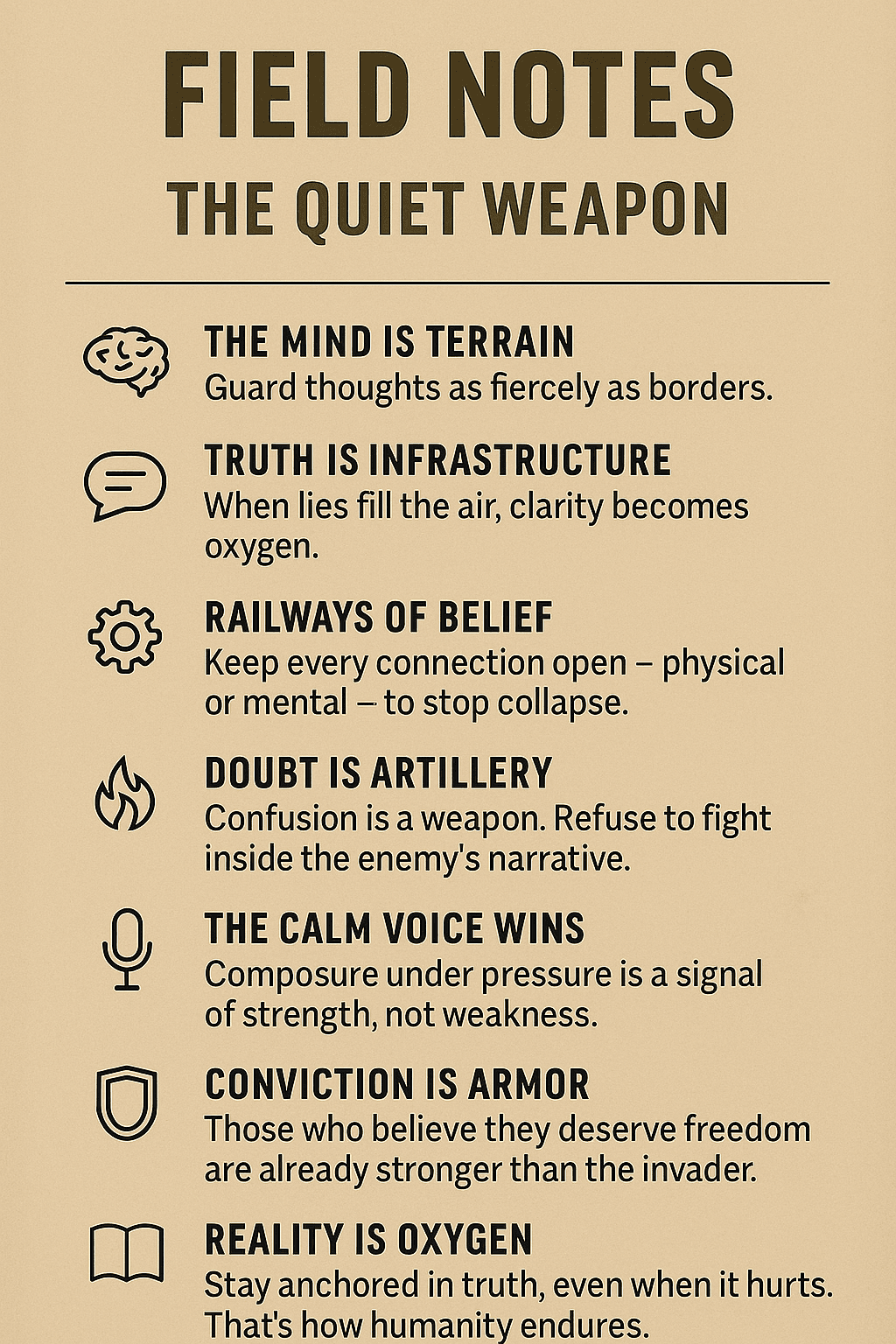
Belief is infrastructure.
It must be maintained like roads, grids, and rail lines — quietly, constantly, deliberately.
When trains still run under bombardment, when food and medicine reach those cut off, it tells people something deeper than logistics: we are still connected.
Every track that stays open keeps the nation’s mind from fracturing.
Redundancy in message.
Clarity in meaning.
Silence when truth is uncertain.
These are acts of defense.
When people trust what is real, they remain impossible to divide.
Information as Fire
The invader floods the field with confusion.
He does not need you to believe him — only to stop believing in anything.
Doubt is his artillery.
A single calm voice can counter an army of noise.
Words are weapons; use them with precision.
In panic, clarity is power.
Conviction as Armor

A friend once told me that the Ukrainian Revolution succeeded because “people were ready to die for the state they believed should exist.”
They weren’t fighting only for land — they were fighting for the right to live in a country that was theirs, shaped the way they wanted it to be.
Conviction is the rarest resource: when people decide they would rather die for dignity than live in submission, the invasion has already failed.
Another friend, who fought near Debaltseve, described how waves of misinformation created a fog so thick it bent reality itself.
That is how disinformation kills — not with lies, but with disconnection.
To stay connected to reality is to stay human under siege.
Narrative as Shield
Every siege tests a nation’s story. Who are we? Why do we matter? What will we refuse to become? If the story holds, the state stands.
The Quiet Weapon
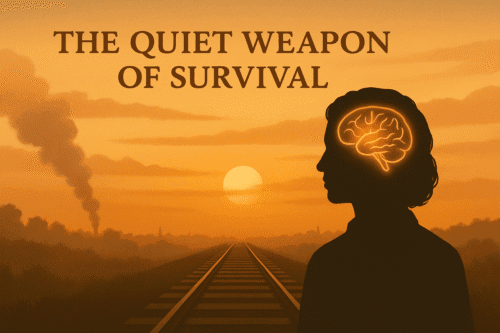
Power does not always roar.
Sometimes it speaks softly and refuses to shake.
To maintain will is to maintain sovereignty.
To stay composed under chaos is to win before the battle ends.
No one is coming.
But if the story survives, the nation does too.
Author’s Reflection
Real resistance is not romantic. It’s hunger, exhaustion, and the quiet choice to stay alive one more day under occupation.
Mental resistance does not replace physical survival — it sustains it.
It means preserving the ability to think clearly, to stay human when everything around you demands that you stop being one.
The people who endure both physically and mentally are not symbols; they are proof that consciousness itself can resist domination.
Every heartbeat that continues under occupation is a form of defiance.
Every clear thought that refuses propaganda is a victory.