
When Size Stops Being an Advantage
Large nations often assume that sheer volume ensures survival. They trust in their populations, economies, and geographic depth to absorb shocks. Yet the last decade has demonstrated that abundance can conceal fragility. Critical systems fail not from external invasion but from slow corrosion of coordination and trust.
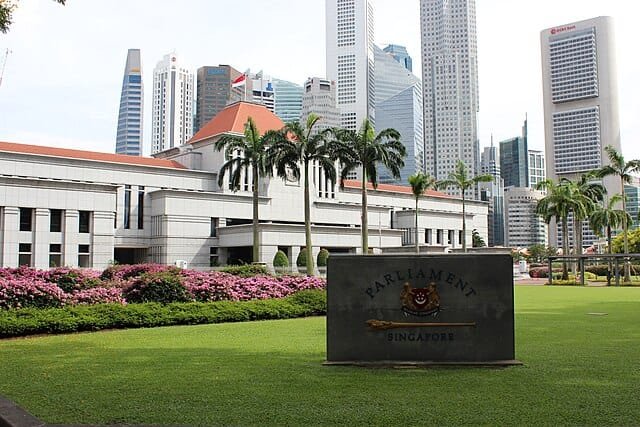
Small states like Singapore offer a different lesson. They cannot afford complacency. Their survival depends on designing resilience into every layer of society. Singapore’s Total Defence framework integrates citizens, government, and the private sector into one disciplined system. It is not a slogan or a campaign but an operating principle: every individual and institution shares responsibility for national endurance.
The lesson for larger states is straightforward yet difficult to execute. Security is not a function of magnitude; it is a function of cohesion. By observing how Singapore built this framework from necessity, large powers can learn how to transform scale from a liability into an advantage.
Since this article was published, Singapore has continued to demonstrate the Total Defence model in action. In February 2026, the country conducted Exercise SG Ready 2026, its third national-level Total Defence exercise, simulating prolonged power outages and degraded digital connectivity across the island, with participation from schools, corporations, and community centers. Coordinating Minister for National Security K. Shanmugam warned during the exercise broadcast that Singapore’s critical infrastructure had come under cyberattack from a “highly sophisticated actor” in 2025. Singapore’s 2026 defense budget rose 6.4% to SGD $24.93 billion (~USD $19.7B), with Defense Minister Chan Chun Sing telling Parliament that “rules that once restrained behavior are being tested and, in some cases, deliberately ignored.” A new National Simulated Scams Exercise was launched alongside the Total Defence exercise to strengthen digital resilience. These developments reinforce the article’s central argument: small-state discipline in resilience planning is not theoretical. It is operational and continuously evolving.
The article below has been updated with additional context reflecting these developments.
The Small-State Mindset: Building Cohesion Before Crisis
When Singapore launched Total Defence in 1984, it was responding to a simple reality: it could not outgun or outnumber its neighbors. The only way to survive was to make the population inseparable from the state’s defense posture.
The framework rests on six interlocking pillars, namely military, civil, economic, social, psychological and digital, each reinforcing the others. Together, they create a feedback system that links public morale, infrastructure, and information resilience.
In Singapore’s planning culture, no ministry or company operates in isolation. A civil emergency becomes a military logistics issue, a psychological messaging issue, and an economic continuity issue at once. This multidimensional mindset treats governance as a single nervous system.
For large nations with sprawling bureaucracies, the takeaway is not to centralize control but to synchronize intent. National security should extend beyond defense ministries into education, healthcare, transportation and digital infrastructure, creating a network of mutually aware systems.
Integration as a Source of Strength
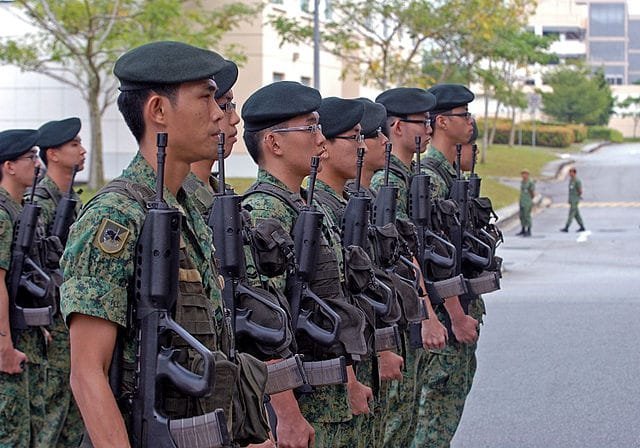
Singapore’s administrative integration is deliberate. Every ministry participates in cross-sector contingency planning, and major corporations coordinate with civil authorities during national exercises. The result is a culture where efficiency and resilience reinforce one another.
In large states, institutions often guard jurisdiction more than they guard continuity. The United States, India, and many European countries maintain vast agency networks that excel individually but coordinate poorly in crisis. Integration, in this sense, is not a loss of autonomy but a gain in predictability.
Creating interoperable doctrine, meaning a common operating language across civilian and defense institutions, builds the connective tissue that keeps systems functioning under strain. The model works because integration is treated as a policy discipline, not an ad hoc task.

Civil Defense as National Literacy
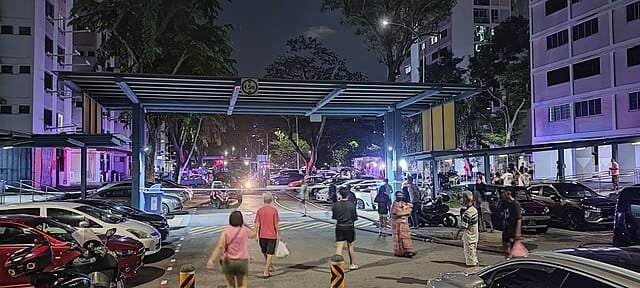
The Singapore Civil Defence Force (SCDF) runs preparedness programs that reach from schools to corporations. Its community drills, neighborhood shelters, and first-aid courses ensure that resilience becomes habit rather than spectacle. The motto “There’s A Part For Everyone” reflects this integration between daily life and national security.
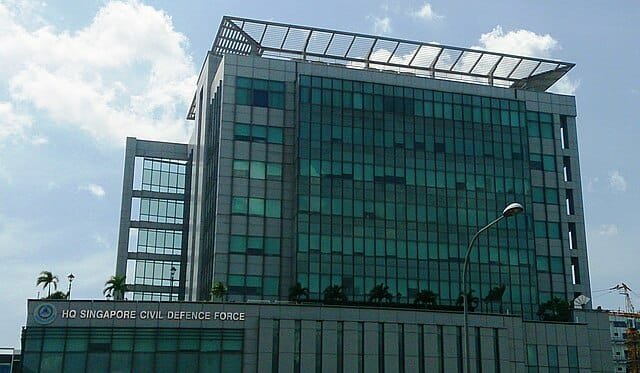
Large states frequently treat civil defense as emergency management, activated only after disaster strikes. Singapore instead treats it as a form of civic literacy. The more distributed the knowledge of what to do, the less panic, rumor, and paralysis during crisis.
Embedding preparedness in education systems and professional standards builds muscle memory across generations. The act of learning resilience becomes an act of citizenship, closing the gap between civilians and the state.
Economic Defense Through Continuity
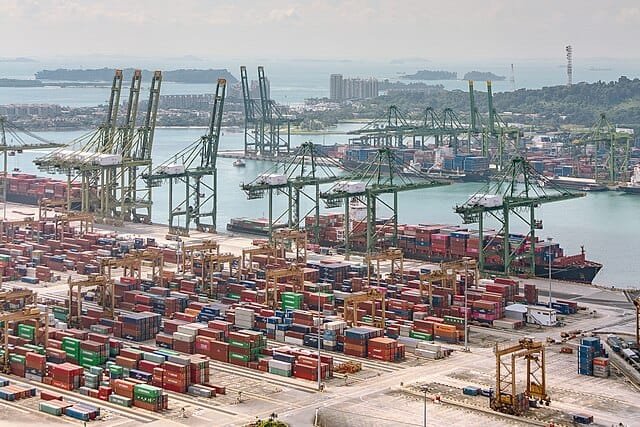
Singapore’s economic defense is organized around one word: continuity. The state assumes that trade routes can close, energy prices can spike, and digital logistics can fail. It plans accordingly through redundancy, reserves, and long-term contracts.
The Ministry of Trade and Industry works with private enterprises to map vulnerabilities in global supply chains and develop alternatives. Every major port operator, energy distributor, and data hub participates in these exercises.
Larger powers can emulate this approach by mandating continuity planning across critical industries. Supply chain mapping, mutual aid agreements, and strategic reserves should be standard practice. True resilience lies not in isolation but in disciplined interdependence that can reroute under pressure.
Social Cohesion as a Shield
Singapore’s social defence aims to preserve unity in a society of multiple languages, religions, and origins. The government invests heavily in interfaith dialogues, community centers, and integrated housing policies to ensure that no community becomes isolated.
The architecture of everyday life, from housing to education to conscription, reinforces this cohesion. Every citizen shares the same public services, the same defense obligations, and the same civic narrative. The system prevents fragmentation before it appears.
In large and diverse societies, social cohesion can become the decisive variable between recovery and disorder. Investing in shared spaces, cross-cultural education, and digital civility programs can replicate some of the same resilience Singapore enjoys without replicating its centralization.
Psychological Defense and Shared Purpose
Singapore recognizes morale as a measurable resource. Its psychological defense pillar connects education, history, and communications to create a sense of ownership. Students learn how occupation and independence shaped national identity. Adults are reminded that vigilance is collective, not delegated.
This shared sense of purpose explains the country’s rapid recovery from crises like SARS, the global financial crash, and the COVID-19 pandemic. Citizens act not because they are ordered to, but because they already understand why action matters.
Larger states often struggle to maintain such coherence. Restoring it requires transparent communication, credible leadership, and a narrative that binds freedom to responsibility. Citizens who see themselves as participants in resilience will act before systems fail.
Loading podcast player…
Digital Defense as Civic Infrastructure
The newest pillar, Digital Defense, merges cybersecurity with national education. Singapore’s Cyber Security Agency works with private firms, schools, and community groups to improve awareness of phishing, misinformation, and cyber hygiene. The approach treats digital competence as social behavior, not merely technical skill.

Large states possess advanced cyber commands but often lack public integration. Treating citizens and small enterprises as part of the digital perimeter closes that gap. Shared responsibility across public and private networks strengthens the overall system.
In an era where disinformation campaigns can paralyze decision-making faster than physical attacks, teaching digital literacy is equivalent to building fortifications.
Legitimacy Built on Trust
Singapore’s success depends on one intangible resource: legitimacy. The public trusts that national mobilization serves collective, not political, goals. Each Total Defence exercise is transparent, bounded by law, and publicly reviewed.
Large democracies can adapt this principle through oversight, public metrics, and legal clarity. Integration without accountability erodes the very cohesion it seeks to protect. Citizens must see the system as participatory and reversible, not as a tool of control.
Resilience becomes durable only when it is rooted in voluntary cooperation. Trust, once built, multiplies across sectors and crises alike.
Scaling Small-State Logic
The Total Defence model can be scaled through disciplined systems thinking:
- Map cross-sector dependencies to identify cascade points.
- Assign co-responsibility for each function between state and civil entities.
- Conduct national continuity exercises with private industry participation.
- Publish resilience benchmarks for public accountability.
- Integrate psychological and digital defense education into civic curricula.
This approach transforms bureaucratic states into adaptive networks. It does not mimic Singapore’s hierarchy but mirrors its coherence: a living architecture of awareness, redundancy, and trust.
| Pillar | Singapore Practice | Large-State Gap | Scalable Action |
|---|---|---|---|
| Military | Universal conscription, reservist system, whole-of-nation talent deployment | Professional militaries disconnected from civilian population | National service frameworks, civil-military integration exercises |
| Civil | SCDF drills in schools and corporations, neighborhood shelters, first-aid certification | Civil defense treated as post-disaster emergency management | Embed preparedness in education systems and professional standards |
| Economic | Supply chain mapping, strategic reserves, continuity planning with private sector | Critical industries lack mandated continuity planning | Mandate continuity planning, mutual aid agreements, redundancy standards |
| Social | Integrated housing, interfaith dialogue, shared conscription obligation | Social fragmentation, polarization, siloed communities | Invest in shared civic spaces, cross-cultural education, national service |
| Psychological | History-based civic narrative, ownership culture, morale as measurable resource | Erosion of shared narrative, trust deficits, delegated vigilance | Transparent communication, credible leadership, freedom-responsibility narrative |
| Digital | CSA public integration, National Simulated Scams Exercise, digital literacy in schools | Advanced cyber commands without public integration | Treat citizens as part of the digital perimeter, digital literacy as civic duty |
Source: The Resistance Hub analysis of Singapore’s Total Defence framework
Integration as the True Measure of Power
Singapore’s Total Defence demonstrates that power resides in systems, not in size. By aligning its people, infrastructure, and governance around shared responsibility, it achieves what many larger nations fail to sustain, which is cohesion under uncertainty.
For great powers facing complex global competition, adopting elements of small-state discipline may become essential. Integration of policy, communication, and trust is the ultimate deterrent in an era of hybrid threats.
Resilience, once institutionalized, becomes culture. It is built every day through habits of coordination, transparency, and civic pride. Large states that learn this lesson may discover that genuine strength begins with design, not reaction.
Masters of Resistance Total Defence rests on the same premise the classic resistance theorists worked from, that a prepared population is itself a strategic capability, and this volume collects the foundational texts on how that capability is built.
View on Amazon →// Further Reading
Singapore’s Total Defence framework is documented on the official Total Defence website and the Ministry of Defence portal. The Irregular Warfare Center provides comparative analysis of total defense as a national resilience strategy. NDU Press examines Sweden’s parallel model of societal security. Exercise SG Ready 2026 details are available from MINDEF.
