
The Algerian war of independence is one of the foundational case studies in the modern irregular warfare literature. The political defeat of metropolitan France by the National Liberation Front (FLN) between November 1, 1954 and the proclamation of Algerian independence on July 5, 1962 is taught as a paradigmatic example of how a militarily weaker insurgent movement can win the strategic decision by maintaining political coherence, exploiting external support, and waiting out a counterinsurgent state whose domestic political will degrades faster than the insurgency does. Paul A. Jureidini’s 1963 Special Operations Research Office study Case Studies in Insurgency and Revolutionary Warfare: Algeria 1954-1962 is the original American doctrinal treatment of the case, written close enough to the events that several of the principal actors were still in power.
Reissued under the ARIS series by US Army Special Operations Command, the study sits alongside the parallel Cuba 1953-1959 volume as one of the two SORO-era foundations of the modern revolutionary warfare canon. The full PDF lives on the ARIS resource page; this article distills its argument and pulls forward the operational lessons that recur across cases. Note on timing: this piece publishes in the weeks following November 1, the Algerian national holiday commemorating the FLN’s launch of the war.
This article is part of TRH’s walkthrough of the ARIS case studies. Earlier articles covered counter-unconventional warfare, Guatemala, the Patriot Insurgency, and Sri Lanka.
The setting: 130 years of structural exclusion
French military operations against the Regency of Algiers began in 1830. The case study marks the political starting point of the eventual revolution at the same date. The conquest of Kabylia in 1857 brought all of northern Algeria under French control; pacification was not complete until 1881. Across the century that followed, the European settler population, the colons, grew to roughly one million by the 1950s against a Muslim Algerian population approaching nine million. The case study treats the structural inequality between the two communities as the central feature of the colonial system. The 1834 ordinance annexed occupied Algeria, and the constitution of 1848 declared it an integral part of France, organized as French départements. French citizenship, however, was never extended to Arabs and Berbers as a class. The Crémieux Decree of October 1870 granted citizenship to Algerian Jews. The Muslim majority remained French subjects without citizenship.
The case study traces three interwar nationalist movements that emerged from this structural exclusion. The Federation of Elected Muslims, whose best-known figure was Ferhat Abbas, sought assimilation and political equality within the French Republic; it never developed mass support but produced senior nationalist personalities. The North African Star (ENA) under Messali Hadj sought independence and Islamic-proletarian social reform; it built a popular base in immigrant Algerian workers in metropolitan France and exported its politics back to Algeria. The Association of Ulema, religious scholars, advocated Arabic language, Islamic culture, and independence on more conservative theological grounds. The three movements shared three points: independence from France, opposition to French cultural assimilation, and Arabic as the official language. The case study calls these the platform that would eventually be inherited by the FLN.
The 1936 Blum-Violette proposal to extend French citizenship to roughly 25,000 educated Muslims died when the Congress of Mayors of Algeria threatened to resign en masse; the bill never came to a vote. The 1945 Sétif uprising on V-E Day, suppressed at a cost of Muslim lives estimated at roughly 1,500 by the French authorities and at 45,000 by the Algerian government, removed the credibility of further reform proposals from the rising generation of Algerian nationalists. The 1947 Algerian Statute and the rigged 1948 elections confirmed that the political path was closed. By the early 1950s, a small number of younger militants in the Movement for the Triumph of Democratic Liberties (MTLD), frustrated with what the case study calls the older nationalist parties’ “lackadaisical attitude,” had begun preparing for armed revolution.
The FLN and the launch of the revolution
In March 1954, former members of the MTLD’s paramilitary Special Organization (OS) formed the Revolutionary Committee for Unity and Action (CRUA) with the explicit objective of launching the war. Leadership coalesced around nine men, the neuf historiques: six inside Algeria and three, Ahmed Ben Bella, Hocine Aït Ahmed, and Mohamed Khider, in Cairo. In October 1954 the six internal leaders met for the last time, set November 1 as the date, and adopted a new organizational name: Front de Libération Nationale, the National Liberation Front. The case study puts the founding cadre at between 2,000 and 3,000 militant nationalists and traces the FLN’s growth across seven and a half years of war into a revolutionary force it estimates at approximately 130,000. Other estimates of the armed strength at launch run considerably lower.
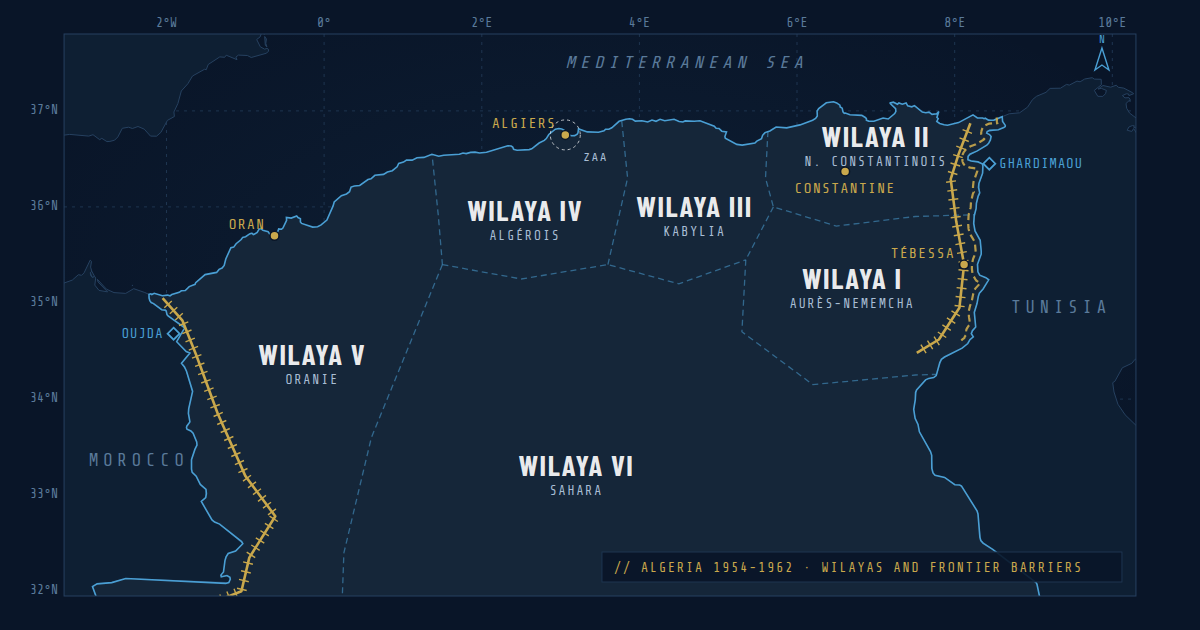
On the night of October 31 to November 1, 1954, coordinated bomb explosions and attacks on French military and gendarmerie posts went off across Algeria. The Voice of the Arabs broadcast from Cairo announced that the Algerian war of independence had begun. The case study’s structural account of how the FLN built the organization that fought the next eight years is one of the cleanest available descriptions of revolutionary organizational architecture in the open literature. The political apparatus was wilaya-based, dividing Algeria into military-political zones, each with its own command; the initial five zones were formalized as six wilayas in 1956. The underground network in the cities, particularly in Algiers and Oran, ran terrorist operations, intelligence collection, and finance. The trade union arm, the General Union of Algerian Workers (UGTA), provided labor mobilization. The military arm, the National Liberation Army (ALN), conducted guerrilla operations in the countryside and increasingly cross-border operations from sanctuaries in Tunisia and Morocco after both became independent in 1956.
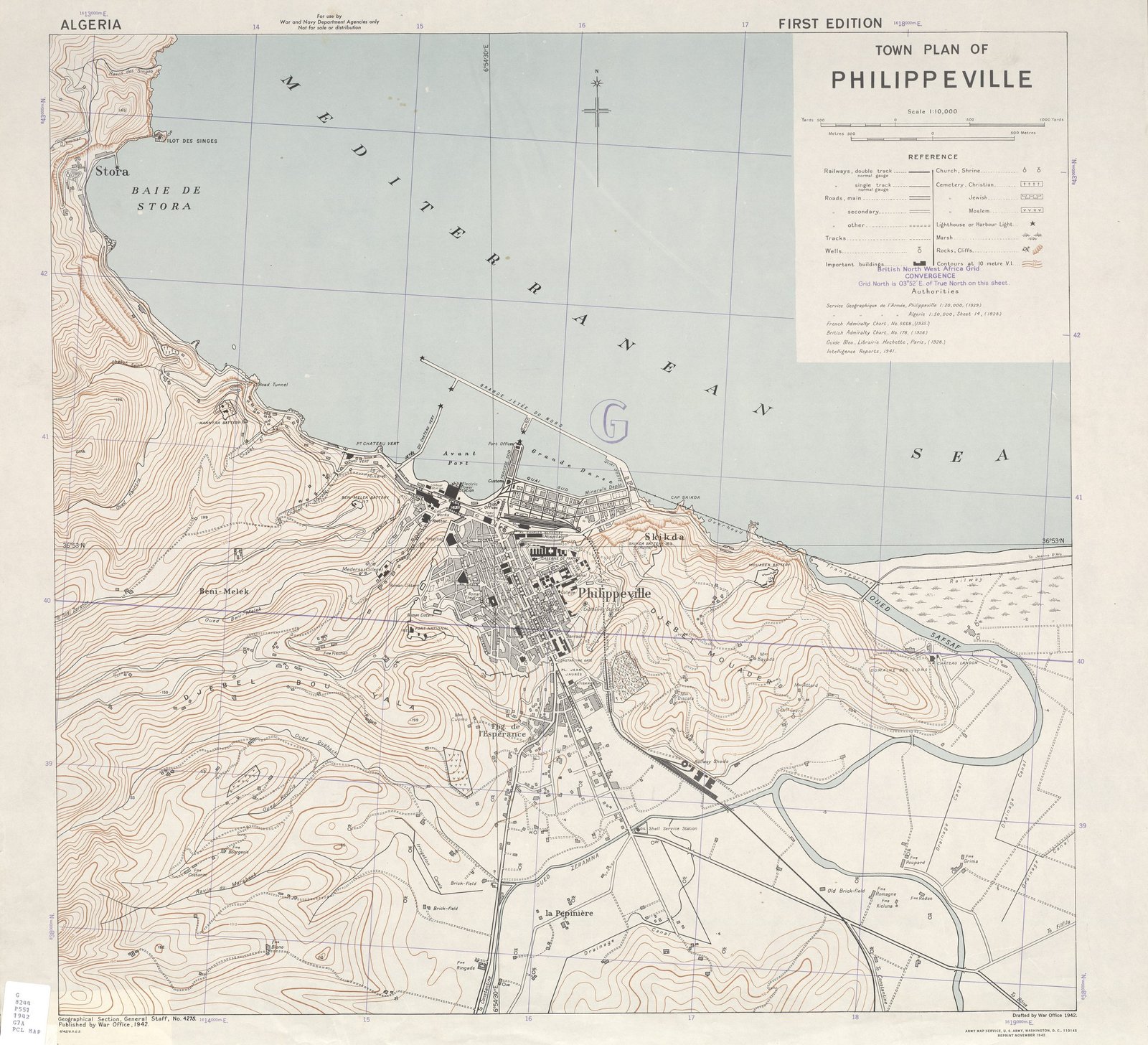
The war’s first decisive escalation came in August 1955, when the FLN’s North Constantinois command launched the Philippeville offensive. The killing of European and Muslim civilians, and the far larger French reprisals that followed, polarized both communities and closed off the space for a negotiated middle ground. Externally, the FLN’s Cairo connection helped draw France into the Suez operation of 1956, which Paris saw in part as a way to cut Nasser’s support to the rebellion; the same month, French authorities diverted a Moroccan aircraft carrying Ben Bella and four other FLN leaders and interned them for the rest of the war.
Externally, the FLN’s Cairo connection helped draw France into the Suez operation of 1956, which Paris saw in part as a way to cut Nasser’s support to the rebellion; the same month, French authorities diverted a Moroccan aircraft carrying Ben Bella and four other FLN leaders and interned them for the rest of the war.
The Battle of Algiers and the limits of tactical success
The most studied operational episode of the war is the Battle of Algiers in 1957. The FLN ran an urban terrorist campaign in the Algerian capital through 1956 and into 1957, with the case study providing detail on the cell structure, the bomb-making network in the Casbah, and the political-organizational logic that connected the urban operations to the FLN’s wider strategy. The French response, after the civil authorities lost control, was to deploy General Jacques Massu’s 10th Parachute Division with effectively unlimited authority across the city. The operation that followed, conducted across 1957, dismantled the FLN’s urban network through systematic intelligence collection, mass arrests, and torture. By autumn 1957 the urban FLN apparatus had been largely destroyed.
The case study’s framing of what this tactical success cost is one of the volume’s most important arguments. The use of torture, in particular the systematic use of electrical interrogation and waterboarding, was widely documented and reached the French metropolitan press in spring 1957. The political response in Paris and across the international community was severe enough that a tactical operation that had militarily succeeded contributed materially to the strategic loss. The case study summarizes the lesson the way it would be repeated across the next sixty years of counterinsurgency literature: a counterinsurgent state can win the urban battle and lose the international and domestic political war that followed, and in some cases the tactical victory is what produces the strategic defeat. For broader analytical context on how this dynamic continues to shape contemporary debates, see TRH on major counterinsurgency thinkers.
Masters of Resistance
The Distillery Press anthology of foundational thinkers behind unconventional warfare and resistance doctrine. The conceptual lens that runs through the Algerian case study, particularly on how political mobilization can outlast tactical reverses, sits inside the framework this volume develops.
View on Amazon →The Challe Plan and the rural campaign
By 1958, French operations in the rural areas had reached a level of tactical sophistication that the case study describes in some detail. General Maurice Challe, who took command of the French forces in December 1958, ran what became known as the Challe Plan: a systematic, sector-by-sector rolling clearance of FLN-controlled rural areas using mobile reserves, helicopter-borne paratroop units, and the quadrillage static-defense grid. The Morice Line, completed in 1957, and the Challe Line added in 1959, both belts of barbed wire, mines, and electronic surveillance along the frontiers, effectively cut the ALN’s external infiltration routes from Tunisia and Morocco. By 1960, French forces had killed, captured, or pushed across the borders most of the ALN units operating inside Algeria.
The case study’s analysis of why this tactical and operational success did not translate into strategic victory runs at three levels. First, the FLN had built its political legitimacy on a base that did not require continuous military presence. Even with the ALN largely defeated in the field, the Provisional Government of the Algerian Republic (GPRA), formed in exile in September 1958, retained recognition from a growing list of Arab and African states and conducted increasingly successful diplomacy at the United Nations. The February 1958 French bombing of Sakiet Sidi Youssef, a Tunisian border village, had already brought an Anglo-American “good offices” mission and internationalized the war at the moment France most needed to contain it. Second, the demographic balance inside Algeria, with one million European settlers against nine million Muslim Algerians and a high Muslim birth rate, made indefinite continuation of Algérie française politically unsustainable in the long run regardless of military performance. Third, and most consequentially, the political will inside metropolitan France for an open-ended war, arriving directly on the heels of defeat in Indochina, was finite, and the FLN’s strategic patience was structurally suited to outlast it.
De Gaulle, the OAS, and the decision
The May 1958 crisis, when French Army elements in Algiers staged what amounted to a coup against the Fourth Republic and brought General Charles de Gaulle back to power, is one of the moments where the case study’s analysis becomes particularly useful. De Gaulle’s initial public posture was ambiguous; the famous “I have understood you” speech to the settlers in Algiers in June 1958 could be, and was, read in different ways. Over the following two years the case study traces de Gaulle’s evolution toward acceptance of the principle of Algerian self-determination, formalized in the September 1959 declaration that offered Algerians a choice between integration, association, or independence.
The reaction inside the French settler community and within the army was severe. In February 1961, settler activists and dissident officers founded the Organisation de l’Armée Secrète, the OAS, in Madrid. The April 1961 Generals’ Putsch, in which Generals Challe, Salan, Jouhaud, and Zeller attempted to seize Algiers in opposition to the negotiation track, failed when conscript French soldiers refused to follow the rebel command. Salan and Jouhaud went underground and took over leadership of the OAS, which conducted a campaign of terror against Muslim Algerians, the FLN, the de Gaulle government, and metropolitan French civilians. The Évian Accords of March 18, 1962 nonetheless held. The July 1, 1962 referendum returned a 99.7 percent vote for independence among Algerians; France recognized Algerian independence on July 3, and Algeria proclaimed it on July 5. Roughly 800,000 European settlers, the pieds-noirs, fled to France in the months that followed. The harkis, Muslim auxiliaries who had served with French forces, were largely left behind, and many thousands were killed in reprisals after independence.
Why this case still matters
Three observations from the Algerian case continue to shape contemporary practice. The first is that the political war and the military war run on separate scorecards, and a counterinsurgent state can win the military one while losing the political one. The Algerian case is the canonical illustration. By every conventional military measure, France was winning by 1960. The political and diplomatic terms of trade had nonetheless moved decisively against Algérie française. Counterinsurgency doctrine that treats the political war as a residual to be sorted out after the military campaign succeeds will produce the Algerian outcome.
The second is that organizational coherence under pressure is one of the variables that distinguishes successful insurgencies from unsuccessful ones. The FLN held its political-organizational architecture together through the Battle of Algiers, the Challe Plan, the destruction of much of its in-country military force, and the internal factional struggles that characterized its leadership. The case study identifies the Soummam Conference of August 1956, which codified the primacy of the political over the military and of the interior over the exterior, as the institutional foundation for that coherence. That coherence came at a price. The FLN fought a parallel war against Messali Hadj’s rival Algerian National Movement (MNA), including the May 1957 massacre at Melouza and a prolonged “café war” among Algerian workers in metropolitan France. The Soummam principles were largely reversed at the August 1957 meeting of the FLN’s executive in Cairo, and their principal architect, Abane Ramdane, was killed by his own FLN colleagues in December 1957. The lesson survives the correction: the FLN eliminated its rivals and absorbed its own leadership crises while keeping its organizational architecture intact. Movements that fail to settle these questions early tend to fragment under pressure; movements that settle them tend to survive. For comparative material, see TRH on resistance mobilization.
The third is that external sponsorship matters, and its decisive form varies by case. The FLN received significant support from Egypt under Nasser, from Tunisia and Morocco as transit and sanctuary states, and from a broader bloc of Arab and Non-Aligned states diplomatically. None of this approached the level of Soviet support to the Vietnamese or Chinese support to ZANU in Rhodesia, covered in an earlier article in this series. What the FLN received was political and diplomatic support that mattered most in the international arena where the strategic decision was actually being made. Sponsor states focused on military hardware sometimes miss the leverage points that the political-diplomatic dimension of the conflict actually provides. For an adjacent treatment of how the same dynamic operates in modern hybrid warfare, see TRH on the Resistance Operating Concept.
Further reading
Related Articles on The Resistance Hub
Recommended Reading
- Masters of Resistance: The Distillery Press anthology of foundational thinkers behind modern unconventional warfare and resistance doctrine.
- The Guerrilla Tactical Triad: Distillery Press treatment of the operational logic that integrates ideology, organization, and irregular tactics.
- OSS: Combined & Remastered: The canonical OSS field manuals on simple sabotage, intelligence, and underground organization, distilled and annotated.
The full ARIS study, Paul A. Jureidini’s Case Studies in Insurgency and Revolutionary Warfare: Algeria 1954-1962 (Special Operations Research Office, 1963; ARIS reissue), is available on the ARIS resource page alongside the rest of the case study collection.
