On Easter Sunday 2026, thousands gathered outside Dublin’s General Post Office (GPO) as President Catherine Connolly laid a wreath marking the 110th anniversary of the Easter Rising. An officer of the Defence Forces read the 1916 Proclamation from the same steps where Pádraig Pearse first declared an Irish republic, and military aircraft traced overhead paths that symbolize a nation still reckoning with the event that catalyzed its independence. The ceremony was political theater and historical memorial in equal measure, a reminder that the six-day insurrection of April 1916 generated consequences far beyond anything its planners expected.
The Easter Rising irregular warfare case study is foundational for anyone working through the vocabulary of insurgency. It failed militarily but succeeded strategically, inverting the conventional relationship between battlefield outcomes and political results. The execution of its leaders by the British Army transformed a localized rebellion into a mass mobilization event that ultimately fractured the United Kingdom. That dynamic, where state overreaction amplifies insurgent legitimacy, recurs across every modern theater of irregular conflict.
The Strategic Logic of the Rising
The Irish Republican Brotherhood (IRB) planned the Easter Rising knowing it would almost certainly fail in conventional military terms. The roughly 1,600 volunteers who seized positions across Dublin on 24 April 1916 faced a British garrison that could draw on tens of thousands of reinforcements. The Military Council, the IRB’s seven-member planning body, understood these odds. Their calculation was political rather than military: a blood sacrifice would shatter the incremental logic of Home Rule and force the Irish question into a revolutionary frame.
This logic parallels what modern irregular warfare doctrine calls the influence-centric approach. Pearse, in particular, believed that an armed demonstration of national will, even a doomed one, would catalyze popular sentiment in ways that decades of parliamentary negotiation had failed to achieve. The Royal United Services Institute (RUSI) has analyzed similar dynamics in contemporary resistance movements, noting that insurgent forces frequently calibrate their operations to provoke disproportionate state responses rather than to seize terrain.
The IRB’s planning incorporated several tradecraft elements recognizable from later espionage and subversion operations. The Military Council operated as a cell within the broader Irish Volunteer movement, concealing its true intentions from Eoin MacNeill, the Volunteers’ nominal commander. Weapons were procured through a German arms shipment aboard the Aud, a covert supply operation that Roger Casement helped coordinate. When MacNeill discovered the plan and issued a countermanding order on Easter Sunday, the conspirators pressed ahead regardless, though with significantly reduced numbers.
Urban Insurgency and the Battle for Dublin
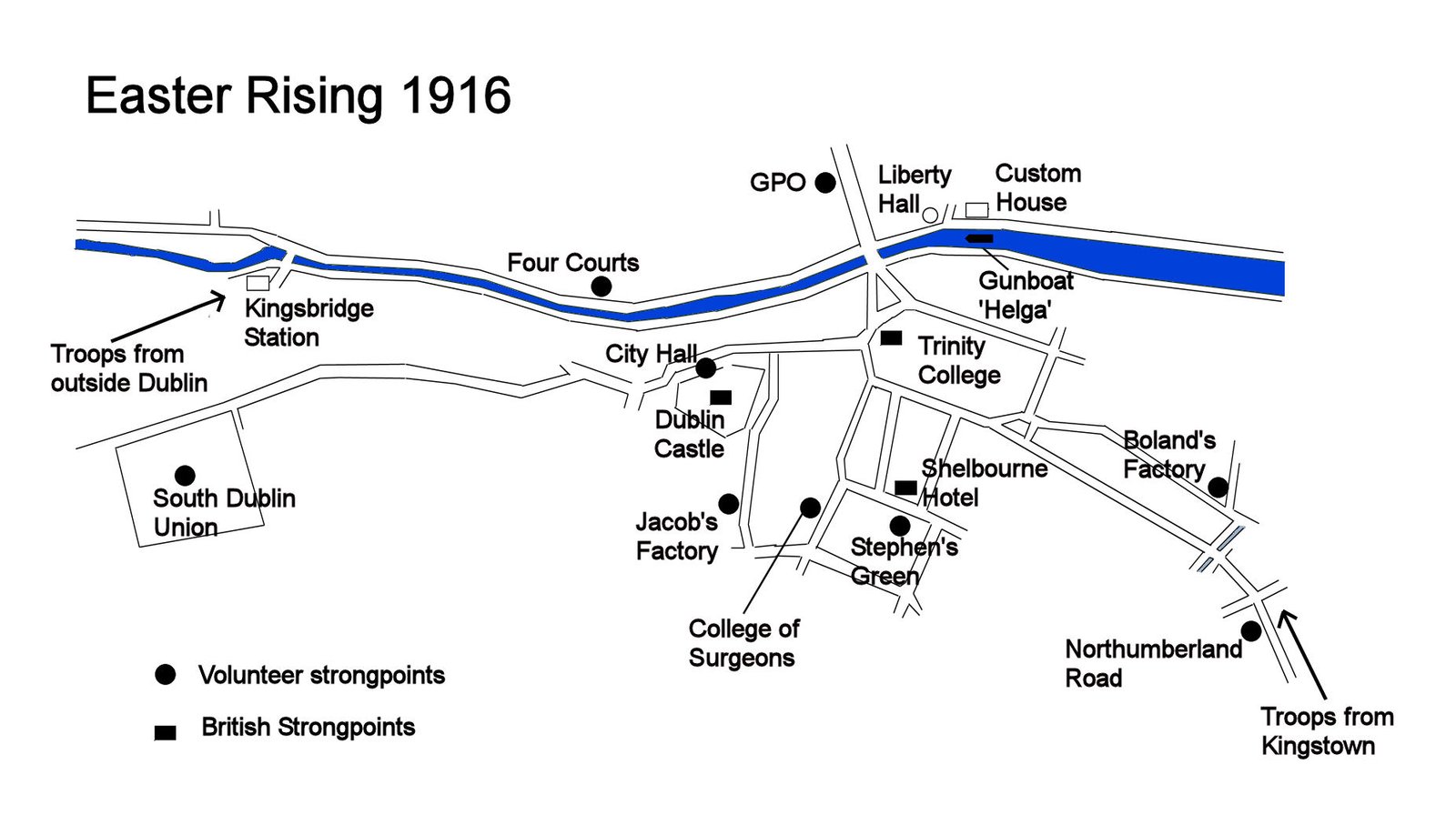
The tactical conduct of the Rising offers one of the earliest modern examples of urban resistance tactics employed against a conventional military force. The insurgents occupied a constellation of positions across Dublin’s city center, anchored on the GPO as their headquarters. Other positions included the Four Courts, Jacob’s Biscuit Factory, Boland’s Mill (commanded by Éamon de Valera), the South Dublin Union, and St. Stephen’s Green.
The selection of these positions reflected a mix of symbolic and tactical logic. The GPO provided a command hub and a stage for the Proclamation. However, many positions were poorly sited for mutual support, and the insurgents never controlled Dublin’s port or rail terminals, which allowed British reinforcements to flow into the city largely unimpeded. The Military History Society of Ireland has documented how the failure to deny these entry points constrained the Rising from the outset.
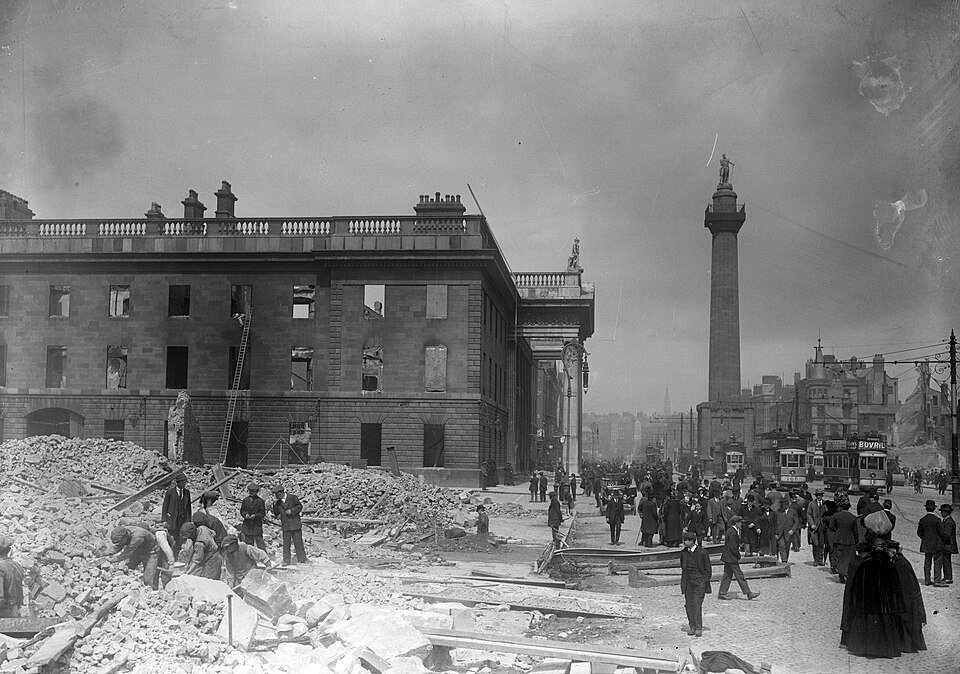
The British response followed a pattern now familiar in counterinsurgency studies. Initial confusion gave way to overwhelming force. Brigadier-General W.H.M. Lowe deployed artillery against positions in the city center, including the gunboat Helga shelling Liberty Hall from the River Liffey. By Wednesday, incendiary rounds had set much of the Sackville Street (now O’Connell Street) area ablaze. The indiscriminate nature of the bombardment, combined with incidents like the North King Street massacre where British soldiers killed fifteen civilians, fundamentally undermined the legitimacy of the Crown’s response. This pattern, where counterinsurgency overreach drives popular sympathy toward the insurgents, is among the most studied dynamics in irregular warfare theory.
The Role of Na Fianna Éireann and Cumann na mBan
Women and youth played significant roles that are often overlooked in military accounts. Cumann na mBan, the women’s auxiliary, served as dispatchers, nurses, ammunition carriers, and in some cases combatants. At the GPO, the College of Surgeons, and Marrowbone Lane, women sustained garrison operations under fire. Na Fianna Éireann, the republican boy scout movement, had been training young men in fieldcraft and weapons handling since 1909. Several Fianna members, some as young as fifteen, fought and died during Easter Week.
The participation of these networks illustrates a principle central to resistance mobilization: insurgencies that integrate diverse segments of the population develop resilience and depth that purely military organizations lack. The auxiliary networks of 1916 directly prefigured the organizational structure of the Irish War of Independence, where intelligence, logistics, and political action operated alongside guerrilla operations as coequal pillars of resistance.
Timeline of the Easter Rising
The Executions and the Transformation of Public Opinion
In the immediate aftermath, public reaction to the Rising was mixed. Many Dublin residents were hostile toward the insurgents, whose occupation had caused significant civilian casualties and property destruction. British soldiers were cheered as they marched captured rebels through the streets. The insurrection appeared to have backfired.
Then the executions began. Between 3 and 12 May 1916, General Sir John Maxwell, the military commander given authority over the aftermath, ordered fourteen leaders shot at Kilmainham Gaol, and Thomas Kent was shot at Cork Detention Barracks on 9 May. The drawn-out sequence, spread across nine days, amplified the psychological impact. James Connolly, unable to stand from wounds sustained during the fighting, was executed while tied to a chair. Roger Casement was later hanged in London on 3 August. Over 3,400 people were arrested and roughly 1,800 interned without trial, sweeping up many who had no connection to the Rising at all.
The shift in Irish public opinion was rapid and profound. As the historian Charles Townshend has argued, the executions achieved exactly what Maxwell intended to prevent: they created martyrs. Within two years, Sinn Féin, which had virtually no role in the Rising itself, swept the 1918 general election and established the first Dáil Éireann. The Irish War of Independence followed. The British state’s response to the Rising remains one of the most consequential strategic miscalculations in the history of state responses to political dissent.
Easter Rising Irregular Warfare: Modern Lessons
The Easter Rising offers several enduring lessons for the study of irregular conflict. Each has direct parallels to contemporary cases documented across The Resistance Hub’s Resistance Toolkit.
Military Failure as Political Catalyst
The Rising demonstrates that the relationship between military outcomes and strategic results in irregular warfare is nonlinear. A military defeat that is perceived as courageous, principled, or unjustly punished can generate political momentum that a tactical victory never would. This is the dynamic that Gene Sharp later formalized in his work on political defiance, and it remains visible in movements from the 2024 Bangladesh uprising to the Serbian student protests. Masters of Resistance, published by The Distillery Press, examines this pattern across multiple historical case studies.
The Disproportionate Response Trap
Maxwell’s executions are a textbook example of what contemporary counterinsurgency literature calls the “overreaction trap.” The Center for Strategic and International Studies (CSIS) has documented this dynamic across modern hybrid conflicts: states that respond to political violence with indiscriminate repression frequently accelerate the radicalization they intend to suppress. The British response in 1916 transformed a fringe military operation into a mass political movement within months.
Urban Terrain as a Force Multiplier
The fighting at Mount Street Bridge on 26 April 1916, where a handful of Volunteers inflicted over 200 British casualties in a single engagement, demonstrated the defensive advantages of prepared urban positions. This engagement prefigured the urban warfare dynamics that would later characterize conflicts in Stalingrad, Hue, Grozny, and Mosul. The Modern War Institute at West Point continues to study urban insurgency through this historical lens. The Guerrilla Tactical Triad provides a doctrinal framework for understanding how small forces exploit terrain advantages in these engagements.
Symbols, Narratives, and Legitimacy
The Rising was deliberately staged as political theater. The choice of the GPO, the reading of the Proclamation, the flying of the tricolor and the green harp flag, all were calculated acts of symbolic communication aimed at establishing legitimacy rather than seizing territory. The Proclamation itself, with its invocation of “the right of the people of Ireland to the ownership of Ireland,” framed the Rising in terms of popular sovereignty and international legal principles that resonated far beyond the military engagement. Similar legitimacy-building strategies appear in resistance movements from the American Revolution, whose shadow government and public component the ARIS Patriot insurgency case study maps in doctrinal detail, to contemporary civil resistance campaigns.
From Rising to Revolution: The Long Shadow of 1916
The Easter Rising did not end the British presence in Ireland. It initiated a chain of events, including the conscription crisis of 1918, the War of Independence (1919-1921), the Anglo-Irish Treaty, and the subsequent Civil War, that eventually produced a partitioned island. The Rising’s leaders, executed or imprisoned, became the founding mythology of the Irish state. The 1916 Proclamation is displayed in Irish schools to this day, and the annual GPO commemoration remains a focal point of national identity.
The long-term trajectory of the Rising also illustrates a pattern common in social movement theory: radical action by a small vanguard can shift the political landscape in ways that make previously unthinkable outcomes possible, even when the vanguard itself is destroyed in the process. The 1918 election results, in which Sinn Féin won 73 of 105 Irish seats despite the party’s leadership being largely imprisoned, demonstrated the scale of political transformation that the Rising triggered.
For contemporary practitioners and scholars of irregular warfare, the Easter Rising remains required reading. It sits at the intersection of urban insurgency, political warfare, sabotage, and the strategic use of narrative, making it a case study that speaks to nearly every dimension of modern irregular conflict. The OSS: Combined & Remastered, available from The Distillery Press, provides additional historical context on how irregular warfare doctrine evolved in the decades following the Rising.
