The first mistake in trying to understand the conflict between the Karen National Union (KNU) and the Myanmar military is to treat it as a war that moves toward resolution: an event that begins, escalates, and eventually ends. It is more accurately understood as a system of persistence structured by enduring asymmetry: a configuration of political, military, and social forces in which uneven forms of power do not resolve into balance but continuously reproduce the conditions of their own continuation. In this system, conflict is not an interruption of order but one of the mechanisms through which asymmetrical forms of order become entangled, maintained, and continuously adapted over time.
Moe Gyo is a writer and consultant working with ethnic organizations in Myanmar. Writing from the Thai–Myanmar borderlands, he draws on years of direct engagement with communities shaped by conflict and disrupted health systems. His work captures firsthand how resilience and informal support networks develop under prolonged irregular warfare. His writing has appeared in the Small Wars Journal and the Journal of Special Operations Medicine, among others.
The second mistake is to assume this system can be mapped primarily in territorial terms, as though it unfolds across stable and bounded space. In southeastern Myanmar, control is not continuous but layered, conditional, and discontinuous distributed across shifting networks of authority, movement, and survival. Asymmetry is not only military or institutional; it is spatial, infrastructural, and social. It is embedded in how governance is exercised, how mobility is regulated, and how different actors inhabit the same terrain under radically different capacities of control.
To understand this system is to abandon the expectation of a final form. There is no stable endpoint toward which it evolves, and no equilibrium in which asymmetry is resolved into balance. Instead, what persists is a dynamic architecture in which centralizing pressure and distributed adaptation become mutually entangled, continually reshaping one another without eliminating their underlying inequality. War, here, is not an event within history. It is the operating condition of an entangled architecture that persists by continuously reorganizing its own asymmetries.
Loading podcast player…
The True Terrain Is Social
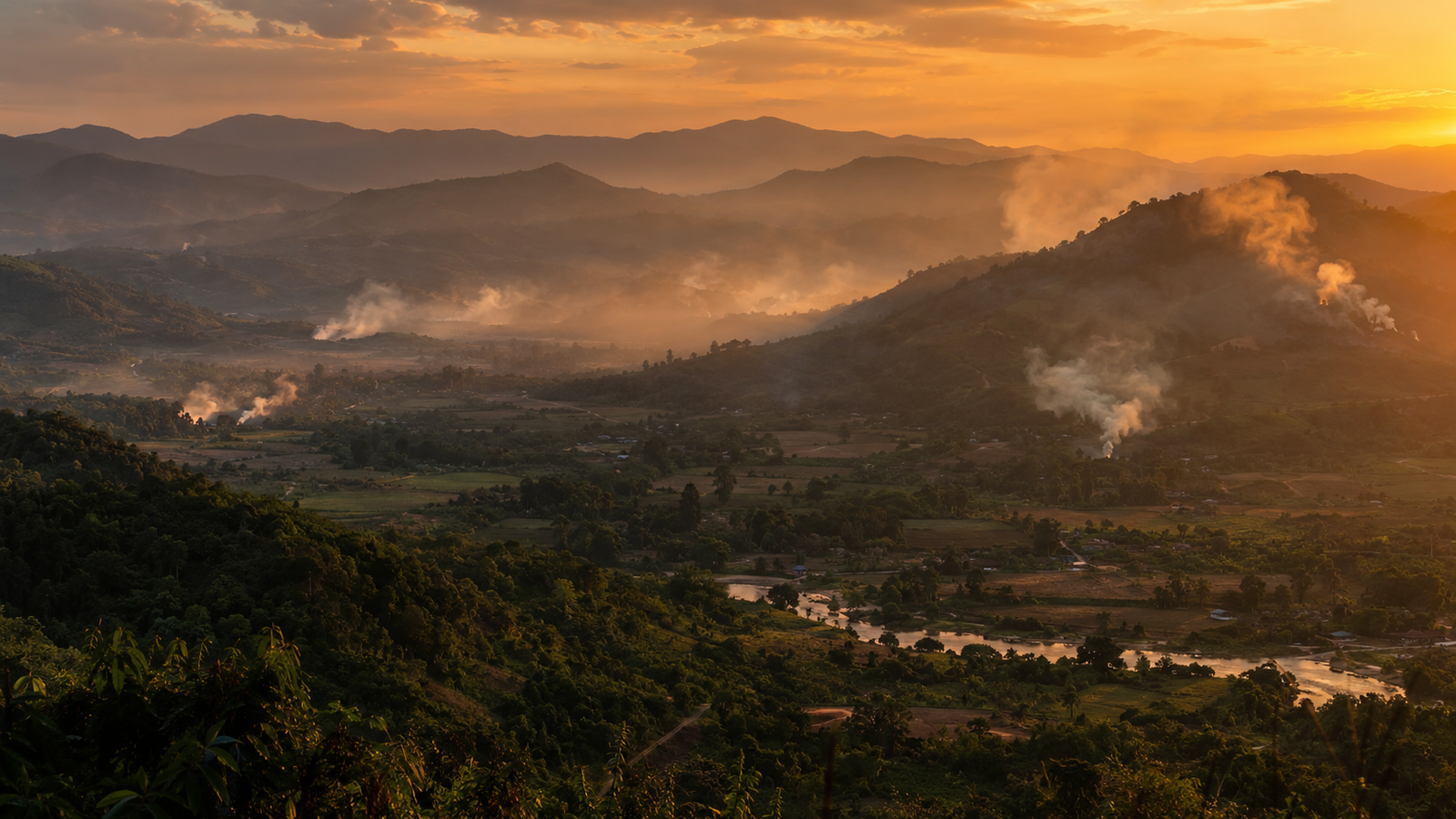
At first glance, the geography of the conflict appears straightforward: mountainous borderlands, forest corridors, river valleys, and scattered rural settlements across southeastern Myanmar. But this physical terrain is only the surface layer of a deeper structure. The true terrain is social.
It is composed of overlapping networks: kinship ties that determine trust and movement; displacement routes that function as informal infrastructure; trade systems that cross contested borders; local governance structures that shift depending on armed presence; and humanitarian channels that operate in parallel to state systems.
In this layered environment, a village is not simply a location. It is a node in a distributed system whose function changes depending on pressure. A school is not simply an institution. It may become a shelter, a recruitment site, a negotiation space, or a military checkpoint depending on shifting authority. Roads are not fixed infrastructure; they are conditional pathways that open and close according to the presence of competing forces.
This is why mapping the conflict spatially in traditional terms produces distortion. Control is not continuous across space. It is punctuated, layered, and conditional. The social fabric itself becomes the medium through which conflict is organized. War, in this sense, is not located in geography. Geography is reorganized through war.
The Colonial Formation of Burma
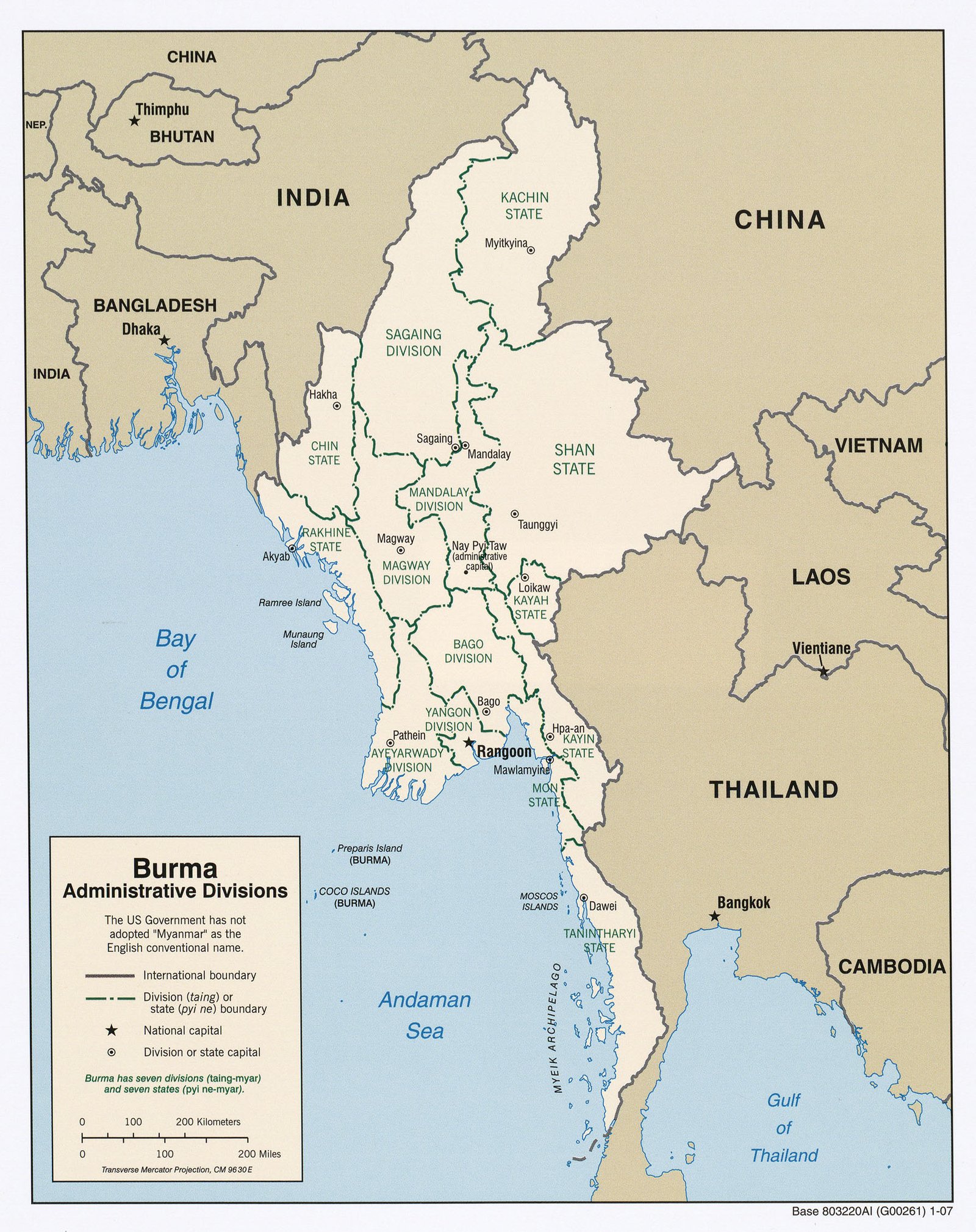
The structural asymmetries of the present conflict are rooted in the colonial formation of Burma. Under British rule, governance was not uniformly applied. Some regions were administered directly; others were ruled indirectly through local intermediaries. This produced uneven integration across ethnic and geographic lines.
More importantly, colonial recruitment patterns and administrative classifications hardened identities that were previously more fluid. Ethnic categories became political units. Administrative boundaries became imagined as natural divisions. The state that emerged after independence inherited not a unified territory but a mosaic of partially connected governance zones.
When independence arrived in 1948, the expectation of national unity collided with the reality of structural fragmentation. Competing visions of sovereignty emerged simultaneously: a centralized unitary state versus a federated or autonomous ethnic political order. The formation of the KNU in 1947 and the outbreak of armed conflict in 1949 were not deviations from state formation; they were parallel expressions of it.
A Difference in Architecture
The conflict between the KNU and the Myanmar military is defined not by parity but by asymmetry that is structural, not incidental. The Myanmar military operates as a centralized institution built around hierarchical command, territorial integration, and the aspiration toward singular sovereignty. Its logic is one of compression: bringing fragmented space under unified control. The KNU, by contrast, operates as a distributed system. Its armed wing, the Karen National Liberation Army, is organized through semi-autonomous brigades, local governance nodes, and adaptive territorial arrangements that shift with pressure. Authority is not centralized but dispersed.
This is not simply a difference in capacity. It is a difference in architecture. One system assumes order requires centralization. The other assumes order can exist through distribution. This asymmetry ensures that neither system can fully eliminate the other. Instead, each continuously reshapes the conditions of the other’s existence.
Persistence Without Phases
The KNU is often grouped among the longest-running post–World War II insurgencies. However, its significance is not adequately captured by duration alone. Unlike insurgencies that peak and decline within identifiable cycles of escalation and resolution, the KNU has persisted as part of a broader, continuously adapting conflict system in southeastern Myanmar. Its endurance is not primarily temporal but structural: it is maintained through the reproduction of distributed governance, shifting territorial arrangements, and overlapping authority regimes that do not converge toward a singular end-state. In this sense, the conflict is better understood as an enduring political ecology rather than a protracted war with discrete phases.
Fragmentation as Durability
Fragmentation is often interpreted as weakness or breakdown. In this system, it functions as durability. The distributed structure of the KNU allows for survival under sustained pressure. When one node is disrupted, others persist. When one corridor is closed, another opens. Authority does not depend on continuity of territory but on continuity of relationships. Fragmentation, therefore, becomes an adaptive structure.
The Myanmar military interprets fragmentation as something to be eliminated. Its operations are designed to compress dispersed authority into legible and controllable space. Yet every attempt at compression generates further dispersion. Every consolidation produces new edges of resistance. The system does not move toward unity. It oscillates between compression and dispersal.
Distributed Persistence and Centralizing Pressure
At the core of the conflict is a dynamic tension between distributed persistence and centralizing pressure. Centralizing pressure operates through military occupation, administrative expansion, forced relocation, infrastructure control, and the attempt to standardize governance across space. It seeks to eliminate ambiguity by making authority singular.
Distributed persistence resists this by refusing singularity. It disperses authority across networks that can survive partial destruction. It reorganizes itself in response to pressure rather than collapsing under it.
The OSS: Combined & Remastered collection preserves the foundational doctrines of unconventional warfare and irregular conflict, including the organizational logic of dispersed networks built to survive sustained pressure from a centralized adversary.
Get the Collection →Pressure, Recoil, and Reformation
In the field where the Myanmar military’s central authority meets the distributed structures of the KNU, nothing ever settles into a final arrangement. Instead, power moves in cycles that feel less like strategy and more like physics: pressure, recoil, and reformation.
At first, the military advances with the logic of compression. It pushes outward from centralized command structures, extending roads, establishing bases, consolidating administrative control, and attempting to make space legible and uniform. Villages are relocated, movement is monitored, and contested zones are drawn into tighter circuits of authority. From above, it looks like order being imposed onto disorder, as if fragmented space is being pulled back into coherence.
But compression never arrives without consequence. As pressure increases, the social and geographic fabric begins to bend rather than conform. Communities that cannot be fully absorbed or controlled begin to disperse. Armed actors withdraw into terrain that resists central visibility. Civilian networks adjust their movement, communication, and survival strategies. What looked like consolidation begins to generate its own counter-current: fragmentation.
Yet fragmentation is not collapse. It is reorganization. As the system breaks into dispersed parts, new points of stability emerge within the gaps. Small nodes of authority form in remote villages, along border corridors, and within mobile networks of governance and protection. The KNU and its associated structures adapt in these spaces, maintaining influence not through continuous territorial control but through presence that can shift, reappear, and persist across discontinuous space.
These new nodes of persistence change the balance again. What has been dispersed cannot be ignored or left alone indefinitely, because it continues to exert influence, e.g., logistical, political, symbolic, and military. Over time, the central authority is drawn back into motion, reasserting pressure to contain, compress, or reorganize what has spread beyond its immediate reach.
And so, the cycle returns. Compression produces fragmentation. Fragmentation produces persistence. Persistence invites renewed compression. Nothing resolves. Everything adjusts. Time in this system is not linear progression toward resolution. It is transmission of structure across generations.
Each stage of the cycle produces the conditions for the next. No stage is an endpoint, and the loop has no exit inside the system that generates it.
Transmission of Structure Across Generations
Knowledge of survival, movement, governance, and adaptation is embedded in practice rather than recorded as history. Villages learn evacuation patterns. Armed groups inherit logistical pathways. Military doctrine evolves through repeated engagement with dispersed resistance. Each generation does not simply inherit memory. It inherits a structured environment shaped by prior cycles of conflict. Time therefore does not heal the system. It reproduces it in modified form. Even ceasefires or political transitions do not reset this transmission. They simply alter its configuration.
Learning Within Asymmetry
Both the Myanmar military and the KNU function as adaptive systems engaged in continuous learning. The military learns through counterinsurgency cycles: adjusting territorial strategies, refining control mechanisms, incorporating proxy forces, and experimenting with administrative restructuring. The KNU learns through survival under pressure: decentralizing authority when necessary, consolidating governance where possible, and adapting to shifting territorial conditions. This is not learning toward convergence. It is learning within asymmetry. Each adaptation becomes the environment for the next iteration of conflict.
Governance Becomes Layered
One of the most important structural features of the system is that governance does not disappear during conflict. It becomes layered. In the areas where the conflict between the Myanmar state and the KNU unfolds most intensely, authority does not appear as a single line of command. Instead, it arrives in layers, stacking over the same land in uneven and often contradictory ways, so that governance is less a unified system than a set of overlapping presences.
A village may sit formally within the administrative map of the Myanmar state, its existence recorded in bureaucratic categories that assume stable jurisdiction. On paper, it belongs to the structures of civil administration: registration, taxation, official documentation, and state services that define belonging to the national framework.
At the same time, that same space may be under the operational influence of military governance structures, where authority is exercised not through civil institutions but through security posts, movement restrictions, and the immediate presence of armed control. In such contexts, rules are not only written; they are enforced in real time through checkpoints, patrols, and the shifting demands of security logic.
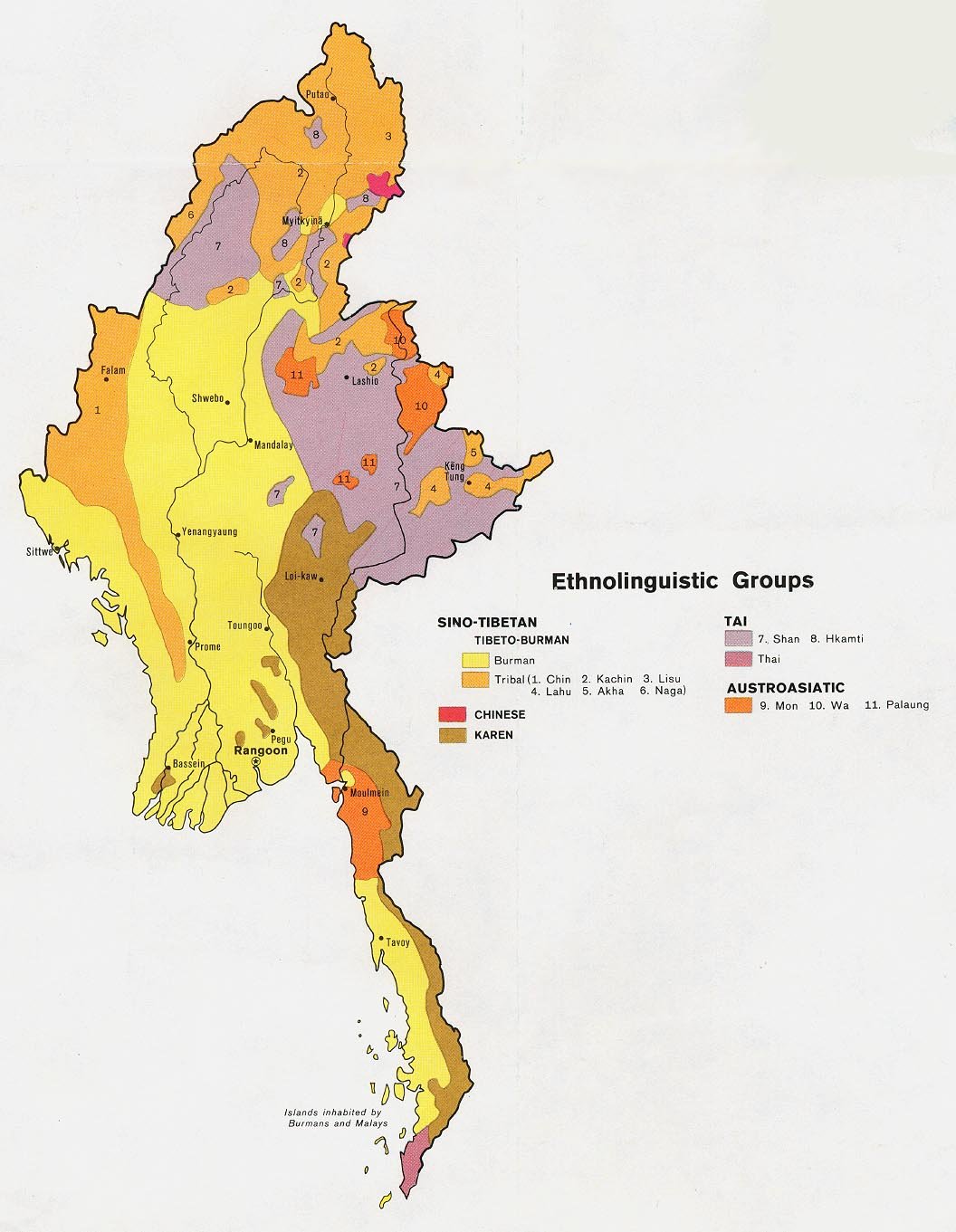
Layered onto this, often in parallel rather than in opposition, are the political and administrative institutions associated with the KNU. These structures may provide alternative systems of local governance, dispute resolution, education, and community coordination. Their authority does not always replace state structures; instead, it operates alongside them, sometimes in competition, sometimes in negotiation, and sometimes in uneasy coexistence depending on shifting conditions of control.
In many places, local customary authorities continue to function as well, that is, older systems of village leadership, elders’ councils, and traditional decision-making practices that predate the modern state entirely. These forms of governance do not disappear under pressure from armed actors or political institutions. Instead, they adapt, mediating between larger systems of power while maintaining continuity in everyday social regulation.
None of these structures fully replaces the others. Instead, they overlap, intersect, and sometimes contradict one another within the same physical and social space. Governance becomes situational rather than singular, shifting depending on which authority is most present, most enforceable, or most immediately relevant at any given moment. In this layered environment, authority is not a unified system imposed from above but a constantly negotiated field that is lived through rather than resolved. As a result, governance becomes situational rather than absolute. People navigate between systems depending on access, necessity, and proximity of power. Schools, justice systems, taxation, and infrastructure all operate within this layered authority structure.
None of these layers replaces the others. They stack over the same terrain, and which one governs at a given moment depends on presence, enforceability and proximity.
An Ecology of Endurance
The conflict functions as an ecology of endurance. Like ecological systems, it persists not through stability but through adaptability. It absorbs shocks, redistributes pressure, and reorganizes relationships without collapsing. In this system, endurance is not a matter of strength in any single location or institution. It is not achieved through permanence or fixed control but through the ability to remain coherent while constantly changing shape. What persists does so because it is never fully dependent on any one structure, route, or center of authority.
Networks stretch across space in overlapping layers so that if one pathway is disrupted, another can take its place. This redundancy is not inefficiency; it is survival logic. Communication, supply, governance, and protection do not rely on a single channel but on multiple routes that can absorb disruption without collapsing the whole system.
Authority itself moves. It is not always anchored in one place or tied to one institution. At times it is present in formal structures, at other times in mobile arrangements that shift with conditions on the ground. This mobility allows governance to persist even when territorial control is unstable, because authority can relocate rather than vanish.
Governance, too, does not remain rigid. It flexes according to pressure, adjusting its form depending on what is possible in a given moment. Rules, enforcement, negotiation, and local decision-making are not fixed systems but adaptable responses to shifting constraints. What governs in one place or time may look entirely different in another, even within the same broader framework.
Social structures follow the same logic. Communities reorganize themselves repeatedly in response to displacement, insecurity, and changing access to resources. Roles shift, responsibilities move, and survival strategies evolve, producing forms of social life that are continuously reassembled rather than preserved intact.
All of this requires constant recalibration. Nothing is ever allowed to settle completely, because settlement itself can become vulnerability. The system survives by adjusting again and again to pressure, never allowing its own form to harden into something that can be fully targeted or eliminated. In such a condition, nothing remains fixed long enough to become final.
The Limits of Transformation
Attempts at decisive transformation repeatedly encounter structural limits. Ceasefires reduce violence but do not resolve asymmetry. Peace processes create institutional frameworks but do not eliminate distributed authority. Military campaigns shift territorial control but do not eliminate insurgent adaptation. The 2021 military coup intensified these dynamics rather than resetting them. It reactivated existing structures across multiple layers of the system. The reason transformation remains partial is not failure of execution. It is the absence of a stable endpoint within the system’s architecture. There is no single lever through which the system can be fully reconfigured.
Conclusion
Ultimately, the conflict does not evolve toward resolution. It evolves through continuous reconfiguration. Centralization and fragmentation are not opposing endpoints but entangled forces that continuously reproduce and reorganize one another. Time does not lead to closure but transmits structure across generations. Governance does not disappear in conflict but becomes embedded within overlapping systems of authority, survival, and adaptation. War does not interrupt order but reorganizes it through distributed and entangled forms of control, persistence, and negotiation.
Attempts at decisive transformation repeatedly encounter structural limits because there is no singular center through which the system can be fully resolved. Ceasefires alter patterns of violence without eliminating asymmetry. Political transitions reorganize authority without dissolving layered governance. Military campaigns shift territorial arrangements without ending distributed adaptation. Each intervention becomes absorbed into the evolving architecture of the conflict itself.
There is no final peace because the conflict does not exist as a temporary rupture awaiting closure. Nor is there a final war in which one side achieves complete resolution through force. What persists instead is an entangled system in which centralizing pressure and distributed persistence continually generate the conditions of one another’s survival.
The conflict between the Karen National Union and the Myanmar military is therefore not simply an event within history. It is an enduring architecture of entangled war: a structure in which asymmetry is continually reproduced rather than resolved, and in which political order emerges not through stability, but through continuous adaptation to instability itself.
Not a story moving toward an ending, but an entangled architecture that continuously reorganizes the conditions of its own persistence.
