The Commercial Shutdown Came First
On February 28, 2026, the United States and Israel launched Operation Epic Fury, a joint air and maritime campaign targeting Iranian command infrastructure, ballistic missile sites, and naval assets. Within hours, Iran’s Islamic Revolutionary Guard Corps began issuing warnings to vessels: no ship would be allowed to pass through the Strait of Hormuz. But by the time those warnings reached bridge crews, the commercial shutdown was already underway.
War risk premiums surged fivefold within 48 hours. Major marine insurers terminated existing coverage and offered replacements at roughly sixty times pre-crisis rates. Lloyd’s Joint War Committee redesignated the entire Arabian Gulf as a conflict zone. Commercial vessel traffic dropped 70 percent before a single IRGC missile struck a merchant ship. Insurance closed the strait before the Iranian navy did.
This sequence is not incidental. It represents a structural feature of modern hybrid warfare: the exploitation of commercial systems to achieve strategic effects without direct military confrontation. The Hormuz crisis of 2026 is an irregular warfare case study in how chokepoints, economic coercion, and interlocking commercial dependencies can be weaponized to paralyze global systems.
The Chokepoint as a Weapon System
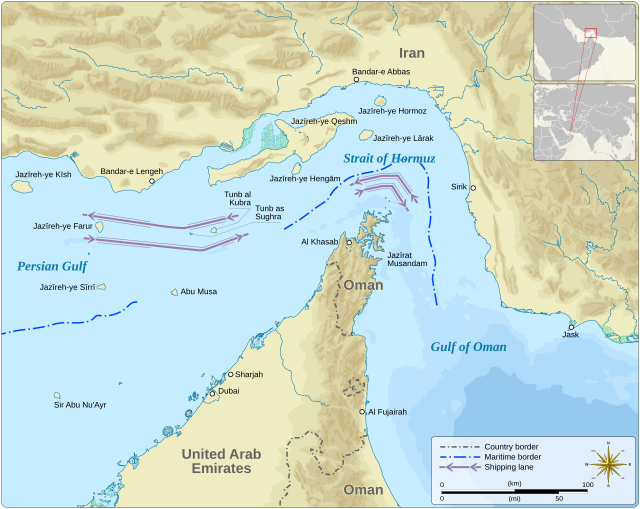
The Strait of Hormuz is 21 miles wide at its narrowest point, with two unidirectional shipping lanes separated by a two-mile buffer zone. According to the U.S. Energy Information Administration, approximately 20 million barrels of oil transit the strait daily, representing roughly 20 percent of global petroleum liquids consumption. Qatar’s liquefied natural gas exports, among the world’s largest, also pass through this corridor. The IEA estimates that alternative pipeline capacity to bypass the strait is limited to roughly 3.5 to 5.5 million barrels per day. There is no practical alternative route for the full volume of energy that flows through Hormuz.
The strait’s characteristics make it an ideal pressure point. The concept is not new. Iran has long viewed maritime chokepoint control as an asymmetric lever, a way to impose disproportionate costs on adversaries whose economies depend on uninterrupted passage. What changed in 2026 was the mechanism of closure. Previous assumptions centered on kinetic denial: mines, fast attack craft, anti-ship cruise missiles deployed from Iran’s southern coastline. These capabilities remain real. U.S. Central Command reported destroying 16 Iranian minelayers near the strait on March 10, and Iran was confirmed to have laid mines in the waterway. But the initial disruption operated through an entirely different domain.
The critical infrastructure targeted was not pipelines, refineries, or port facilities. It was the commercial architecture that makes global shipping possible: insurance markets, classification societies, and the risk-pricing mechanisms that determine whether a vessel sails or stays in port. When Lloyd’s redesignated the Gulf as a war zone, the effect cascaded through Protection and Indemnity clubs, reinsurance layers, and cargo underwriting. As major P&I Clubs issued formal cancellation notices, shipowners could not obtain coverage. Without coverage, vessels cannot legally sail. Without vessels, oil does not move.
The Insurance Weapon
The concept of insurance as an irregular warfare tool deserves closer examination. Modern global shipping operates on a tightly coupled system of interlocking commercial agreements. A vessel transiting the Strait of Hormuz carries hull insurance, cargo insurance, war risk insurance, and Protection and Indemnity coverage. Each layer is underwritten by different entities, governed by different triggers, and repriced according to different risk models. When a single node in this system fails, such as a war risk designation from Lloyd’s Joint War Committee, it creates a cascade that no amount of naval escort can immediately reverse.
This is a fundamentally different dynamic than the 1980s Tanker War, when Iran and Iraq attacked over 400 ships during an eight-year campaign. In that conflict, insurance markets adjusted gradually. The global insurance architecture was less concentrated, less dependent on reinsurance, and less tightly coupled. Ships continued to sail, and the United States eventually intervened with Operation Earnest Will, escorting reflagged Kuwaiti tankers through the strait. Murray and Mansoor’s Hybrid Warfare: Fighting Complex Opponents from the Ancient World to the Present provides essential historical grounding in how great powers have confronted these blended conventional and irregular challenges.
The 2026 mechanism operated at a different speed and through a different logic. A limited military action triggered a systemic commercial response because today’s insurance architecture is far more interconnected than its predecessor. The JWC designation alone was sufficient to shut down the majority of commercial traffic. Iran did not need to sink a single tanker to achieve what its military planners had long sought: effective closure of the world’s most important energy chokepoint.
This represents an evolution in hybrid warfare: the weaponization of commercial systems as force multipliers. The attacker does not need to control the system. It only needs to introduce sufficient uncertainty to trigger the system’s own risk-avoidance mechanisms.
Iran’s Layered IW Approach
Iran’s response to Operation Epic Fury followed a layered irregular warfare logic that extended well beyond the strait itself. Understanding this architecture requires examining it as a coordinated campaign rather than a series of isolated incidents.
The first layer was commercial denial. By issuing IRGC warnings via VHF radio to all vessels approaching the strait, Iran created legal ambiguity that insurers could not ignore. The warnings alone, before any kinetic action, were sufficient to trigger coverage withdrawals.
The second layer was selective access. By March 4, Iran announced it would permit Chinese-flagged and Chinese-owned vessels to transit the strait, exploiting Beijing’s economic relationship with Tehran to fracture the international response. A bulk carrier operated by a Shanghai-based company transited the strait broadcasting “CHINA OWNER.” A Turkish-operated tanker passed through identifying itself as Muslim-owned. Iran was not merely closing a waterway. It was creating a differentiated access regime that rewarded political alignment and punished adversary nations.
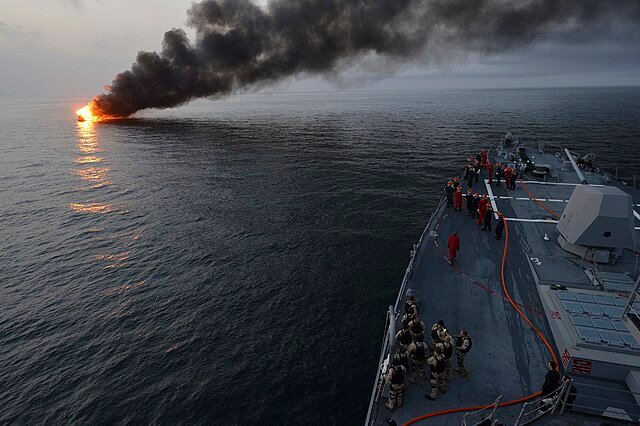
The third layer was kinetic escalation on a controlled timeline. Attacks on merchant vessels began after the commercial shutdown was already in effect. By March 12, Iran had conducted 21 confirmed attacks on shipping, killing crew members and setting vessels ablaze. The Houthi movement in Yemen resumed Red Sea attacks, closing the Suez alternative and forcing global shipping into longer Cape of Good Hope routes. Each escalation was calibrated: severe enough to sustain the insurance crisis, restrained enough to avoid triggering a full NATO response.
The fourth layer was economic coercion through energy dependency. The closure affected not only oil but LNG exports from Qatar, fertilizer shipments from the Gulf region, and helium supplies. Brent crude surged past $100 per barrel on March 8 for the first time in four years, eventually peaking at $126. Global fertilizer prices rose 50 percent. The energy security implications rippled through every economy dependent on Gulf hydrocarbons.
This layered approach mirrors the principles outlined in Iran’s broader irregular warfare apparatus: avoid direct confrontation with superior conventional forces, exploit asymmetric advantages in domains where the adversary is vulnerable, and impose costs that are disproportionate to the investment required.
2026 Strait of Hormuz Crisis — Key Events
Feb 28
U.S.-Israel launch Operation Epic Fury; IRGC issues VHF warnings; vessel traffic drops 70%; war risk premiums surge fivefold
Mar 2
IRGC formally declares strait closed; Lloyd’s JWC redesignates Arabian Gulf as conflict zone
Mar 4-5
Iran allows Chinese-flagged vessels through; selective access regime established; ~200 tankers anchored in open Gulf waters
Mar 8
Brent crude passes $100/barrel for first time in four years; IEA declares largest supply disruption in oil market history
Mar 10
U.S. destroys 16 Iranian minelayers; Iran confirmed mining the strait; 21+ attacks on merchant vessels by Mar 12
Mar 19
U.S. begins military campaign to reopen the strait; daily transits down from ~130 vessels to fewer than 6
Mar 27
IRGC formalizes closure to U.S., Israeli, and allied vessels; Brent crude peaks at $126/barrel; Iranian parliament proposes transit fees
Sources: Critical Threats · USNI News · Congressional Research Service
Parallels and Precedents
The weaponization of commercial chokepoints is not unique to the Persian Gulf. China’s use of fishing flotillas as paramilitary economic warfare in the South China Sea operates on similar logic: exploit commercial vessels and economic dependencies to project power below the threshold of conventional military response. Russia’s campaign of undersea cable sabotage in the Baltic Sea targets a different kind of infrastructure but follows the same principle of attacking commercial systems to impose strategic costs. Oscar Jonsson’s Russian Hybrid Warfare provides a detailed examination of how Moscow has systematized these below-threshold operations into a coherent strategic framework.
What distinguishes the Hormuz crisis is the speed and totality of the commercial cascade. In the Baltic, cable damage is localized and reparable. In the South China Sea, fishing flotilla incursions create friction but do not halt international trade. At Hormuz, the insurance mechanism created a binary outcome: covered or uncovered, sailing or anchored. The IEA described the resulting disruption as the largest in the history of the global oil market.
The lesson for analysts is that commercial systems are the medium through which irregular warfare approaches can operate. A state does not need to match an adversary’s naval power to close a chokepoint. It needs only to introduce enough risk to trigger the commercial system’s own shutdown mechanisms.
Implications for Irregular Warfare Doctrine
The Hormuz crisis exposes several gaps in how Western doctrine addresses irregular threats to commercial infrastructure.
First, intelligence preparation of the environment must include commercial architectures. Understanding how insurance markets, classification societies, and shipping risk models interact is now as operationally relevant as understanding adversary order of battle. A combatant command that cannot anticipate how a JWC redesignation will cascade through commercial shipping is operating with incomplete situational awareness.
Second, deterrence must address the insurance mechanism specifically. Naval presence alone does not restore commercial confidence. Even after U.S. Central Command reported destroying all Iranian surface vessels in the Gulf, insurance rates remained prohibitive. The Tanker War precedent of Operation Earnest Will, where military escorts enabled continued shipping, assumed that the primary threat was kinetic. In 2026, the primary threat was commercial, and escorts alone could not resolve it.
Third, selective access regimes represent a new form of coercive leverage. Iran’s decision to permit Chinese vessels while denying Western-flagged shipping created a differentiated chokepoint, one that rewarded geopolitical alignment rather than applying universal denial. This fractures coalition responses and creates incentives for individual nations to negotiate bilateral arrangements rather than enforce collective security.
Fourth, multi-domain integration must include economic warfare. The Hormuz crisis involved simultaneous operations across maritime, cyber, information, and economic domains. Houthi attacks in the Red Sea closed the Suez alternative. Iranian propaganda amplified the energy crisis. Diplomatic signaling to China created wedge issues within the international community. Treating these as separate problems rather than a coordinated campaign misses the fundamental nature of the threat. Singer and Brooking’s LikeWar: The Weaponization of Social Media explores how information operations have become inseparable from kinetic campaigns in modern conflict.
The Next Chokepoint
The Strait of Hormuz will not be the last chokepoint weaponized through commercial coercion. The Baltic region’s energy infrastructure, the Taiwan Strait, the Strait of Malacca, and the Suez Canal all share structural vulnerabilities: concentrated commercial traffic, tightly coupled insurance markets, and limited alternative routes. Any actor capable of introducing sufficient ambiguity into the risk environment of these corridors can achieve effects that previously required substantial naval power.
The 2026 Hormuz crisis should serve as a forcing function for defense planners, total defense strategists, and critical infrastructure protection professionals. The insurance weapon is now a demonstrated capability. The question is not whether it will be used again, but whether the next target will have recognized the weapon system before it fires.
From The Distillery Press
The OSS Special Operations Field Manuals: Combined & Remastered distills the foundational doctrine of America’s first unconventional warfare organization into an accessible modern format, essential reading for understanding how irregular warfare principles apply in contested environments.
Sources and Further Reading
The Irregular Warfare Initiative published a detailed analysis of how insurance mechanisms functioned as a weapon system during the Hormuz crisis, examining the structural differences between the 2026 disruption and the 1980s Tanker War. The Congressional Research Service maintains an updated assessment of the Strait of Hormuz’s role in global oil and gas markets, including Iran’s naval capabilities and historical disruption precedents. Critical Threats at the American Enterprise Institute provided real-time situation tracking of Iranian military actions and commercial shipping disruptions during the opening days of the crisis. USNI News covered the operational dimensions of Operation Epic Escort, including mine countermeasures challenges and the Pentagon’s assessment of options for reopening the strait. The GLOBSEC analysis of Russia’s hybrid warfare escalation in 2026 provides a comparative framework for understanding how state actors exploit commercial and infrastructure vulnerabilities across multiple theaters.
Related Reading on The Resistance Hub
Iran’s Global Irregular Warfare Apparatus
What Is Hybrid Warfare? A Comprehensive Guide
Protecting Critical Infrastructure from Sabotage
China’s Fishing Flotillas as Paramilitary Economic Warfare
Cyber Security Differences Between States and Resistance Movements
